
SK Hynix CEO Warns 2027 Will Be the Worst Year Ever for Memory Chip Supply
SK Hynix's chief executive delivered a sobering forecast on the same day his company debuted on the Nasdaq, warning that the global memory chip shortage will hit its worst point in industry history next year and that demand could keep outpacing supply well into the next decade.

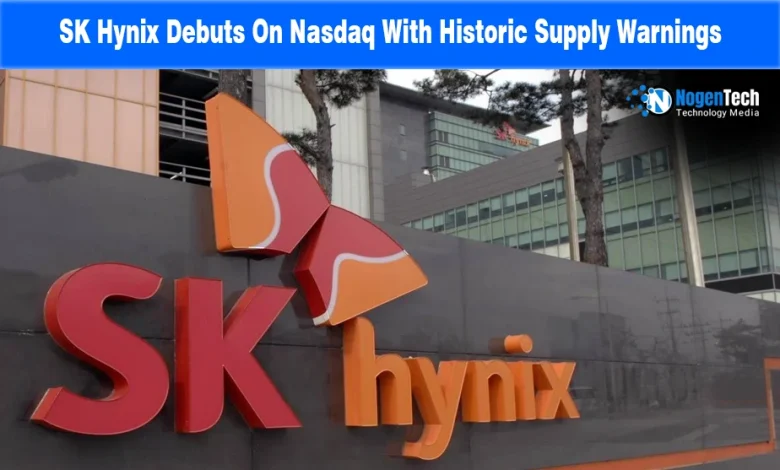
SK Hynix Chief Executive Kwak Noh-jung issued a stark warning during the company’s Nasdaq debut on Friday, saying the memory industry is heading toward an unprecedented supply crunch.
“We forecast that next year will be the worst year in the industry’s history from the supply perspective,” Kwak told Reuters. “Our customer demand continues to go up, while our capacity has limitations.
” He added that demand could exceed supply capacity beyond 2030, despite the company’s efforts to address the gap. The warning comes amid broader memory-chip concerns this year, with rising prices already affecting consumer products.
A Blockbuster IPO Meets a Sobering Forecast
SK Hynix’s warning came alongside a strong market debut. The company sold 177.9 million American Depositary Shares at $149 each, raising $26.5 billion in the world’s second-largest public offering, behind only SpaceX’s $2 IPO.
Shares opened at $170, about 14% above the offering price, and traded up 14.8% near $171 Friday afternoon, according to Yahoo Finance.
The momentum reflects SK Hynix’s role in the AI buildout: the company holds an estimated 62% share of the high-bandwidth memory market, supplying chips for Nvidia’s advanced AI processors.
SK Hynix’s operating profit reached a record 47 trillion won, or about $31 billion, in 2025, double the prior year, a major recovery from its 2023 operating loss, and recently became South Korea’s most valuable firm.
Expansion Plans Racing Against Demand
Kwak said SK Hynix is actively evaluating new locations for future wafer fabrication investment, with the U.S. remaining one of several candidates alongside Japan and Southeast Asia, though no final decision has been made.
He said the company would prioritize sites offering sufficient land, electricity, water, and skilled labor at competitive manufacturing costs.
In the meantime, SK Hynix continues expanding its existing South Korean footprint beyond its headquarters in Icheon and its Cheongju facility, with a new plant under construction in Yongin.
The company is also part of a broader South Korean government initiative, alongside rival Samsung Electronics, aimed at doubling the country’s overall memory chip production capacity within five years.
Independent Forecasts Back Up the Warning
Kwak’s pessimism isn’t coming from SK Hynix alone. Nvidia CEO Jensen Huang said last month that AI memory shortages would likely persist for several years given the strength of demand, adding that SK Hynix would remain Nvidia’s largest memory supplier.
UBS separately projects the global DRAM market will stay undersupplied until at least the second quarter of 2028, though manufacturers are making record profits due to this high demand.
Adding to the bottleneck, HBM chips require advanced 2.5D packaging alongside GPUs and CPUs, meaning capacity constraints at partners like TSMC could compound the shortage regardless of how much SK Hynix expands.

![Top Tech Stories of 12th Week [2026]](https://www.nogentech.org/wp-content/uploads/2026/03/Top-Tech-Stories-of-12th-Week-2026-390x220.webp)