Private Claude Conversations Found Indexed on Google and Bing Search Results
Hundreds of Claude conversations that users believed were shared privately turned up searchable on Google and Bing over the weekend, exposing everything from API keys to legal documents through nothing more than a standard search query.

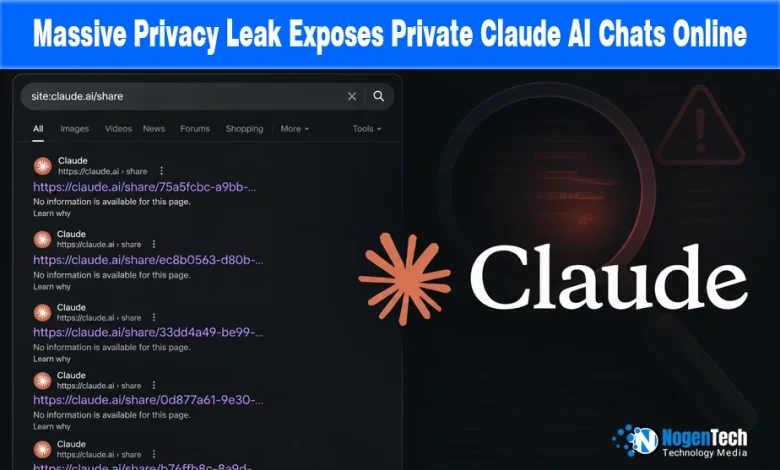
The exposure came down to a basic mismatch between how Claude’s share feature was built and how search engines treat public web pages.
When a user clicks “share” on a Claude conversation, Anthropic generates a public URL meant to function as a private link passed between a small number of people.
Nothing about that URL required a password or login to view, and once one of those links ended up posted somewhere crawlable, whether a forum, a public Slack channel, or a stray social post, search engines did exactly what they’re built to do: index it.
Missing Noindex Tags Left Pages Open to Crawlers
Wired’s review of the exposed Claude pages found they did not include the noindex tag that both Bing and Google factor into indexing decisions, despite Anthropic’s crawler instructions telling search engines not to index shared chats.
That distinction matters technically: a robots.txt file tells well-behaved crawlers which sections of a site to avoid, but Google and Bing have documented they can still index a page if it’s linked from elsewhere on the internet and lacks an explicit noindex signal.
Google spokesperson Ned Adriance told Wired that responsibility for what gets indexed sits with the page owner, not the search engine, since Google doesn’t control what content site operators choose to make publicly crawlable.
Google spokesperson Ned Adriance told Wired that the responsibility for what gets indexed sits with the page owner, not the search engine, since Google doesn’t control what content site operators choose to make publicly crawlable in the first place.
Google Pointed to Website Controls While Other Engines Stayed Exposed
BBC reported a similar defense from Google, with a company spokesperson saying Google gives site owners clear controls to decide whether pages can be crawled or indexed and always respects those directives once properly set.
The outlet also noted the exposure wasn’t limited to Google and Bing, with Claude chat logs appearing through other search engines, including Brave and DuckDuckGo, all of which were approached for comment.
By the time reporters checked over the weekend, the chat logs were no longer searchable on Google, suggesting Anthropic had quickly applied the standard tools available to website owners to block indexed content once the exposure came to light.
Exposed Content Went Well Beyond Casual Chatbot Prompts
The scale and sensitivity of what surfaced turned a technical indexing quirk into a genuine privacy incident.
Yahoo reported that roughly 600 Claude conversations were indexed, exposing crypto wallet keys, API credentials, login tokens, legal strategy discussions, internal company documents, and resumes containing names and phone numbers.
It also included a therapy app prototype and a medical billing dashboard built as Claude Artifacts.
That last detail points to a second exposure: Claude’s Artifacts, the interactive tools and documents the chatbot generates, were reportedly indexed and searchable through a similar technique even after the original chat log query stopped returning results.
The incident also echoes a nearly identical episode last year when nearly 100,000 ChatGPT conversations became searchable on Google, highlighting that treating a shareable link as inherently private has now affected more than one major AI chatbot.
Source: Private Claude Chats Exposed in Google and Bing Search Results