Tesla’s Flying Roadster Demo Put Its Control Software on a Display
Tesla's Roadster left the ground at a Texas SpaceX site, but the stunts hinged on software timing ten thrusters, and no regulator has a clear framework for it.

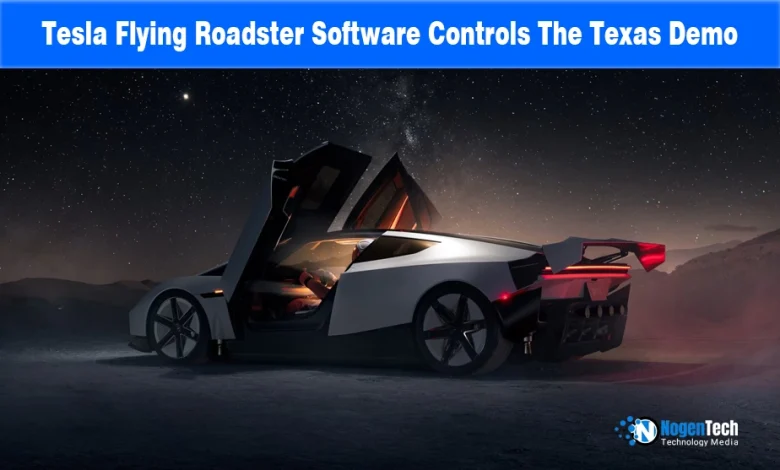
Tesla unveiled its redesigned Roadster at a livestreamed event on October 15 at a SpaceX test site near Waco, Texas. The car drove upside down along a curved ramp, left its end, rolled in midair, and landed on its wheels.
CEO Elon Musk presented it as proof that flying cars are real, and Tesla says production begins in 2028.
For many skeptics scrolling through social media, the surreal stunt footage initially sparked passing comparisons to internet deepfakes like the viral Tesla glide shoes hoax.
Most coverage has followed the stunt and the acceleration figure instead. The harder question is what actually controlled the car in the air.
Ten SpaceX-Built Thrusters Carried the Roadster Off the Ramp
TechCrunch’s reporting says the flight-capable Roadster carries 10 thrusters fed by tanks of compressed air.
The report described them as cold-gas nozzles that push the car, while a fan system pulled air out from beneath the car to hold it against the ramp upside down.
Tesla says the thrusters produce four to five times the force tires can deliver; the car reportedly hit a 0 to 60 mph run in under one second.
Teslaoracle’s breakdown puts the four main thrusters at the rear, with angle-control nozzles on the sides that fired mid-air to flip the car before downward thrusters fired again for landing.
No driver was inside, and Musk said that was “to make sure we don’t kill anyone,” CNN reported.
The maneuvers were brief, and there are no official metrics for how long or how far the car can stay airborne.
What Tesla’s Control Software Had to Do During the Waco Flight
Tesla has not released official technical specifications for the control system, meaning the clearest insights come from independent industry analysis.
A report from Parametric Architecture noted that the onboard software must calculate orientation, speed, tank pressure, and landing angles within fractions of a second.
This system relies on pre-simulated flight paths combined with real-time feedback loops to correct minor deviations.
Handling complex physical maneuvers like this requires far more advanced compute logic than driver-assist features like Smart Summon, which recently cleared regulatory hurdles.
Reports also vary regarding how the vehicle was operated. Ahead of the event, Electrek reported that the car would run via remote operation with zero passengers, requiring spectators to stand hundreds of yards away due to hearing-damaging thruster noise.
Elon Musk reportedly described the vehicle as fully autonomous for safety reasons. Reports also noted that an actual driver could likely not operate the car manually while the high-power thrusters were firing.
What the FAA, NHTSA and Wall Street Left Unanswered on Tesla’s Roadster
The FAA told CBS News the Roadster does not meet its definition of an aircraft, and NHTSA said it will keep monitoring the situation.
Tesla’s site says the flying version is not approved for public roads, and Musk said he is unsure it is legal in every jurisdiction. Neither the FAA nor Britain’s CAA has a clear framework for a road-going vehicle like this.
Reuters noted the reveal came days before Tesla’s third-quarter results, and eToro’s Josh Gilbert said margin and cash flow would weigh far more with investors.
Gene Munster called the demo an engineering showpiece with no commercial value.
The facts sit awkwardly together. Axios reported Musk saying the Roadster will be the only manually driven Tesla long term, yet the capability that drew the headlines is one a driver could not operate.
The thrusters are hardware anyone can photograph. The part Tesla actually demonstrated, and the part no regulator or analyst can yet measure, is the software deciding when each nozzle fires.
Sources:
Tesla: https://www.tesla.com/roadster
Axios: https://www.axios.com/2026/10/16/tesla-flying-roadster-goodbye-car-busines
CBS News: https://www.cbsnews.com/news/tesla-roadster-dot-flying-car/
Electrek: https://electrek.co/2026/10/15/tesla-remote-operators-crashing-robotaxis/
Parametric Architecture: https://parametric-architecture.com/tesla-roadster-kickflip-thrusters