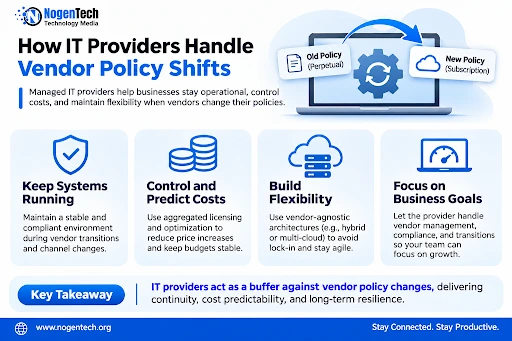
How IT Providers Handle Vendor Policy Shifts
IT providers help businesses manage vendor policy changes through licensing agreements, cost controls, planned migrations, and flexible infrastructure to reduce disruption and maintain operational stability.

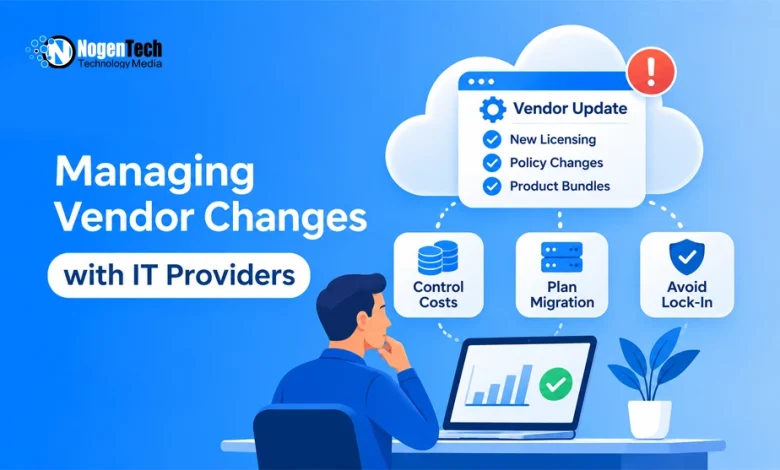
A major software vendor acquisition can disrupt an organization’s IT infrastructure. Perpetual licenses may shift to mandatory subscriptions, product bundles can change, and existing budgets may no longer cover essential services.
These changes create licensing, compliance, and migration challenges for internal IT teams. Managed IT providers help businesses handle vendor policy shifts through supplier agreements, cost management, and infrastructure alternatives.
How Vendor Policy Changes Affect IT Infrastructure
When vendors revise their licensing or partner policies, businesses may face higher costs, fewer purchasing options, and new compliance requirements.
Common challenges include:
- Higher licensing costs: Mandatory subscriptions and product bundles can increase expenses.
- Limited partner access: Changes to reseller programs may restrict purchasing options.
- Compliance audits: New licensing terms may require detailed software inventories.
- Security risks: Unsupported software may stop receiving security patches.
- Migration pressure: Businesses may need to replace or modify infrastructure before contract deadlines.
Software license audits can also identify virtual machines, test environments, and unused installations that require review under revised licensing terms. Proper compliance audits and software asset records help businesses verify license usage and resolve discrepancies.
How Managed IT Providers Support Vendor Transitions
A licensing change does not always require immediate infrastructure replacement. Managed IT providers can help businesses assess existing agreements, maintain eligible services, and plan migrations.
1. Maintain Access Through Vendor Partnerships
Some managed providers have supplier agreements that offer licensing options unavailable through standard customer contracts.
For example, partnering with an authorized Broadcom VCSP may allow eligible businesses to maintain VMware infrastructure services under an alternative licensing arrangement.
Availability depends on the provider’s authorization and contract terms.
2. Assess Infrastructure Before Migration
Rushed infrastructure changes can cause application failures, downtime, and security vulnerabilities. Before migration, IT providers assess:
- Application dependencies: Connections between applications, servers, and databases.
- Network configurations: Connectivity, access controls, and network requirements.
- Security policies: Protections that must remain effective after migration.
- Storage requirements: Capacity, performance, and data transfer needs.
- Compatibility: Application support on alternative platforms.
Providers can then move less critical workloads first and schedule complex migrations after appropriate tests.
How IT Providers Help Control Licensing Costs
Vendor changes can disrupt budgets, particularly when licensing shifts from perpetual purchases to subscriptions or from per-user to per-core pricing.
Managed IT providers may reduce financial uncertainty through volume agreements, centralized procurement, and license optimization.
Potential benefits include:
- Volume discounts: Lower rates based on eligible service commitments.
- Defined contract terms: Agreed pricing for a specified period.
- Centralized procurement: Fewer supplier contracts and renewals.
- License optimization: Identification of unused licenses or unnecessary product tiers.
- Reduced administrative work: Provider support for procurement, audits, and license reconciliation.
Managed service contracts may also combine software, infrastructure, and support into recurring monthly charges.
However, predictable monthly pricing does not guarantee protection against vendor price increases. Businesses should review renewal terms, usage limits, additional charges, and price adjustment clauses.
How IT Providers Reduce Vendor Lock-In
Vendor lock-in occurs when applications, data, or infrastructure depend heavily on proprietary technology, which can make future migrations costly.
Managed IT providers can improve flexibility through suitable infrastructure architectures and workload portability.
1. Use Flexible Infrastructure Options
Depending on business requirements, providers may use:
- Private cloud: Dedicated or controlled cloud environments.
- Public cloud: Infrastructure hosted by external cloud providers.
- Bare-metal servers: Physical servers with direct hardware access.
- Hybrid infrastructure: A combination of cloud and on-premises systems.
A mix of private cloud, bare-metal, and public cloud resources can provide alternatives when vendor licensing or service terms change.
2. Improve Portability With Containers and Virtualization
Containers package applications with their dependencies, which can simplify deployment across compatible environments.
Virtual machines operate through a hypervisor that manages virtualized hardware resources. The relationship between containers and the underlying hypervisor matters when evaluating platform compatibility.
However, containers do not eliminate every dependency. Proprietary databases, storage systems, and cloud services can still complicate migrations.
3. Establish an Exit Strategy
A practical exit strategy should address:
- Data portability: Export options and usable data formats.
- Application compatibility: Dependencies that may restrict migration.
- Backup and recovery: Protection of critical systems and data.
- Alternative platforms: Suitable infrastructure replacements.
- Migration costs: Technical effort, downtime, and licensing expenses.
Reducing vendor lock-in helps businesses retain more control over future technology decisions.
Securing Long-Term IT Stability Through Service Agreements
Managed IT providers help businesses handle vendor policy shifts through supplier agreements, cost controls, and planned infrastructure transitions.
Service-level agreements (SLAs) define provider responsibilities, including:
- Availability: Uptime targets and exclusions.
- Support: Incident response times.
- Security: Updates and access controls.
- Recovery: Backup and recovery objectives.
- Service credits: Remedies for missed targets.
Clear contracts and flexible infrastructure help businesses reduce vendor-related risks and maintain operational stability. However, SLAs cannot guarantee uninterrupted service, so exclusions and third-party dependencies must be reviewed.