
Ripple’s RLUSD Stablecoin and What It Means for XRP Holders
Ripple's RLUSD stablecoin complements XRP by supporting stable dollar payments, while XRP remains essential for network fees and liquidity. Greater RLUSD adoption could increase XRP Ledger activity, but it doesn't guarantee higher XRP prices.

Ripple’s decision to launch its own stablecoin has raised an important question among XRP holders: could RLUSD compete with XRP or reduce its importance in Ripple’s payment ecosystem? Both digital assets are connected to Ripple, but they serve different purposes.
Launched in December 2024, Ripple USD (RLUSD) is designed to maintain a stable value against the US dollar, offering the stablecoin advantage of reduced price volatility. As stablecoins become more important in digital payments, understanding how these assets work together matters.
So, does RLUSD threaten XRP’s future? Below is a closer look at their differences, how RLUSD affects the XRP Ledger, and what XRP holders should consider.
Do RLUSD and XRP Compete With Each Other?
Although RLUSD and XRP can operate on the same blockchain, questions about whether RLUSD and XRP can share one ledger without competing have emerged because the two assets serve different purposes.
- XRP: The native cryptocurrency of the XRP Ledger, used for transaction fees, liquidity, and cross-currency transfers. It can also serve as collateral in supported financial applications.
- RLUSD: A dollar-backed stablecoin designed for payments and settlement without the same price volatility as XRP.
XRP can act as a bridge currency, helping transfer value between currencies without requiring a direct trading pair. RLUSD, however, allows businesses to hold and transfer dollar-denominated value with greater price predictability.
Here is how the two assets compare:
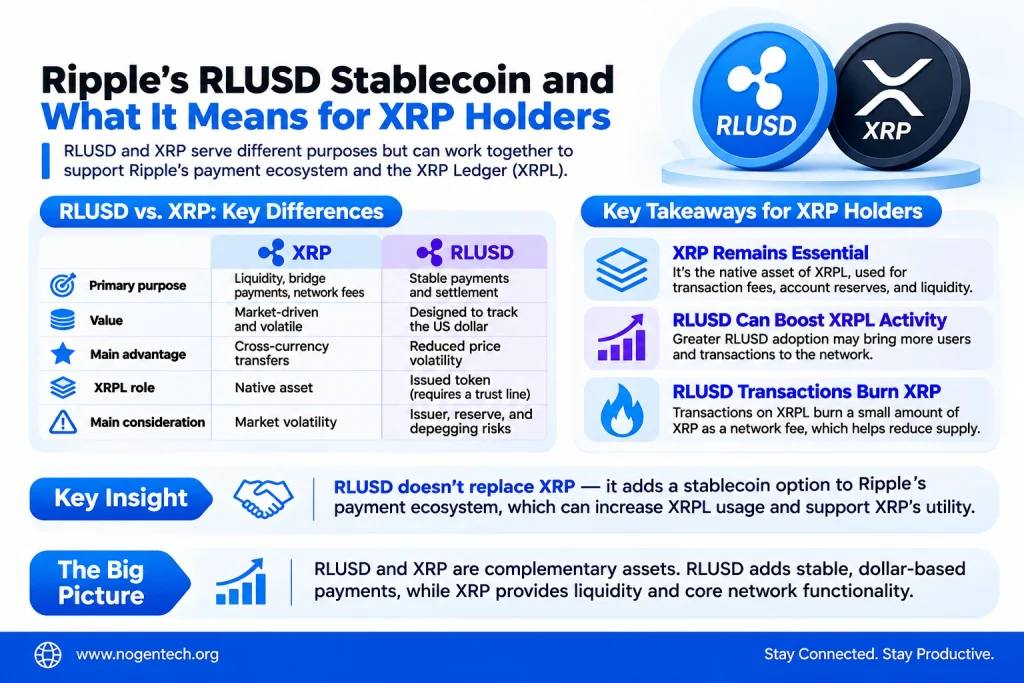
| Feature | XRP | RLUSD |
| Primary purpose | Liquidity, bridge payments, network fees | Stable payments and settlement |
| Value | Market-driven and volatile | Designed to track the US dollar |
| Main advantage | Cross-currency transfers | Reduced price volatility |
| XRPL role | Native asset | Issued token |
| Main consideration | Market volatility | Issuer, reserve, and depegging risks |
For example, a business transferring a fixed dollar amount may prefer RLUSD, while a payment provider handling cross-border transfers may use XRP when it offers a suitable liquidity route.
However, some overlap exists. Payment providers may choose either asset based on liquidity, transaction costs, and settlement requirements.
What Should XRP Holders Know About RLUSD?
RLUSD’s expansion has raised concerns that Ripple might prioritize its stablecoin over XRP. While RLUSD offers greater price predictability for payments, its growth does not automatically reduce XRP’s importance.
According to a Yahoo Finance report, RLUSD grew 88% in 2026, highlighting its expanding adoption even as XRP faced market pressure.
Three factors matter most to XRP holders.
1. XRP Remains the Native Asset of the XRP Ledger
XRP is built directly into the XRP Ledger and is required for:
- Transaction fees: Paying for transactions processed on XRPL.
- Account reserves: Meeting the ledger’s minimum reserve requirements.
- Liquidity: Supporting currency transfers and other financial activities.
RLUSD is an issued token. Users generally need to set up a separate trust line to hold it on XRPL, whereas XRP does not require one.
This means RLUSD cannot replace XRP’s native network functions. Ripple has also positioned RLUSD as a complementary asset within its broader payment infrastructure.
2. RLUSD Could Increase XRP Ledger Activity
Greater RLUSD adoption could attract businesses, payment providers, and users to the XRP Ledger, supporting broader real-world crypto adoption.
RLUSD is available on XRPL and Ethereum, among other supported networks. Transactions conducted on XRPL require XRP for network fees.
This creates a connection between RLUSD adoption and XRP utility, although the actual impact depends on:
- RLUSD transaction volume on XRPL.
- Demand for XRP-based liquidity.
- How businesses integrate both assets into payment services.
More RLUSD activity does not necessarily mean greater investment demand for XRP.
3. RLUSD Growth Does Not Guarantee XRP Price Gains
RLUSD and XRP have different measures of success.
- RLUSD adoption is generally assessed through circulating supply, transaction volume, and usage because its price is designed to remain close to $1.
- XRP’s market value depends on several key value drivers in crypto, including investor demand, liquidity, market conditions, and expectations about future utility.
Even if RLUSD adoption increases, XRP’s price may rise or fall independently. Stablecoin growth should therefore be viewed as a potential ecosystem benefit, not a guarantee of investment returns.
Do RLUSD Transactions Burn XRP?
Yes. RLUSD transactions on the XRP Ledger burn a small amount of XRP through network transaction fees.
This mechanism helps protect XRPL from spam while permanently removing the fees paid in XRP from circulation.
However, three points are important:
- Small burn amounts: Ordinary transaction fees destroy very little XRP.
- Limited price impact: Reduced supply does not automatically increase XRP’s market value.
- Network differences: RLUSD transactions on Ethereum use Ethereum’s fee system and do not burn XRP.
Therefore, only RLUSD transactions processed on XRPL contribute directly to XRP transaction-fee burning.
Can RLUSD Strengthen XRP's Long-Term Utility?
RLUSD could strengthen Ripple’s payment ecosystem by giving businesses access to both stable dollar-denominated transfers and XRP-based liquidity.
For example, a payment provider could use RLUSD for dollar settlement and XRP for currency conversion when appropriate.
Potential benefits include:
- Broader adoption: More businesses may use XRPL for stablecoin transactions.
- Payment flexibility: Providers can select XRP or RLUSD based on their needs.
- Additional network activity: RLUSD usage may support liquidity services and blockchain-based financial applications.
- Ecosystem growth: Stablecoin adoption could encourage further development around XRPL, including applications for machine payments.
However, not every RLUSD transaction requires XRP as a bridge currency. Greater stablecoin adoption may increase network usage without creating equivalent demand for XRP.
The long-term impact depends on actual XRPL activity, liquidity requirements, and business adoption.
Final Thoughts on Ripple's RLUSD Stablecoin Discussion
RLUSD and XRP are largely complementary assets, although their payment use cases can overlap. RLUSD provides dollar-denominated stability, while XRP supports network fees, liquidity, and cross-currency transfers.
For XRP holders, RLUSD’s expansion could encourage greater XRPL adoption and network activity. However, these benefits do not guarantee XRP price appreciation.
The key factors to monitor are RLUSD transaction activity on XRPL, XRP liquidity demand, and real-world adoption of both assets.