Apple’s New Mac Mini and Mac Studio Just Got Pricier, and AI Is Why
Apple has unveiled a refreshed Mac mini with its all-new M6 chip and a Mac Studio built around a first-of-its-kind M5 Ultra processor, both engineered to run demanding AI workloads directly on the desktop rather than in the cloud.

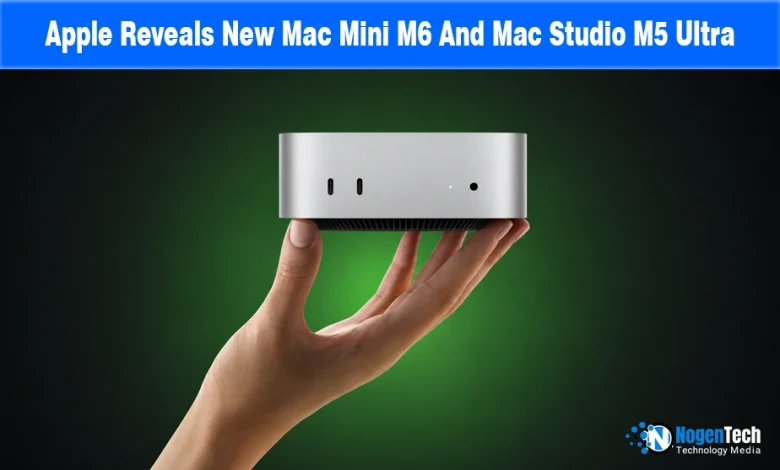
Apple introduced a new Mac mini and Mac Studio on Tuesday in its first major desktop refresh since 2024. The launch came just hours after Bloomberg’s reported that a pre-September launch was imminent.
Both machines share the same goal: running AI models locally rather than relying heavily on cloud servers.
The Mac mini features Apple’s new M6 or M5 Pro chip, while the Mac Studio replaces the discontinued Mac Pro as Apple’s sole pro desktop, powered by the M5 Max or new M5 Ultra. Pre-orders are live now on Apple’s online store, with shipments arriving September 22.
Mac Mini’s M6 Chip Marks a Manufacturing First for Apple
The Mac mini’s headline change is architectural: M6 is Apple’s first chip built on a 2-nanometer manufacturing process, the same architecture expected to power the upcoming entry-level MacBook, abandoning the 3-nanometer node used in the M5 family.
That density lets Apple pack a 12-core CPU with two “super” cores, four performance cores, and six efficiency cores, alongside a 12-core GPU with Neural Accelerators in every core for the first time on this machine, per Wired.
Apple’s chief hardware officer, Johny Srouji, said the mini delivers “a whole new level of AI performance,” backed by a Dual 16-core Neural Engine capable of roughly twice the previous generation’s peak compute.
Memory bandwidth reaches 170GB/s on higher configurations, while Thunderbolt 5 lets owners cluster multiple mini units to run larger LLMs entirely on device instead of splitting workloads across a network.
Mac Studio’s M5 Ultra Uses a New Four-Die Design
The Mac Studio’s M5 Ultra chip uses a quad-die architecture, the first in the M series, fusing four processing dies through Apple’s UltraFusion interconnect instead of the dual-die approach used in earlier Ultra chips.
The result, per Wired, is up to a 36-core CPU, 80-core GPU, and 256GB of unified memory in testing configurations, aimed at professionals running compute-intensive frontier AI models locally, along with 3D rendering and scientific simulations.
Apple says M5 Ultra delivers roughly 4.3 times the peak AI compute of the M3 Ultra it replaces.
The Studio also supports Thunderbolt 5 clustering across multiple units and can drive up to eight displays, including four Studio Display XDR monitors at full 5K resolution.
Higher Prices Reflect a Broader AI Supply Squeeze
What’s notable here isn’t just the performance jump, but that Apple is passing along real cost increases for the first time in years.
The $899 entry-level Mac mini is $300 more than the M4 model’s original 2024 launch price, while the M5 Pro configuration reaches $1,699.
Apple has attributed part of the increase to an industry-wide shortage of memory and storage, driven by the broader AI data center buildout.
That framing positions Apple as passing through costs faced by hardware makers rather than simply charging more for better silicon.
The bigger bet is architectural: by bringing Neural Accelerators and clustering support to even its cheapest desktop, Apple is betting that on-device AI will differentiate its machines from Windows PCs.
That only pays off if software such as Xcode and Final Cut Pro actually uses that local compute rather than treating it as a spec sheet feature.
Source: Apple’s new Mac mini, featuring M6 and M5 Pro, delivers a massive leap



![Top Tech Stories of 26th Week [2026]](https://www.nogentech.org/wp-content/uploads/2026/07/Top-Tech-Stories-of-26th-Week-2026-390x220.webp)