Have you ever wondered what it takes to build a fitness app that people actually keep using? That question is becoming a serious business priority, and the numbers back it up.
The global fitness app market was valued at $12.91 billion in 2025 and is growing at 13.5% annually through 2034 (Polaris Market Research).
Businesses that get in now with a well-built product are the ones that will be hardest to catch later.
Now moving onward, I will walk you through why so many of them are choosing to invest in professional fitness app development services to make that happen.
Why Is the Demand for Fitness App Development Services Growing?
Demand is growing because businesses need AI-powered fitness apps with wearable integration, personalization, retention features, scalability, and stronger monetization opportunities.
Fitness apps brought in $3.4 billion in direct revenue in 2025, a 24.5% increase year over year (Business of Apps). That excludes what businesses earn through loyalty, upsells, and corporate wellness deals.
The market grows at 13.5% annually through 2034. Companies that build now accumulate the user base and product depth that latecomers will spend years trying to close. This naturally led to a bigger demand for fitness app development services.
What Market Trends Are Changing the Fitness App Industry?
AI adoption, wearable growth, rising app downloads, and demand for personalized digital health experiences are reshaping the fitness app industry.
There are three concurrent trends at play here.
- The fitness and wellness AI market generated $10.7 billion by 2025 and is projected to generate $57.8 billion in revenue by 2035 at a compound annual growth rate of 19.3% (InsightAce Analytic).
- The shipment of wearables was recorded to have touched 611.5 million units in 2025, registering a 9.1% year-over-year growth (IDC).
- Fitness applications were downloaded 858 million times in 2023 alone (Grand View Research).
The customers are there. The devices are in their hands. It’s just fitness mobile app development that matters now.
How Are Changing Consumer Expectations Shaping Fitness Apps?
Consumers expect personalized, connected fitness experiences, while digital health adoption pushes businesses to build smarter, data-driven, retention-focused apps.
People do not want a basic workout log anymore. They want an app that adjusts to how they slept, connects to their watch, and gives them some sense of accountability.
According to ABC Fitness’s Q1 2025 Wellness Watch report, 63% of active consumers already use AI-based fitness tracking apps. The catch: the average fitness app keeps just 3% of users by day 30.
That is the problem professional fitness app development services are built to solve.
Why Businesses Invest in Fitness App Development Services? The Key Benefits
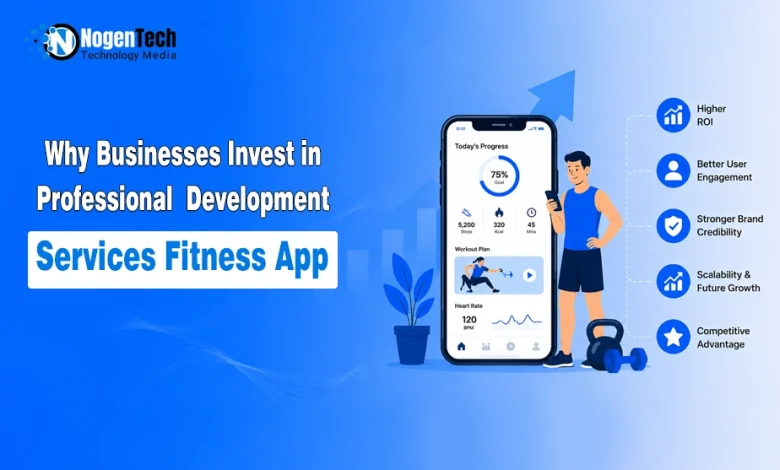
Businesses invest in custom features, scalable architecture, higher user retention, wearable integration, AI personalization, stronger monetization, and long-term growth.
The template application will help you launch, but it will not help you grow. Professional fitness mobile app development involves collaborating with individuals who have successfully navigated these issues and understand the key elements that lead to user retention.
Customization and Scalability for Business Growth
Customization gives you control over everything:
- User experience
- Data
- Brand
It also makes it easy to scale right from the get-go. Fitness app development cost varies depending on what you need built. The only way to get a number that means something is to scope your requirements with a team that has built in the space before.
Working with a health and fitness app development company that builds for scale from day one saves you from expensive rewrites when your user base starts growing.
Improved User Engagement and Retention
A fitness app development partner that is good knows the importance of retaining your customers right from the beginning, before they even start to code anything. This is reflected through their:
- Value-oriented onboarding process
- Dynamic training according to their performance
- Relevant notifications instead of invasive ones
Artificial intelligence plays a big role in making this happen. It helps the app learn from user behavior, adjust workout recommendations in real time, and send nudges that actually feel relevant rather than random.
If you want to understand how AI works, along with its proper types and history, our detailed guide on Artificial Intelligence covers it in full.
- Quick Fact: The average person unlocks their phone 96 times a day (Asurion). That’s 96 chances for your app to either add value or get ignored.
Integration with Wearables and Emerging Technologies
Synchronization with Apple Health, Google Fit, and the leading wearable devices is where you start, not an added benefit (Digital Fitness Ecosystem Report).
The fitness app development companies that regard this feature as optional release products that are already out of date upon launch.
Major wearables devices today, including Apple watches and Garmin wearables, do a lot more than count steps. They track heart rate variability, sleep quality, blood oxygen levels, and stress patterns, all of which give your app the data it needs to make smarter recommendations.
A development team that knows how to pull and use this data correctly can build an experience that feels genuinely intelligent. On the other hand, teams that treat wearable integration as an afterthought end up with apps that only scratch the surface of what these devices can actually offer.
Essential Features Delivered by Fitness App Development Services
The features that help users stay engaged are not necessarily those that look the best in the demo. They are the less spectacular features that help make the daily lives of users easier and more comfortable.
Personalized Workout and Nutrition Plans
While fixed databases of workout and nutritional plans work at some point for users, they quickly exhaust their content, and users stop using such apps.
Fitness app development services include AI fitness app development to generate personalized plans and workouts, tailored to each user’s history, recovery, and individual characteristics.
Real-Time Tracking and Analytics
Seeing the pace and heart rate on-screen during the exercise session motivates much better than looking through the results of the workout later.
This fitness software feature helps keep users engaged. From the company’s perspective, however, collecting analytics from real-time tracking features allows you to understand how your application is used and which functions require adjustment.
Social and Community Features
According to Core Health and Fitness, in gyms with the highest engagement levels (above 75%), there are active community programs. Similarly, social networking features, like challenge groups and leaderboards, help keep people motivated even on days when they do not want to exercise.
How Fitness App Development Services Drive Business Success?
Fitness app development services drive business success through monetization, user engagement, actionable analytics, brand differentiation, and scalable digital growth.
An effective fitness application is multi-functional in nature, as it engages the users, gathers data, and assists all aspects of your business.
Monetization Strategies and Revenue Opportunities
The apps that hold up financially do not bet everything on subscriptions. They build multiple streams from the start:
| Revenue system | How it works |
| Subscriptions | Monthly or annual premium access |
| In-app purchases | One-off programs, coaching sessions, nutrition plans |
| Brand partnerships | Gear, supplements, health services integrated in-app |
Fitness app cost goes up with complexity, but so does the revenue ceiling.
Brand Differentiation and Competitive Advantage
The generic fitness app sector is extremely competitive. But when it comes to the highly personalized fitness app, the market space is wide open.
Fitness app development experts know how to create a product tailored for your niche, whether it be gyms, corporates, or sports performance. And once that is done, it cannot easily be duplicated.
How Do You Choose the Right Fitness App Development Partner?
Choose a partner with fitness domain expertise, wearable integration experience, compliance knowledge, transparent communication, scalable development, and post-launch support.
There are several factors to ensure the fitness app development services help you launch a successful AI fitness app:
- Domain experience: Have they built fitness apps before? Not just general mobile apps.
- Compliance knowledge: Do they understand HIPAA and GDPR without you having to explain it to them?
- Wearable API familiarity: Apple Health, Google Fit, Garmin, and similar integrations should not be new territory for them.
- User-first thinking: They should talk about your users before they talk about features or tech stacks.
- Strategy before cost: A team that jumps to pricing before understanding your product is a red flag.
- Transparent process: Do they involve you in decisions or just send updates when something is done?
- Communication quality: Are they easy to reach, and do they actually explain things clearly?
- Realistic timelines: Good teams push back when something is not feasible. That is a sign of experience, not attitude.
- References and live products: Ask for apps that are live on the store, not just case study PDFs.
Evaluating Portfolio, Expertise, and Support
Ask to see real products with real ratings, not mockups. The build is the beginning. Research in software engineering shows that post-delivery maintenance accounts for over 70% of total software development costs (ResearchGate).
A fitness app development partner who goes quiet after launch is not a partner. Their post-launch support model deserves the same scrutiny as their technical proposal.
People Also Ask
How much does it cost to build a fitness app?
The cost depends on the features, complexity, and the team you hire. A basic app can start around $25,000, while a fully custom one with AI and wearable integrations can go well beyond $100,000.
How long does it take to develop a fitness app?
A simple fitness app typically takes 3 to 6 months to build. More complex apps with custom features, integrations, and AI can take anywhere from 9 to 12 months.
Do fitness apps need to be HIPAA compliant?
If your app collects or handles any health data, HIPAA compliance is something you need to take seriously. A good development partner will already know this and build with it in mind from day one.
What makes users stick with a fitness app long term?
Personalization, progress tracking, and community features are the biggest drivers of retention. Apps that feel generic or stop adding value after the first week are the ones that get deleted.
Can a fitness app work without wearable integration?
Yes, but it puts you at a disadvantage since most users already own a smartwatch or fitness tracker. Supporting wearables gives your app access to richer data and makes the experience feel a lot more seamless.
Final Thoughts on Investing in Fitness App Development for Scalable Growth
Investing in fitness app development services in 2026 is no longer just a tech decision; it is a growth strategy. With AI personalization, wearable integration, user retention, digital health adoption, and scalable monetization shaping the market, businesses need expert development partners to stay competitive.
In my opinion, brands that act early and build user-centric fitness apps will gain the strongest long-term advantage. A well-developed fitness app is not just a product; it is a sustainable digital asset for future business success.