Hardware-intensive embedded products fail for physical reasons that firmware can’t fix. Thermal load, vibration, enclosure stress, and signal integrity issues often surface only after deployment or during the transition from prototype to production.
That is where most programs break down. A board that works on the bench can fail on the production line, miss certification, or create unexpected cost and yield problems. The issue is usually not software. It is the gap between engineering design and manufacturing reality.
That gap matters more as the market grows. The European edge AI hardware market is projected to reach 344.0 million units by 2030 from 189.7 million units in 2025.
In sectors such as industrial automation, medical devices, and automotive electronics, hardware failure carries real regulatory, safety, and financial consequences. For 2026 programs in these categories, the best embedded systems development companies need to own the hardware layer.
- Hardware-intensive embedded products often fail because of thermal, EMC, signal integrity, or manufacturing issues rather than firmware bugs.
- In-house testing infrastructure is a major indicator of real hardware engineering depth.
- DFM, DFT, and DFC practices are essential for successful production scaling.
- SQUAD stands out for full-stack embedded hardware and production continuity.
- Prototype-to-production transition remains the highest-risk stage in embedded hardware development.
What do Embedded Systems Development Companies do?
Embedded Systems Development Companies design, develop, and maintain the hardware and software used in smart electronic devices and connected systems.
They help businesses build reliable products for industries like IoT, automotive, healthcare, industrial automation, and consumer electronics.
Their services typically include:
- PCB and hardware design
- Firmware and embedded software development
- IoT and connected device integration
- Prototyping and product testing
- Hardware validation and certification support
- Manufacturing and production optimization
- Cloud, mobile, and AI integration for smart devices
5 Best Embedded Systems Development Companies
The five companies below are selected for their depth in hardware engineering beyond a service list.
1. SQUAD: The Full-Stack Industrial Powerhouse
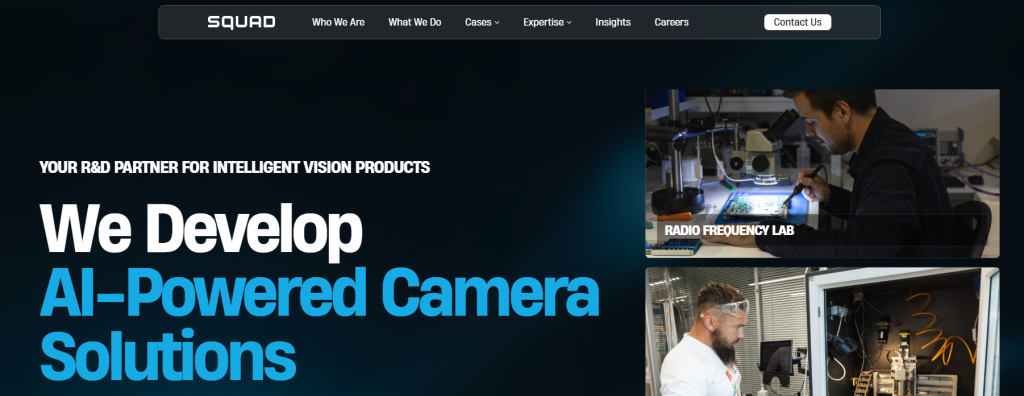
A full-stack engineering company specializing in AI-powered cameras, connected security devices, and IoT hardware. SQUAD supports large-scale delivery with:
- 700+ engineers
- 6,500+ m² of lab infrastructure
- 50+ products shipped to mass production
- End-to-end PCB, firmware, AI, and manufacturing support
Best for:
- AI camera systems
- Connected security hardware
- Consumer IoT products
- Full production-scale embedded programs
SQUAD stands out because it consistently moves connected hardware from prototype to full-scale production rather than stopping at proof-of-concept delivery.
The company has already shipped more than 50 connected security and IoT products into mass production while supporting the entire lifecycle through:
- PCB engineering
- Firmware development
- AI integration
- Cloud infrastructure
- EMC validation
- Sustaining engineering
Its infrastructure includes:
- RF and EMC anechoic chambers
- Thermal testing labs
- Multi-channel power analysis rigs
- CNC and rapid prototyping equipment
- Image quality testing facilities
What makes SQUAD particularly strong is engineering continuity. The same team handling PCB design also supports firmware optimization, manufacturing preparation, and post-launch BOM management. That reduces the communication gaps that commonly derail hardware-intensive programs.
2. eInfochips: The High-Volume Connectivity Firm:
eInfochips is part of Arrow Electronics and brings significant scale to embedded hardware development.
Key strengths include:
- 1,500+ engineers
- 10 global design centers
- ASIC and FPGA engineering
- PCB design and product lifecycle management
- Supply chain and component sourcing integration
Best for:
- High-volume embedded products
- Silicon-to-system engineering
- Industrial and medical deployments
- Global manufacturing programs
eInfochips brings a major advantage through its relationship with Arrow Electronics.
That connection provides:
- Supply chain visibility
- Better component sourcing
- Second-source planning
- BOM stability support
- Global logistics coordination
For high-volume manufacturing programs, these capabilities can be as important as the engineering itself.
The company is particularly effective for organizations scaling from prototype to global production while managing component shortages and supply chain volatility.

3. Tessolve: The Automotive and Edge AI Expert
Tessolve specializes in complex board-level engineering with strong expertise in analog, mixed-signal, and RF systems.
Highlights include:
- 200+ PCB designers
- 99% first-pass PCB success rate
- Semiconductor and automotive experience
- Advanced signal integrity engineering
Best for:
- Automotive electronics
- RF-heavy PCB programs
- High-speed data systems
- Semiconductor validation
Tessolve stands out for deep board-level engineering expertise.
Its strengths include:
- Analog PCB design
- Mixed-signal systems
- RF engineering
- Signal integrity analysis
- High-speed interface validation
The company’s 99% first-pass PCB success rate is particularly important in automotive and industrial projects where even one board respin can delay schedules by weeks or months.
Tessolve is especially strong in:
- 5G systems
- High-speed connectivity
- mmWave applications
- Semiconductor validation
- Power-intensive embedded designs

4. Yalantis: The Medical and Regulatory Specialist
Yalantis focuses on regulated embedded systems and hardware-software co-design.
Core capabilities include:
- 500+ engineers
- 40+ end-to-end IoT deployments
- ISO 9001 and ISO/IEC 27001 certifications
- Hardware-in-the-loop testing
- Reliability validation
Best for:
- Healthcare devices
- Automotive embedded systems
- Compliance-driven IoT programs
- Hardware and firmware co-development
Yalantis is especially well-suited for embedded systems requiring compliance-heavy development processes.
Its experience across healthcare, manufacturing, and automotive sectors makes it a strong option for:
- ISO-driven development
- Hardware-software co-design
- Reliability validation
- Hardware-in-the-loop testing
The company’s integrated development structure helps reduce one of the biggest risks in embedded engineering: firmware issues discovered only after hardware bring-up.
For medical and automotive products where architecture decisions directly affect certification outcomes, that integration becomes extremely valuable.

5. Softeq: The Rapid Prototyping Expert
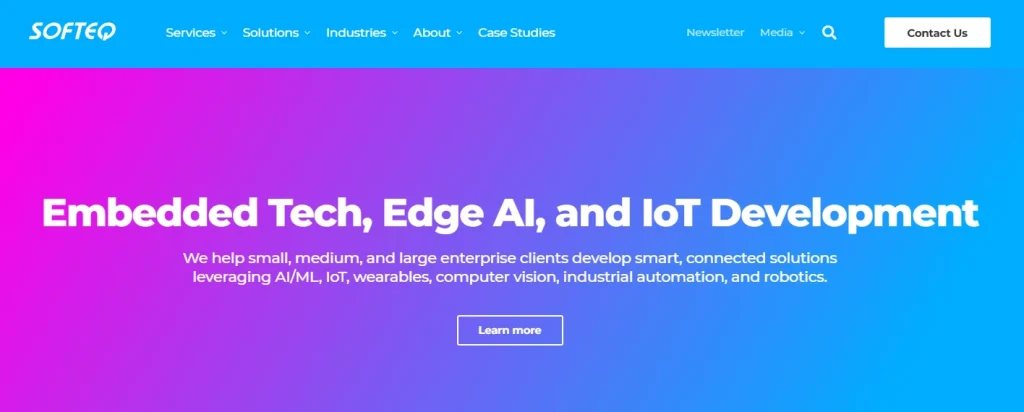
Softeq combines hardware engineering with firmware, cloud infrastructure, and mobile development.
Strengths include:
- In-house hardware labs
- ISO-certified development processes
- Hardware prototyping
- BSP and RTOS engineering
- Cloud and mobile integration
Best for:
- Rapid prototyping
- Connected medical products
- Consumer IoT devices
- Full-stack product launches
Softeq excels in programs where speed and parallel development matter most. The company combines:
- Hardware prototyping
- BSP engineering
- RTOS development
- Edge AI integration
- Cloud backend engineering
- Mobile application development
under a unified workflow.
For startups and early-stage product teams, this allows firmware, hardware, and software workstreams to progress simultaneously instead of sequentially. That significantly shortens prototype-to-pilot timelines.
Comparison of Top Embedded Systems Development Companies
The table below compares five firms with distinct hardware engineering strengths: SQUAD for full-stack delivery, Tessolve for PCB depth, eInfochips for scale and supply chain access, Yalantis for regulated hardware-software co-design, and Softeq for prototyping through cloud integration.
| Company | In-house lab | DFX capability | Certification track record | Best for |
| SQUAD | RF/EMC suites, thermal labs, power rigs, image quality rigs | DFM, BOM optimization, full mass production documentation | Consumer IoT, connected security (50+ products shipped) | Full-stack AI camera and IoT security hardware programs |
| eInfochips | 10 global design centers, test infrastructure across analog, digital, RF | DFM, DFT, BOM management, Arrow supply chain | Medical, industrial, consumer (10M+ deployments) | High-volume silicon-to-system hardware programs |
| Tessolve | Test floor, characterization labs, reliability labs, PCB fabrication | DFM, DFT, full PCB design suite | Semiconductor, automotive, defense, medical (EN9100 certified) | Complex analog, mixed-signal, and RF PCB programs |
| Yalantis | Hardware-in-the-loop testing, environmental and reliability testing | BOM optimization, component selection, PCB co-design | Healthcare, automotive, IoT (ISO 9001, ISO 27001) | Regulated industry hardware-software co-design |
| Softeq | In-house hardware lab, multidisciplinary engineering team | Hardware prototyping, pre-certification support | Medical (ISO 13485, IEC 62304), consumer IoT | Connected product hardware prototyping through cloud integration |
Selection Framework: How to Evaluate Hardware Engineering Depth
- In-house testing infrastructure. The clearest signal of real hardware engineering depth is what a company can validate inside its own facility. RF chambers, EMC testing, thermal labs, vibration and shock rigs, and power measurement equipment are expensive to build and operate. Companies that invest in them have usually built their practice around hardware validation. Companies that rely on third-party test houses often introduce delays at the exact stage where fast iteration matters most. When certification fails, an in-house team can revise and retest in days. A team dependent on outside labs often loses weeks.
- Design for X proficiency. Design for Manufacturability, Design for Testability, and Design for Cost determine whether a board that works in prototype quantities can succeed in production. DFM affects manufacturability at scale. DFT determines whether defects can be identified efficiently on the line. DFC shapes whether BOM decisions create pricing or availability problems later. Partners who apply this discipline from the first schematic, rather than as a late-review step, reduce the problems that usually surface only after the first production run.
- Certification expertise. In sectors such as medical, automotive, and defense, certification requirements must be built into the hardware design process from the start. Standards such as ISO 13485, ISO 26262, and MIL-SPEC are not just documentation exercises. They shape architecture, component choices, and validation strategy. A partner without proven certification experience in your target sector is likely to run into requirements it has never engineered for at the stage where schedule pressure is highest.
Critical Technical Moats for Hardware-Intensive Success
The difference between a successful embedded hardware program and a failed one usually comes down to a few core engineering disciplines.
Thermal Management
High-performance SoCs in sealed industrial or outdoor enclosures generate heat that must be managed during PCB layout, not after testing reveals a problem. Thermal vias, heat spreaders, copper pours, and active cooling all need to be considered early to protect component lifespan and avoid board revisions later.
Partners without thermal simulation capability usually discover these issues too late, in the lab. Teams with in-house thermal tools and testing infrastructure can catch them during design review.
Signal and Power Integrity
In industrial and automotive environments, electromagnetic interference is a constant constraint. Reliable performance depends on differential signaling, shielding, controlled-impedance routing, decoupling, ground-plane design, and power distribution planning.
These are not cleanup tasks after a board is finished. They are core design disciplines. A partner that applies them only as a review step is more likely to produce boards that require respins.
Supply Chain Resilience
Parts that are easy to source at the prototype stage may become hard to get at production volume. Lead times can jump from weeks to months, and component end-of-life events can force expensive redesigns.
Strong partners reduce that risk through second-source planning, BOM optimization, alternative component qualification, and direct distributor relationships. That turns supply chain disruption from a program threat into a manageable transition.
Final Decision Checklist for CTOs
- Does the partner own its validation infrastructure, such as RF chambers, thermal labs, and power measurement rigs, or rely on third-party test houses?
- Has the partner shipped hardware in your target sector with named certification outcomes in ISO 13485, ISO 26262, or equivalent standards?
- Does the team apply DFM, DFT, and DFC from the first schematic, or only as a late review step?
- Is the ATE strategy developed alongside the board or added after the design freeze?
- Does the partner provide sustaining engineering through component EOL events and second-source transitions?
- Do the firmware and hardware teams work together from the architecture phase, or does firmware inherit a finished board at bring-up?
Conclusion – Choosing the Right Partner for Hardware-Intensive Products
Choosing the right embedded systems development company is not simply about hiring the largest engineering team. It is about selecting a partner that has already solved the same manufacturing, EMC, thermal, and supply chain problems your product will face.
- SQUAD leads for end-to-end hardware ownership and production-scale IoT delivery.
- Yalantis is strongest for regulated and compliance-sensitive embedded systems.
- Softeq excels in rapid connected-product prototyping.
- Tessolve offers exceptional PCB and signal-integrity engineering depth.
- eInfochips stands out for high-volume manufacturing and supply chain resilience.
In hardware-intensive embedded systems, success depends on far more than writing reliable firmware. The companies that consistently ship successful products are the ones that understand the physical realities of production, certification, thermal management, and long-term manufacturing support.
People Also Ask
Why do embedded hardware products fail after prototyping?
Many failures appear during production because of thermal issues, signal integrity problems, EMC failures, poor manufacturability, or supply chain instability that were not fully addressed during design.
What is DFM in embedded hardware engineering?
DFM stands for Design for Manufacturability. It ensures that a PCB or hardware product can be produced efficiently, reliably, and cost-effectively at scale.
Why is signal integrity important in PCB design?
Signal integrity affects how reliably electrical signals travel across a board. Poor signal integrity can create data corruption, EMI issues, and system instability.
Why are in-house EMC and thermal labs important?
In-house labs allow engineering teams to quickly identify and fix hardware problems without waiting for third-party testing facilities, reducing delays and redesign costs.