RAND Corporation analysis of enterprise AI deployments suggests that more than 80 per cent of AI agent projects die in production. That number is striking enough that it demands an explanation. And the explanation turns out to be less about artificial intelligence than it is about the sequence of decisions that precede it.
“Most companies approach AI transformation the way you would approach buying new software,” says Vlad Nikitin, co-founder of workhold.ai. “You identify a problem, you select a solution, you implement it, you hope it works.
The problem is that the approach assumes the underlying operation is ready to be automated. In most cases it is not. And automating something that is not ready does not fix the problem. It makes it worse and makes it faster.”
The Three Root Causes
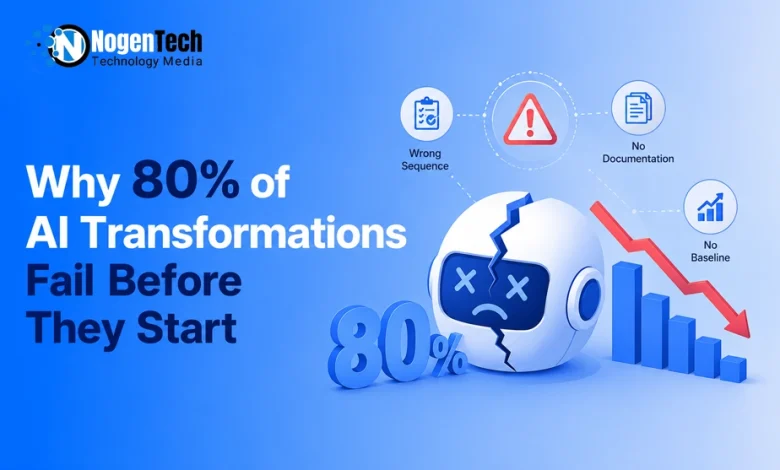
After working across dozens of deployments, Workhold AI has identified three structural failure points that account for the overwhelming majority of AI transformation failures. They are not technology problems. They are operational problems.
| Failure Point | What It Looks Like | Why It Kills Deployments |
| Wrong sequence | Automating before auditing | Broken processes run faster; errors multiply |
| No documentation | Cannot describe the process clearly | AI executes inconsistently; errors are systematic, not random |
| No baseline | No measurement before deployment | Cannot prove value; pilots run forever with no outcome |
Each of these is fixable. None of them requires better AI models.
The broader enterprise AI sector points to a similar challenge. Gartner notes that organizations often struggle not because AI models lack capability, but because governance, business alignment, and implementation practices fail to keep pace with deployment.
The Sequencing Error
The most common path to AI transformation looks like this:
- Leadership decides to invest in AI
- Budget gets allocated
- Vendor gets selected after a compelling demo
- Pilot launches
- Pilot expands
- Months pass, usage metrics look reasonable
- Someone asks what moved in the P&L; the answer is unclear
This path fails because the operation underneath it was never prepared.
A process that has been running the same way for four years, accumulated with workarounds and exceptions and institutional knowledge that lives in three people’s heads, is not ready to be automated. Automating it produces faster outputs of a flawed process. It amplifies inconsistency rather than eliminating it. It scales errors that previously happened at human speed.
The correct sequence, according to Vlad Nikitin, starts considerably earlier than most companies think.
“The first question is what should not exist at all,” he says. “Most companies have processes that are still running because someone created them years ago and nobody ever stopped them. Reports that nobody reads. Approval steps that were added after one bad outcome and never removed. Those should not be automated. They should be deleted.”
The sequence Workhold AI uses across all client engagements:
- Delete first — remove processes that should not exist
- Simplify second — standardize and document what remains
- Automate third — only once the operation is clean
Companies that invert this sequence, automating without auditing, almost always end up in the category that RAND and DeepL tracked.
The Documentation Gap
There is a test Vlad Nikitin applies before any AI deployment that is deceptively simple: can you describe this process on one page in plain language?
If the answer is no, the process is not ready. If you haven’t mapped your processes out yet, stepping back to build proper AI workflow documentation is essential before trying to automate them.
This problem appears more often than most operators expect. Processes that look clean from the outside are frequently more complicated up close:
- Different people execute the same process differently
- Exceptions have accumulated without being documented
- Edge cases live in the memory of senior employees who have never been asked to write them down
- Steps that made sense when the process was created are no longer relevant but nobody removed them
When these processes get automated, the AI picks an execution path and follows it consistently. That consistency becomes a liability if the path was wrong. The errors were previously random. Now they are systematic.
“We have spent significant time, before writing a single line of code, cleaning up processes that had nothing wrong with them from the outside and everything wrong with them up close,” Vlad Nikitin says. “The cleaning alone, before any automation, frequently improved performance.”
This emphasis on operational readiness is echoed beyond individual deployments. Microsoft’s latest Work Trend Index found that employees are often advancing their AI skills faster than their organizations are adapting workflows, governance, and leadership practices to support them at scale.
The Baseline Problem
The second most common reason AI transformations fail is that companies do not define what success looks like before they start.
A pilot without a baseline cannot be evaluated. If you do not know what output per person looked like before the deployment, you cannot know whether the deployment improved it. What you have instead are opinions, which is how successful-seeming pilots run for 14 months without anyone being able to point to a concrete outcome.
Workhold AI’s deployment methodology captures four metrics before any system gets built:
| Metric | What It Measures | Why It Matters |
| Output per person | Productivity divided by headcount | Shows whether the team is producing more with the same resources |
| Cost structure | Fully-loaded operational cost | Shows whether overhead is actually declining |
| Error rate | Frequency of incorrect or incomplete outputs | Shows whether quality is improving or declining |
| Decision cycle time | Time from question to action | Shows whether the organization is moving faster |
At 90 days, those four metrics are measured again. Two questions decide the outcome: did output per person improve, and did the cost structure get better? If both are yes, the deployment succeeded, and the next function gets addressed. If either is no, something went wrong, and the team investigates before expanding.
The First Task Problem
Even companies that audit correctly and set baselines carefully often stumble at the selection of the first automation candidate. The instinct, nearly universal, is to start with the most painful process. This instinct is wrong.
The most painful process is usually the most complex. It has the most exceptions, the most dependencies, the most institutional knowledge embedded in its execution. It is the most likely to fail under automation and the least likely to produce a clean result that builds confidence for the next deployment.
The right first task meets three criteria:
- High frequency — happens more than five times per week
- Low error cost — if the output is wrong, it is recoverable
- Binary definition of done — you can verify in under a minute whether it was completed correctly
This focus on operational discipline aligns with broader industry research. McKinsey’s global AI survey also highlights that organizations achieving the greatest value from AI typically redesign workflows and operating models alongside technology adoption.
What Structural Transformation Requires
The companies that succeed at AI transformation share characteristics that have less to do with AI and more to do with operational discipline:
- They audited before they automated
- They documented workflows clearly enough that an outside person could execute them
- They captured baselines before deployment started
- They selected first tasks based on frequency and risk, not pain and ambition
- They measured output metrics, not activity metrics, with a defined window and a clear standard
“The model improvements are real,” Vlad Nikitin says. “Every generation of models is meaningfully better than the last. But the gap between a better model and a successful deployment is still being closed by operational discipline, not by the model. That gap will probably always exist because it is not a technology problem. It is a business problem.”
The failure rate for enterprise AI deployments will not improve because the models get smarter. It will improve when more companies approach deployment the way they approach any other operational change: with preparation, clear success criteria, and the patience to build on small wins rather than betting everything on an ambitious first attempt.