Cisco Introduces Antares Open Weight AI Models for Software Vulnerability Detection
The company released two compact, secure small language models as open-weight software to help organizations identify known software vulnerabilities within codebases while supporting local deployment.

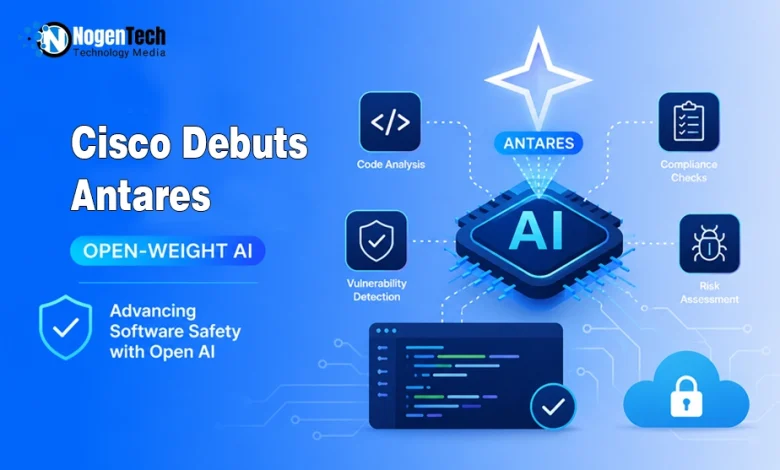
SAN JOSE, Calif., July 21, 2026 — Cisco (NASDAQ: CSCO) today introduced Antares, a family of open-weight security small language models (SLMs) designed to help organizations identify known software vulnerabilities within codebases. The announcement includes the first two models, Antares-350M and Antares-1B, which are intended to support vulnerability localization while running on local or on-premises systems.
The launch forms part of Cisco’s broader effort to expand practical AI tools for cybersecurity. Alongside the models, the company also introduced a vulnerability localization benchmark and positioned Antares within a broader portfolio of AI security initiatives intended to support enterprise security workflows.
How Antares Helps Security Teams Locate Software Vulnerabilities
Software vulnerability localization involves pinpointing where known vulnerabilities exist within a codebase, a task that becomes increasingly difficult as software repositories grow in size and complexity. Security teams may need to analyze public vulnerability information, inspect multiple files, trace code paths, and determine whether a reported weakness is actually present before remediation can begin.
According to Cisco, Antares is designed to support this early stage of vulnerability investigation rather than replace existing application security tools or expert review. Starting from a vulnerability description, the models search for relevant code patterns, examine candidate files, incorporate new evidence, adjust their search when needed, and narrow the results to source files most likely to contain a relevant vulnerability. Cisco said this approach is intended to help security teams prioritize analyst review and make vulnerability triage more structured, repeatable, and easier to evaluate.
Why Cisco Released Antares as an Open Weight Model
Cisco said it released Antares as an open weight model to make AI-powered security tools more accessible for repository level vulnerability analysis. According to the company, organizations often need security solutions that can be deployed locally to protect sensitive source code while reducing infrastructure and operational costs. Compact models such as Antares are intended to support those requirements by enabling local or on-premises deployment without relying on cloud-based processing.
The company also said this approach could help organizations with limited security resources, including universities, public sector institutions, research organizations, and smaller security teams, adopt AI-assisted vulnerability analysis more easily. By making the models openly available, Cisco aims to encourage broader use of practical AI security tools while supporting an ecosystem of more accessible cybersecurity solutions.
Expert Perspectives
“Software has always shipped with vulnerabilities, and vast bodies of legacy code still carry latent flaws. AI now pushes on the problem from both sides: agents write more of the code, and are growing capable of exploiting it. That makes cheap, continuous verification a control that has to sit close to the loop, checking code before it lands. Small models are especially compelling here: they run locally, so proprietary code never leaves the machine, and they’re fast enough to gate an agent’s output in real time. Antares-1b is a good example: it recognizes vulnerabilities in code it is shown, across several weakness classes and languages. The provided CLI packages the model’s capabilities into a practical workflow, making it easy to scan codebases, inspect findings, and integrate it into automated pipelines. What I found compelling was seeing a model this small navigate a codebase and identify security issues that would otherwise require larger models or more manual analysis.”
— Reza Shokri, Associate Professor of Computer Science at the National University of Singapore (NUS)
“Security can’t be a luxury good, yet advanced AI-based detection has largely belonged to organizations with frontier-scale budgets. Antares’s results change that equation: near-frontier accuracy on secure code reasoning at a fraction of the cost, fast enough to run on every commit. At a moment when attackers are already using AI, that kind of efficiency isn’t a nice-to-have; it’s what makes always-on security scanning possible for every team.”
— Amin Saberi, Professor of Management Science and Engineering and Director of the Language, Data, and Reasoning Lab at Stanford University
About Cisco
Cisco is a global technology company that develops networking, cybersecurity, cloud, and AI solutions for businesses, governments, and service providers. The company focuses on helping organizations securely connect people, applications, and data while supporting digital transformation across industries.
New to digital PR? Explore our complete guide to learn how PR strengthens SEO, builds brand authority, and increases media coverage.
Editorial Note: This article was independently prepared by NogenTech using publicly available information from Cisco’s official announcement. It is intended for informational purposes only and is not an official Cisco press release.
Source: Cisco Newroom