- Nearly 35% of consumers see score differences of 10+ points, while 18% see differences of 20+ points.
- A 20-point score change can place borrowers in the wrong pricing tier and increase borrowing costs.
- Tri-merge credit reports combine data from all three major credit bureaus for greater accuracy.
- Bi-merge reports can create significant credit score discrepancies that affect loan pricing.
- Using tri-merge reports helps ensure fair loan terms for borrowers and more accurate risk assessment for lenders.
When it comes to pricing a loan, it’s anything but easy. There are extremely broad factors, like overall market conditions and the lender’s financial appetite, to consider. However, the borrower’s financial status and history are also major factors in the decision-making process. For this reason, obtaining an accurate insight into the borrower’s financial information is paramount.
To account for this, lenders established a standard of ordering credit reports on prospective borrowers from Experian, Equifax, and TransUnion. This type of credit report is called a tri-merge credit report, and it merges information from all 3 places. The credit score output from this type of report uses the median of the 3 scores, which ensures that the score is neither too inflated or too low.
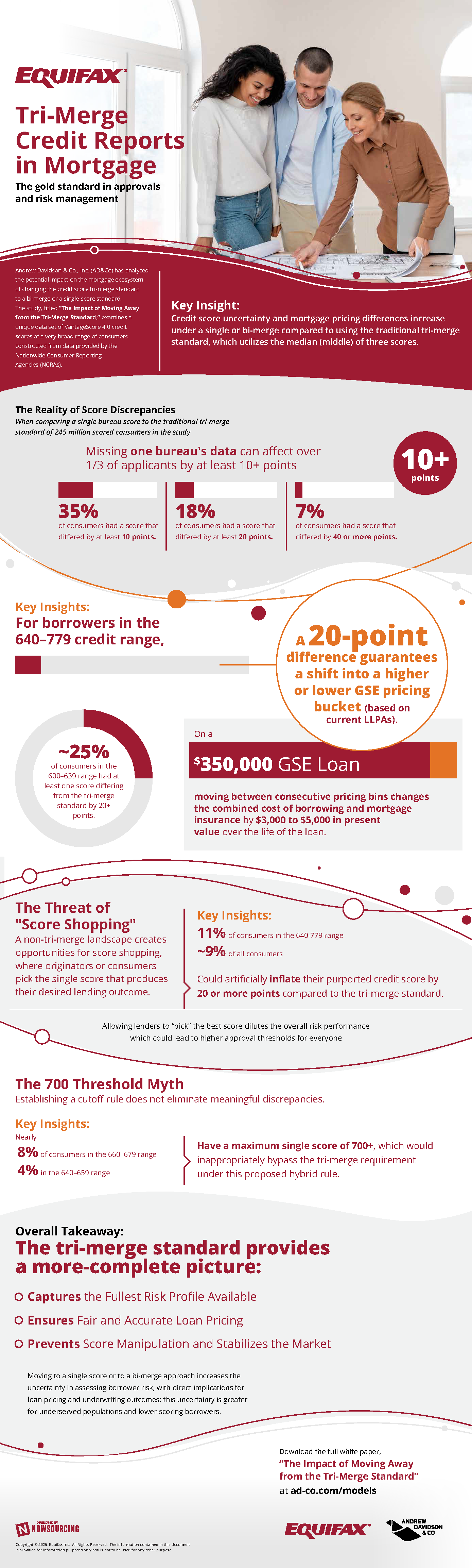
However, recently, some lenders have shifted to a bi-merge report, using only 2 of the 3 available bureaus. Using this method does come with major concerns, however. It is estimated that 35% of consumers had a score that differed from their tri-merge report by 10 points or more.
Similarly, 18% of consumers saw a difference of 20 points or more. While this could seem like a small difference, a 20-point difference ensures that a borrower is placed in the wrong pricing bucket for consumers with a score in the 640 to 779 range. This disproportionately affects those in the 600-639 range, where 1 in every 4 consumers saw over a 20-point difference. Financially, this equates to a cost difference of $3,000 to $5,000.
Ultimately, when it comes to pricing a loan, accuracy is key. Providing the most accurate inputs ensures that neither the customer gets overcharged nor does the bank leave money on the table when offering a loan. Taking advantage of a tri-merge credit report lets you get a complete picture and makes sure the loan terms are entirely fair.
Source: Equifax