How Virtual Terminals Help Businesses Take Payments Without Card Readers
Virtual terminal payments let businesses accept cards without hardware, collect payments faster, and simplify recurring billing.

A technician finishes a furnace repair at 4:40 on a Friday. The homeowner asks how to pay. The technician has an invoice pad and a phone, so the choice is a check that will sit on a dashboard until Monday, or a card number written on the bottom of the work order.
Both outcomes cost the company money, and both are avoidable with a browser and a login.
Businesses Without Counter Hardware
Plenty of companies never had a reason to buy a reader. A consulting firm bills after delivery. A wholesale distributor takes orders over the phone from buyers it has worked with for a decade.
A veterinary clinic charges the owner who dropped the animal off that morning and left. None of these has a customer standing at a counter, so a chip reader would spend most of its life in a drawer.
The field service category is larger than it sounds. The global market for field service management software reached roughly $5.37 billion in 2025 and about $6.14 billion in 2026, and the businesses inside it depend on technicians who are never at the office.
Most of them still collect through a mix of readers and mailed invoices, which is why so many jobs end without any money changing hands.
The Keyed Entry Workflow
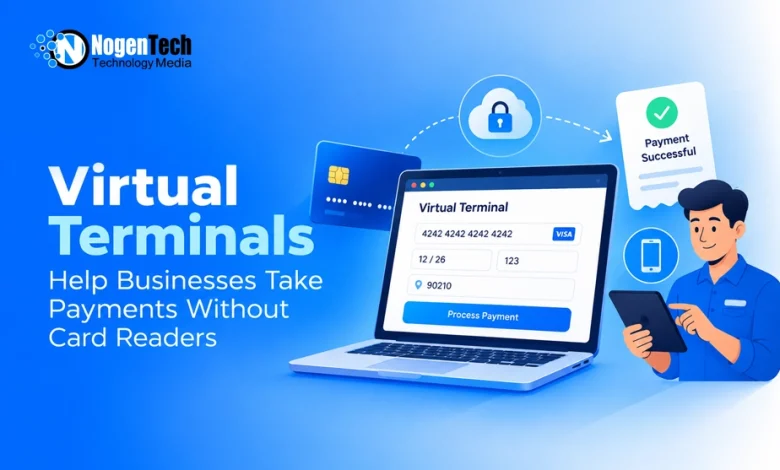
An employee opens a secure page, enters the account number, the expiration month and year, the verification code, and the billing zip, and submits the charge. The provider returns an approval or a decline in a few seconds; the customer gets an emailed receipt, and the amount joins the day’s settlement batch.
Nothing physical is required at any step. The employee can be at a desk or at a kitchen table. The customer can be on the phone from another state. The whole exchange takes about the time it would take to write a check, with the difference that the money is already moving when it ends.
Platform Providers and Dashboard Access
The screen a business types into belongs to a payments platform, and the platform decides what else appears on it. Some are built around a single storefront.
Others, Finix among them, are built as infrastructure that software companies embed, which means the keyed-entry screen arrives alongside reporting, refunds, and stored customer profiles in one place.
A business comparing options should look past the entry form itself. Settlement timing and user permissions differ far more between providers than the card fields do.
Field Collection After the Job
Collecting on site changes the timeline more than any other habit in a service business. An invoice mailed on Friday is paid in two to four weeks. A card taken in the driveway is in the batch that night.
The secondary gain is fewer repeat trips. Published field service data attributes up to a 30% reduction in repeat visits when technicians are equipped with tablets and mobile tools, and payment collection belongs to that same equipment question.
A technician who has to come back for a signature or a check has spent an hour of billable time on paperwork.
The paper alternative brings its own exposure. A check carries the account and routing numbers of the person who wrote it, and check fraud has climbed enough that banks now dispute reimbursement with their own customers. A business holding a stack of checks in a truck console for three days is holding somebody else’s banking details in a vehicle.
There is a customer-side effect as well. People who have been told a bill is coming often assume the amount is negotiable, and a conversation about price two weeks after the work is finished is harder than a conversation at the truck. Collecting at completion ends the discussion while the repair is still visible.
Recurring Charges and Stored Profiles
Once a card is on file, the second charge takes no typing at all. That matters for anyone billing the same customer repeatedly, and the numbers behind subscription-style collection have moved sharply.
According to Neon One’s recurring giving research, nonprofits grew their recurring donor bases by an average of 31.57% between 2023 and 2025.
The same pattern applies to maintenance contracts and membership dues. A stored profile turns a monthly collection task into a scheduled event, removing the need to re-enter card details for every payment and reducing opportunities for manual entry errors.
Storage brings its own obligation. PCI DSS compliance is part of that responsibility, and the card number should live with the provider as a token, never in a spreadsheet or a customer note field.
The card number should live with the provider as a token, never in a spreadsheet or a customer note field, and the business should record what the customer agreed to charge and when they agreed to it.
A signed authorization form covering the amount, the frequency, and the cancellation terms settles almost every dispute that follows. Regulators have also pushed hard on how easily customers can cancel subscriptions, so the exit path should be as short as the signup was.
Approval Rates and Data Requirements
Keyed transactions decline more often than chip transactions, and most of the gap comes from missing or mismatched data. Issuer systems have grown more aggressive as well, and rising fraud alerts mean a valid account can be stopped on a technicality.
Address verification checks the billing address and ZIP against the issuer’s file. A mismatch on either can trigger a decline even when the card is valid, and the customer is legitimate.
Staff should ask for the billing ZIP every time, confirm the security code before submitting, and read the amount back to the customer before pressing the button.
Those three steps remove most avoidable declines. When a decline happens anyway, the correct response is asking for a different card, since retrying the same number repeatedly looks like testing behavior to the issuer.
The Cost of Waiting for a Check
Businesses that keep operating without a way to take a card at the moment of agreement absorb the cost quietly, and the fallback keeps narrowing as national retailers stop taking personal checks at all.
Every job that ends with a promise instead of a transaction becomes a follow-up call, an aging report line, and eventually a decision about how many staff hours chasing $600 deserves.
Choosing the right payment methods can strengthen cash flow by reducing the time between completing a job and receiving payment.
A browser page and a login remove that entire category of work. The companies that set one up tend to notice the cleaner reporting first and the faster deposits second.