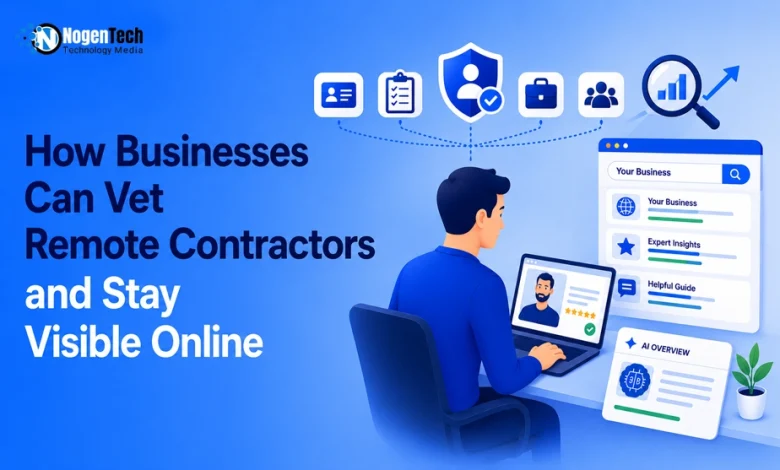
Hiring remote contractors has become essential for businesses seeking specialized talent without geographic limits. But Artificial Intelligence has made it easier than ever to fake resumes, polish interview answers, and even fabricate identities through deepfake technology.
This raises a critical question: how can businesses vet remote contractors safely before granting them access to sensitive systems?
At the same time, AI is reshaping how customers discover companies online, making traditional SEO alone insufficient. This guide breaks down practical, real-world steps for verifying remote talent and staying visible across search engines and AI-driven platforms, helping businesses build trust on both fronts.
Why Remote Contractor Verification Matters?
Remote contractor verification matters as it mitigates identity deepfakes, resume fraud, and security threats while validating technical competence to protect digital enterprise assets.
Hiring remote contractors offers flexibility and access to specialized talent, but it also introduces new verification challenges.
AI-powered tools can generate convincing resumes, enhance interview responses, create professional portfolios, and even enable identity impersonation through deepfake technology.
Gartner predicts that by 2028, 1 in 4 candidate profiles worldwide could be fake, making robust verification more critical than ever.
Although most candidates use AI responsibly, businesses should establish verification processes that confirm both technical competence and identity before granting access to company systems or sensitive information.
This can include steps to access public records to confirm employment history, identity documents, or professional licensing, where applicable.
Why should Businesses Prioritize Practical Assessments over Traditional Interviews?
Businesses should prioritize practical assessments because traditional interviews are easily manipulated by AI-generated scripts or identity deepfakes.
Evaluating real-world tasks forces remote contractors to prove their technical capabilities and problem-solving skills under actual working conditions before accessing secure business systems.
Interviews remain valuable, but they should not be the only factor when evaluating remote contractors.
Practical assessments provide a clearer picture of a candidate’s abilities. Depending on the role, businesses can ask applicants to:
- Complete a real-world assignment
- Review an existing project
- Solve a technical challenge
- Analyze a business scenario
- Demonstrate their workflow during a live session
These exercises reveal how candidates think, communicate, and solve problems in situations similar to their daily responsibilities.
Why Should Businesses Verify a Remote Contractor's Identity and Professional Background?
Organizations must verify identity and professional backgrounds because resumes, portfolios, and LinkedIn profiles can easily be fabricated or enhanced using AI tools.
Resumes, portfolios, and LinkedIn profiles provide useful information, but they should be treated as starting points rather than final proof of credibility.
Organizations should verify:
- Employment history
- Professional certifications
- Educational qualifications
- Portfolio authenticity
- Identity documentation where appropriate
Background verification helps reduce hiring risks while protecting company resources and customer data.
Why Should Businesses Apply Zero-Trust Security During Onboarding?
Businesses should apply zero-trust security during onboarding because it minimizes operational vulnerabilities while newly hired remote contractors become familiar with internal systems
Verification should continue after hiring.
Following a zero-trust approach allows businesses to reduce operational risks while new contractors become familiar with internal systems.
Best practices include:
- Granting minimum required permissions
- Using role-based access controls
- Enabling multi-factor authentication
- Monitoring account activity
- Restricting access to sensitive business systems
These measures protect both company assets and client information without disrupting productivity.
Why Online Visibility Matters After Hiring
Online visibility matters after hiring because building a reliable remote team is only part of long-term business success. Once operations are running efficiently, organizations must ensure potential customers can still discover their products and services online.
Search behavior is evolving rapidly. In addition to traditional search engines, users increasingly rely on AI-powered platforms to research products, compare services, and answer business questions. Companies that publish trustworthy, well-structured content are more likely to remain visible across both search engines and AI-driven experiences.
Why Should Businesses Build Content Around Expertise Instead of Keywords?
Businesses should build content around expertise because modern search systems prioritize deep industry knowledge over keyword density.
Modern search systems evaluate much more than keyword usage. Businesses should focus on creating content that demonstrates:
- Practical expertise
- Original insights
- Industry knowledge
- Accurate information
- Clear organization
- Helpful user experiences
Instead of publishing large volumes of similar articles, organizations should build topical authority around subjects directly related to their products, services, and industry expertise.
How to Make Content Easier for Search Engines and AI for Discoverability?
Businesses can improve discoverability by:
- Organizing content with clear headings
- Implementing structured data where appropriate
- Maintaining consistent business information
- Using descriptive page titles and metadata
- Publishing content that answers specific user questions
Clear content structure helps both users and machines understand information more efficiently.
Why Should Businesses Strengthen Brand Trust Through Consistency?
Businesses should strengthen brand trust through consistency because a unified digital presence establishes long-term credibility for both potential employees and prospective customers.
Whether hiring remote contractors or publishing online content, trust has become one of the most valuable business assets.
Organizations should maintain consistency across:
- Company messaging
- Website information
- Business profiles
- Customer communication
- Professional branding
A consistent digital presence improves credibility for both potential employees and prospective customers.
Practical Checklist for Businesses
Strengthen Hiring
- Verify candidate identity
- Conduct practical skill assessments
- Validate professional experience
- Apply secure onboarding procedures
- Limit initial system access
Improve Online Visibility
- Publish original, experience-based content
- Build topical authority within your industry
- Improve website structure
- Monitor search and AI visibility
- Keep business information accurate across platforms
What People Also Ask About Vetting Remote Contractors and Online Visibility
How can businesses verify remote contractors?
Businesses should combine identity verification, background checks, practical assessments, reference validation, and secure onboarding procedures instead of relying solely on interviews.
Why are practical assessments better than interviews?
Real-world tasks demonstrate how candidates solve problems and perform job-related responsibilities, providing a more accurate evaluation of their skills.
How is AI changing online visibility?
AI-powered search platforms increasingly prioritize trustworthy, well-structured, and authoritative content rather than pages optimized only for keywords.
Does SEO still matter in an AI-driven search landscape?
Yes. SEO remains important, but businesses should focus more on topical authority, user intent, structured content, and expertise alongside traditional optimization practices.
Why is trust important for both hiring and marketing?
Trust reduces hiring risks while improving customer confidence. Organizations that verify contractors carefully and publish reliable information are better positioned for sustainable business growth.
Closing Thoughts on Vetting Contractors and Online Visibility
AI is changing both how businesses hire and how customers discover them online. Companies that combine strong contractor verification with authoritative, well-structured content will reduce hiring risks while building lasting trust.
Relying only on traditional interviews or outdated SEO tactics is no longer enough in this fast-changing landscape. Success now depends on credibility, expertise, and adaptability, helping businesses stay secure, visible, and competitive across both search engines and emerging AI-driven discovery platforms.