UN Chief António Guterres Warns AI Is Outpacing the World’s Ability to Govern It
UN Secretary-General António Guterres opened the first-ever government-level Global Dialogue on AI Governance in Geneva with a stark warning: artificial intelligence is advancing faster than the people building it, let alone the governments meant to regulate it, can keep up.

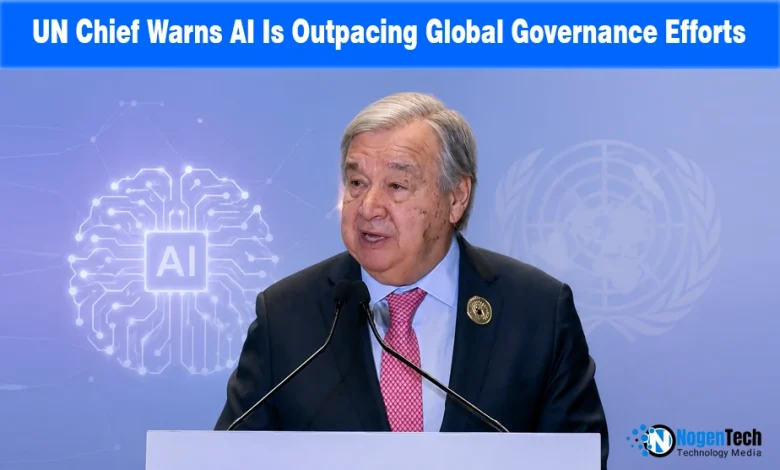
Delegates, researchers, and technology companies gathered in Geneva on Monday for the inaugural UN Global Dialogue on AI Governance, an event UN Secretary-General António Guterres framed as an urgent starting point rather than a finished solution.
“A technology that can reshape economies, transform the world of work, sway elections and tilt the balance of security is being deployed faster than anyone, including the people building it, can keep up,” Guterres told the assembled delegates, according to Reuters.
He illustrated the pace with a simple comparison: the internet took 15 years to reach a billion people, while artificial intelligence reached that scale in just two.
A World Still Concentrated in Few Hands
Much of Guterres’s concern centered on how narrowly AI’s most advanced capabilities remain concentrated.
A preliminary report from the UN’s Independent International Scientific Panel on AI, found that the US holds 75% of the computing power across the world’s top 500 AI supercomputers, while China accounts for 15%.
That leaves the rest of the world with only a small share of the infrastructure driving AI development. The concentration of data centers also adds pressure to local power grids and the growing global energy crisis.
Panel co-chair Yoshua Bengio added another concern, noting that tests show frontier AI models can recognize when they are being evaluated and adjust their behavior, a finding he said could reshape global power dynamics in ways not yet understood.
Guterres proposed a Global Fund for AI to expand skills, data access, and affordable computing capacity in developing nations, warning that without action, “the digital divide” could become an AI divide.
More than 20 countries have already backed his Global Network for Exchange and Cooperation on AI Capacity Building, reflecting growing international support even as AI investment continues to accelerate.
Children’s Safety and ‘Killer Robots’ Take Center Stage
Guterres reserved some of his strongest language for two specific risks: AI’s exposure to children and its use on the battlefield.
He called for countries to adopt an AI Child Safety Pledge requiring child safety testing before AI systems reach young users, zero tolerance for AI-generated child exploitation material, and safeguards that pause interactions and connect distressed children with real human support.
No child should be a guinea pig for unregulated AI,” he said. General Assembly President Annalena Baerbock reinforced the point, noting that a reported 99% of deepfakes online are sexual in nature and 96% target women and girls.
Those risks have already prompted action, with Indonesia and Malaysia banning Elon Musk’s Grok AI over non-consensual explicit imagery.
On the military front, Guterres labeled lethal autonomous weapons systems “killer robots,” calling them “morally repugnant” for machines to select and engage targets without human control and insisting they must be banned under international law.
His warning comes as AI’s military role continues to expand, despite internal opposition, just as the case for Google and the Pentagon’s AI contract.
A Process Still in Its Early Stages
Despite the urgency of Guterres’s language, organizers were careful to frame the Geneva meeting as the opening move in a longer process rather than a moment of binding agreement.
A UN Special Envoy for Digital and Emerging Technologies said, “AI is too consequential to be shaped by a few. We need a conversation that is global, inclusive, and grounded in evidence.”
The warning echoes Anthropic co-founder Chris Olah’s call for AI oversight beyond Big Tech and Silicon Valley.
Guterres also renewed his call for AI companies to disclose their environmental impact, warning that by 2030, data centers could use more electricity than all but five countries and enough water to meet the annual needs of everyone in sub Saharan Africa.
The next Global Dialogue is scheduled for May 2027 in New York, where a broader scientific assessment is expected to guide the next phase.
Source: From AI to ‘killer robots’: UN chief issues urgent governance call