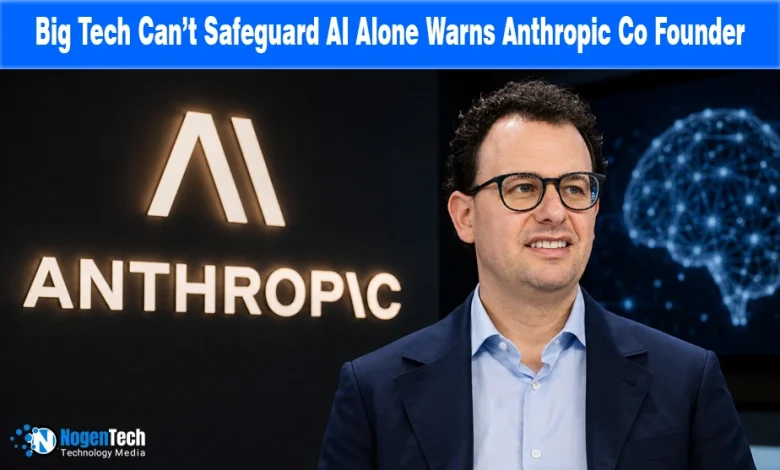
Big Tech Can’t Safeguard AI Alone, Warns Anthropic Co-Founder Chris Olah
Frontier Safety Requires Independent Oversight Beyond Silicon Valley Corporate Guardrails

The rapid commercialization of frontier models has shifted the artificial intelligence domain from theoretical science to an aggressive corporate race. While tech giants pour billions into larger neural networks, the core mechanisms driving these systems remain largely a mystery.
Anthropic co-founder Chris Olah argues that this trajectory poses significant safety challenges, emphasizing that true AI alignment and oversight cannot happen solely within the confines of Big Tech. To ensure safety, independent public research must actively guide the industry’s direction.
The Limits of Corporate Guardrails in Frontier AI Evolution
As AI systems move closer to advanced agentic behavior, leaving safety oversight entirely in the hands of private corporations creates a dangerous single point of failure.
According to a report by US News & World Report, Olah emphasizes that public institutions and external academic bodies need to play a central role in guiding safety frameworks.
The enormous cost of building frontier AI infrastructure has already concentrated power among a small group of tech giants.
However, this corporate concentration creates a structural conflict of interest. When profit margins and market deployment timelines conflict with slow, rigorous safety testing, commercial interests almost always win out.
Meaningful public safety requires independent public scrutiny, something that becomes impossible when the inner workings of cutting-edge AI models remain locked behind corporate secrecy and proprietary trade protections.
Mechanistic Interpretability vs. Market Commercialization Pressures
At the heart of Olah’s critique is the current state of AI safety research itself.
As detailed by Reuters, Olah is a pioneer in mechanistic interpretability, a branch of computer science focused on reverse-engineering neural networks to understand exactly why they produce specific outputs.
The current corporate race rewards building larger, more complex models long before researchers fully understand their internal pathways.
This creates a critical AI vulnerability. If developers do not understand how an AI reaches a conclusion, they cannot reliably prevent it from generating hallucinated facts or manifesting harmful biases.
Olah believes the industry’s current approach treats safety like a final-stage product feature added shortly before release. In his view, that model is fundamentally broken if we want to secure the future of AI responsibly.
True safety, he argues, requires deep interpretability to be built directly into the architecture itself, guided by independent researchers who are free from the commercial pressures of rapid scaling and investor-driven timelines.
Building an Independent Ecosystem for Global Governance
Building a strong, independent AI research ecosystem is no longer an academic ideal; it is becoming essential for long-term safety.
As noted by AOL, Olah argues that relying on Big Tech to regulate itself is not enough to manage the societal risks of advanced AI systems.
Rapid scaling has already produced unexpected industry tensions, including Anthropic’s accusations that Chinese firms copied Claude through large-scale automated data extraction campaigns.
Experts suggest that to avoid a fragmented and potentially dangerous AI sector, safety standards must remain open, peer-reviewed, and decentralized.
That includes federally funded compute centers and open-science initiatives that give independent researchers the processing power needed to stress-test frontier models.
Olah argues that separating AI safety oversight from the companies building the models is critical if the industry wants systems that remain secure, transparent, and aligned with public interests and human values.
Source: Anthropic’s Olah says AI must be guided from outside Big Tech