Google Signs Classified Pentagon AI Deal One Day After 600 Employees Begged It Not To
Google granted the Pentagon access to Gemini for any lawful government purpose, including classified work, just two months after Anthropic was blacklisted for doing exactly what those employees asked Google to do.

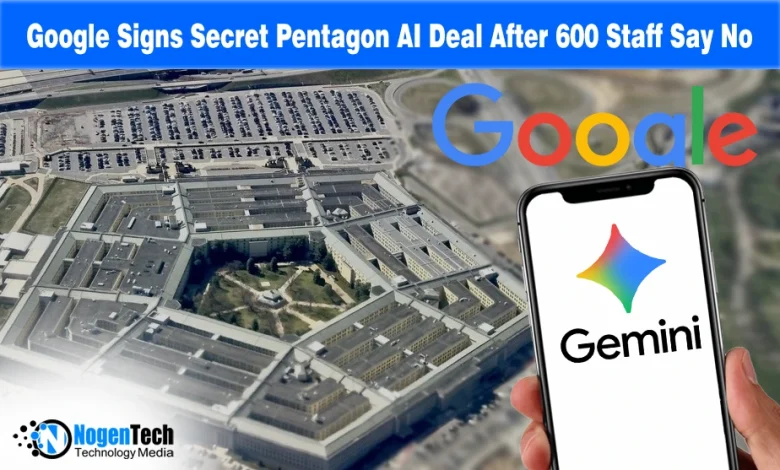
Google signed a classified AI agreement with the US Department of Defense (DoD) on April 28, 2026, giving the Pentagon access to its Gemini models for classified work under terms that allow use for “any lawful government purpose”.
Pentagon Chief Digital and AI Officer Cameron Stanley confirmed the arrangement publicly, stating that the DoD is already using Gemini across a range of applications and saving thousands of personnel hours weekly.
The deal was finalised one day after more than 600 Google employees, including senior directors and vice presidents, sent an open letter to CEO Sundar Pichai urging him to refuse. Pichai did not respond publicly to the letter before the deal was confirmed.
What the Deal Actually Allows and What It Does Not Enforce
The critical detail in Google’s Pentagon agreement, as TechCrunch confirmed, is the gap between what the contract says and what it enforces.
The agreement states that Google does not intend its AI to be used for domestic mass surveillance or autonomous weapons without human oversight, language similar to what OpenAI included in its Pentagon deal.
However, as Reuters reported, the contract explicitly states that Google “does not confer any right to control or veto lawful Government operational decision-making.”
That clause makes the safety language non-binding. Whether a given use is “lawful” is decided by the Pentagon, not Google. The company has no legal way to challenge a use it considers harmful once it is within the scope of a lawful government activity.
A spokesperson reportedly said Google is part of a “broad consortium” of companies supporting national security, with applications spanning logistics, cybersecurity, diplomatic translation, fleet maintenance, and critical infrastructure defence.
Why Anthropic’s Blacklisting Made This Inevitable
The sequence of events leading to Google’s deal began in late February 2026, when Anthropic refused Pentagon access to its Claude models, insisting on guardrails blocking domestic mass surveillance and fully autonomous lethal weapons.
The Trump administration responded by designating Anthropic a “supply-chain risk,” a classification previously reserved exclusively for foreign adversaries. The administration issued a directive ordering federal agencies to stop using Anthropic’s technology.
Anthropic responded, legally challenging the Pentagon. A federal judge in San Francisco granted a preliminary injunction blocking the wider government ban, but a DC appeals court allowed the supply-chain designation to stand.
This leaves Anthropic locked out of new defense contracts while litigation proceeds.
Stanley reportedly called the Google deal a diversification strategy, saying overreliance on one vendor is never good. The Pentagon had already signed deals with OpenAI and xAI before turning to Google, replacing Anthropic’s refusal with three alternative agreements.
The Employee Revolt Google Chose to Ignore
Internal opposition to the deal is the strongest Google has faced on military AI since Project Maven in 2018, the drone imagery contract that sparked employee resignations and led Google to drop its renewal.
This time, as CNET confirmed, over 600 employees signed a formal letter to Pichai warning that the technology could be used in harmful ways. The signatories included directors and vice presidents, adding unusual organisational weight, yet Google proceeded regardless.
Reportedly, more than 30 OpenAI and Google DeepMind employees supported Anthropic’s lawsuit, while recent high-level departures from OpenAI suggest that senior talent is increasingly wary as defense partnerships draw deeper scrutiny.
The contrast with Anthropic is direct: it accepted financial and contractual consequences to keep safety guardrails, while Google accepted internal opposition to remove them.
Source : Pentagon AI chief confirms DOD’s expanded use of Google