OpenAI Proposes Handing Trump Administration a 5% Stake Amid Washington Pressure
Sam Altman has floated giving the U.S. government a 5% ownership stake in OpenAI, a move reportedly aimed at easing mounting political scrutiny over how the AI boom's profits get shared with the public.

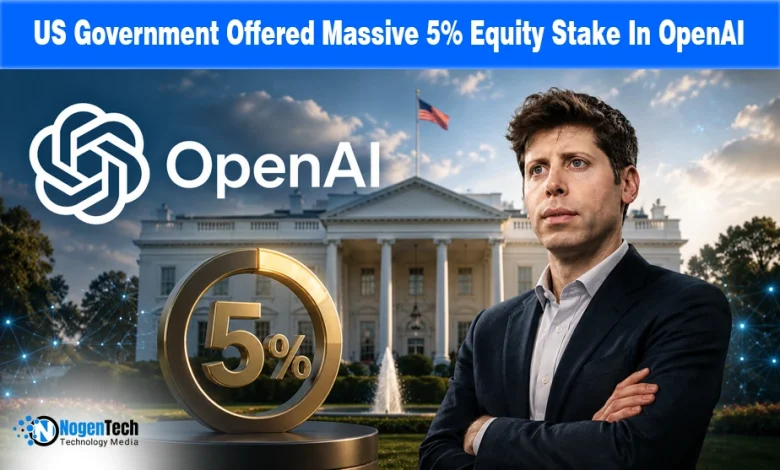
OpenAI has proposed handing the U.S. government a 5% stake in the company as it works to defuse growing political pressure on artificial intelligence firms in Washington, the Financial Times reported.
A stake of that size would be worth close to $42.6 billion, based on the $852 billion post-money valuation OpenAI secured during its record funding round in March.
CEO Sam Altman has argued that giving the public a direct financial interest in the company is the clearest way to share AI’s upside, a position he first raised with Trump administration officials back in early 2025.
A Government Vehicle Modeled on Alaska’s Oil Fund
According to the FT, Altman and other OpenAI executives proposed that leading U.S. AI developers transfer 5% of their equity into a fund resembling the Alaska Permanent Fund, which pays annual dividends to state residents.
Google, Meta, and Anthropic, which navigates legal waters against the Pentagon, were all named as companies that could potentially participate, though it remains unclear whether any of them would actually sign on to the arrangement.
The White House, OpenAI, Anthropic, Google, and Meta did not immediately respond to requests for comment from CNBC. It is also not yet clear whether the Trump administration intends to pursue the stake at all, leaving the proposal in an early and largely informal stage.
Talks Have Quietly Run for Over a Year
The idea of a government stake predates Thursday’s report. Altman first pitched government ownership to Trump’s team in early 2025, and a source told CNBC last month that discussions had already been underway for more than 12 months.
In April, OpenAI separately proposed creating a “public wealth fund” to hold assets tied to AI company growth and distribute the economic benefits to the public.
Altman has since discussed the 5% stake proposal with President Trump, Treasury Secretary Scott Bessent, and Commerce Secretary Howard Lutnick, who supervised Anthropic models before lifting the ban on Anthropic models.
In recent weeks, Altman also met Democratic Senator Bernie Sanders. Taken together, this signals an effort to build bipartisan support across party lines.
Anthropic has proposed a related but distinct idea: a ‘digital dividend’ funded by taxing the AI sector rather than giving the government direct equity. This reflects the company’s approach of finding ways to share AI’s benefits with the public, alongside its work with private partners.
Precedent, Politics, and an IPO in the Background
The Trump administration has already taken equity positions in private companies during its second term, including stakes in Intel and several quantum computing and critical minerals firms, alongside Trump’s recent Apple-Intel partnership announcement.
The report also lands just a week after OpenAI delayed the full public launch of GPT-5.6 at the government’s request, underscoring how closely the company’s product decisions are now intertwined with federal oversight.
OpenAI is also laying the groundwork for a potential IPO after confidentially filing with the SEC in June, though it says the timing is still flexible.
Whether the White House backs the proposed 5% stake or not, the move shows OpenAI sees closer ties with the government as an important part of its long-term strategy.
Source: OpenAI proposes handing Trump administration 5% stake


![Top Tech Stories of 4th week [2026]](https://www.nogentech.org/wp-content/uploads/2026/01/Top-Tech-Stories-of-4th-Week-2026-390x220.webp)