Meta Starts Charging for AI Access as It Chases Anthropic and OpenAI Into Coding
Meta introduced Muse Spark 1.1 on Thursday, its strongest coding and agentic model yet, and for the first time charged developers to use it, marking a sharp reversal from the open-source Llama strategy that defined the company's AI approach for years.

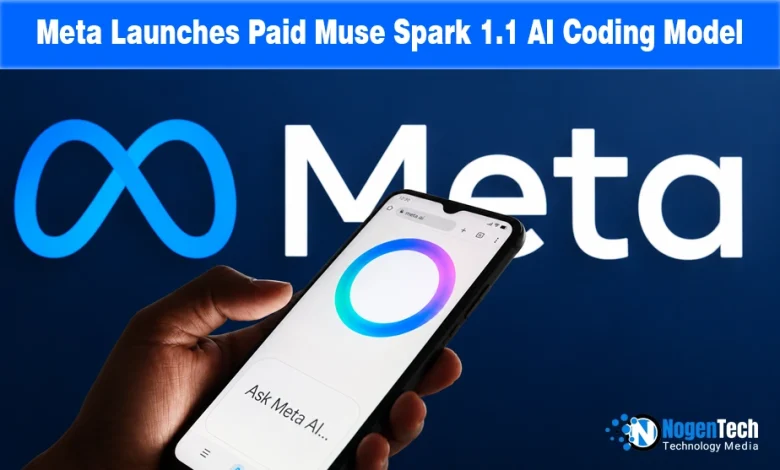
Meta rolled out Muse Spark 1.1 on Thursday, calling it a major upgrade for agentic tasks, tool use, computer use, and coding, three months after the original Muse Spark debuted in April as the successor to Meta’s open-weight Llama family.
As Meta notes, the model supports a million-token context window, remembering earlier steps and compacting information to stay useful across long workflows, while using multiple subagents that plan and delegate work in parallel.
The release is also notable because it marks the first time Meta has charged developers for access to one of its frontier models, a shift for a company that long championed open-source AI as its key competitive differentiator.
An Aggressive Price to Match an Aggressive Ambition
Meta priced the new Meta Model API, now in public preview, at $1.25 per million input tokens and $4.25 per million output tokens, with new developer accounts receiving $20 in free credits.
Zuckerberg reportedly said the pricing is about a quarter of what Anthropic and OpenAI charge for comparable models, while Wang told CNBC the goal was pricing that “scales with immense consumption usage.”
The pricing sits slightly above Anthropic’s Claude Haiku 4.5 and OpenAI’s GPT-5.6 Luna, as per TechCrunch, positioning Muse Spark 1.1 as a budget-conscious alternative.
Wang said the model’s coding focus reflects Meta’s broader agentic ambitions, arguing strong coding is essential for AI agents that can handle multiple tasks autonomously, “like a fleet of human interns.”
He added that Meta trained the model to work with widely used developer tools, a nod to the rise of agent-management platforms like OpenClaw earlier this year.
Wall Street Pressure Meets a Crowded Field
The release comes as Zuckerberg faces pressure from investors to justify Meta’s heavy AI infrastructure spending, despite the company lacking a cloud business and continuing to trail OpenAI, Anthropic, and Google in widely used AI models and applications.
Early partners, including Replit, Cline, and Box, are already testing Muse Spark 1.1, with Replit CEO Amjad Masad calling its long-context handling, multimodal support, like Google Gemini, and coding capabilities “a complete agentic foundation.”
Even so, Meta said the model still trails Anthropic’s flagship Mythos 5 and Fable 5, as well as OpenAI’s GPT-5.6, on some coding benchmarks, underscoring the competitive pressure reshaping AI pricing and access.
Wang said Meta remains “committed to open source” and is developing an open-weight version of Muse Spark, but declined to provide a timeline.
Part of a Bigger Week for Meta’s AI Push
Muse Spark 1.1 arrives just two days after Meta launched Muse Image, its first in-house AI image generator, making this one of the busiest weeks yet for Meta’s Superintelligence Labs division.
Wang confirmed the company is already training a more capable successor model internally code-named Watermelon, following Muse Spark’s own original code name, Avocado, though he offered no release timeline.
With Zuckerberg signaling “more to come soon,” Meta is betting aggressive pricing, rather than benchmark leadership, will be enough to draw developers away from the AI coding tools Anthropic and OpenAI have spent the past two years building.
Source: Introducing Muse Spark 1.1