OpenAI Retires Its Atlas Browser, Folding Its AI Into Chrome and a Revamped Desktop App
OpenAI is shutting down ChatGPT Atlas less than a year after launch, but the move looks less like a retreat and more like a graduation, as the company redirects everything Atlas taught it into a newly unrestricted GPT-5.6 model family and a broader desktop and Chrome presence.

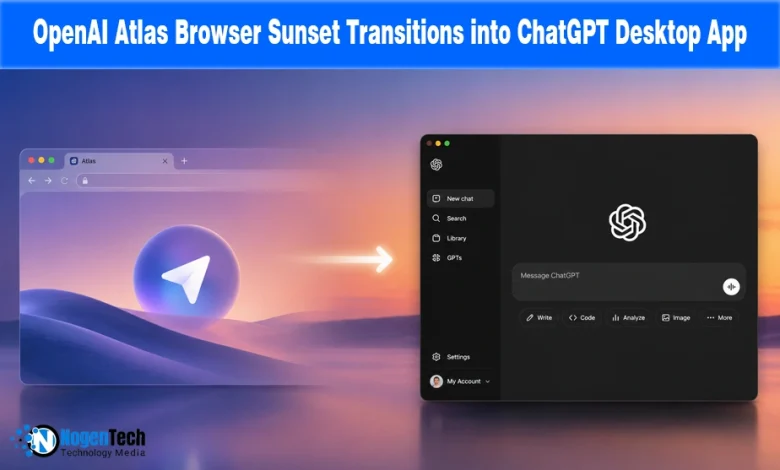
OpenAI confirmed Thursday that ChatGPT Atlas, its Chromium-based browser launched in October 2025, will be discontinued, with a target deprecation date of August 9, 2026.
Browser lead James Sun described the move as a natural next step rather than a failure, writing on X that Atlas helped the company learn “how agents can help make browsing and doing work on the open web better” and thanking early users for taking a leap of faith.
Reports note that the shutdown follows months of pressure from applications chief Fidji Simo to cut side projects, a push that also led to the earlier shutdown of the Sora video app.
A Testbed, Not a Dead End
Atlas launched exclusively on macOS with a persistent AI sidebar, an Agent mode for automating tasks, and memory features that learned users’ browsing habits. However, Agent mode was limited to Plus, Pro, and Business subscribers.
Windows, iOS, and Android versions were planned but never shipped.
OpenAI is advising remaining Atlas users to export bookmarks and other data before the August 9 cutoff, while cookies and saved passwords will carry over to the revamped ChatGPT desktop app, long dubbed the ChatGPT superapp.
Rather than framing the transition as a loss, OpenAI describes Atlas as a nine-month experiment that provided the real-world browsing data needed to make its models capable enough that a standalone browser container is no longer the point.
The Model That Made the Browser Optional
That capability arrived the same day, with OpenAI announcing that its GPT-5.6 family, made up of the flagship Sol, the balanced Terra, and the cost-efficient Luna, reached general availability on July 9 after a limited preview that began in late June with a small group of trusted partners.
According to OpenAI, the rollout followed a voluntary security review tied to a recent executive order requiring frontier AI developers to share new models with the government ahead of public release.
Sol now leads OpenAI’s coding benchmarks with a score of 80 on the Artificial Analysis Coding Agent Index, a result OpenAI says sits ahead of Anthropic’s Fable 5 in that specific test.
While a new “ultra” mode coordinates up to four agents working in parallel on demanding tasks, transforming standard chatbot interactions into long-horizon, autonomous enterprise workflows.
Where Atlas’s DNA Actually Lands
Instead of a standalone browser, OpenAI is routing that intelligence into two places people already spend their time.
The redesigned ChatGPT desktop app combines ChatGPT, Codex, and the new ChatGPT Work environment into a single application with a built-in browser featuring multiple tabs, a password manager, autofill, and account logins.
In addition, a separate cloud-based browser is also present that lets agents complete tasks remotely on a user’s behalf.
Separately, OpenAI is launching a Chrome extension that gives ChatGPT direct access to the page a user is viewing, letting them ask questions, summarize content, or start longer tasks without leaving the browser, placing it as a direct rival to Google’s Gemini Side Panel.
Together, the changes suggest OpenAI has concluded that browsing is best treated as a feature woven into tools people already use.
Source: GPT-5.6: Frontier intelligence that scales with your ambition