
Why Growing E-commerce Brands Are Investing in Last-Mile Delivery Solutions Early
Growing e-commerce brands invest in last-mile delivery solutions early to reduce shipping costs, prevent failed deliveries, improve customer satisfaction, and handle increasing order volumes without operational delays.

As e-commerce brands grow, higher order volumes and expanding delivery locations make routing, carrier coordination, and cost control more difficult. Manual processes often lead to delays, failed deliveries, and dissatisfied customers.
Managing multiple carriers, delivery windows, customer preferences, and unexpected disruptions becomes harder as operations expand. Without proper systems, these challenges increase delivery costs and support workloads.
Investing in last-mile delivery solutions early helps brands automate dispatch, optimize routes, improve shipment visibility, and prepare for higher demand. This article explains the essential capabilities, operational benefits, and performance metrics that support scalable delivery operations.
Why Growing E-commerce Brands Need Last-Mile Delivery Solutions Early
Delivery processes that work at lower order volumes may struggle as businesses expand. Common challenges include:
- Manual dispatch: Route planning becomes difficult across different locations, delivery windows, shipment types, and carrier availability.
- Unreliable delivery promises: Same-day, next-day, and scheduled deliveries require accurate capacity planning.
- Limited visibility: Missing tracking updates increase customer inquiries and support workloads.
- Inconsistent carrier performance: Late shipments, failed attempts, missed scans, and missing proof of delivery affect customer trust.
Early investment replaces manual coordination with structured delivery processes.
Essential Last-Mile Delivery Capabilities and Their Benefits
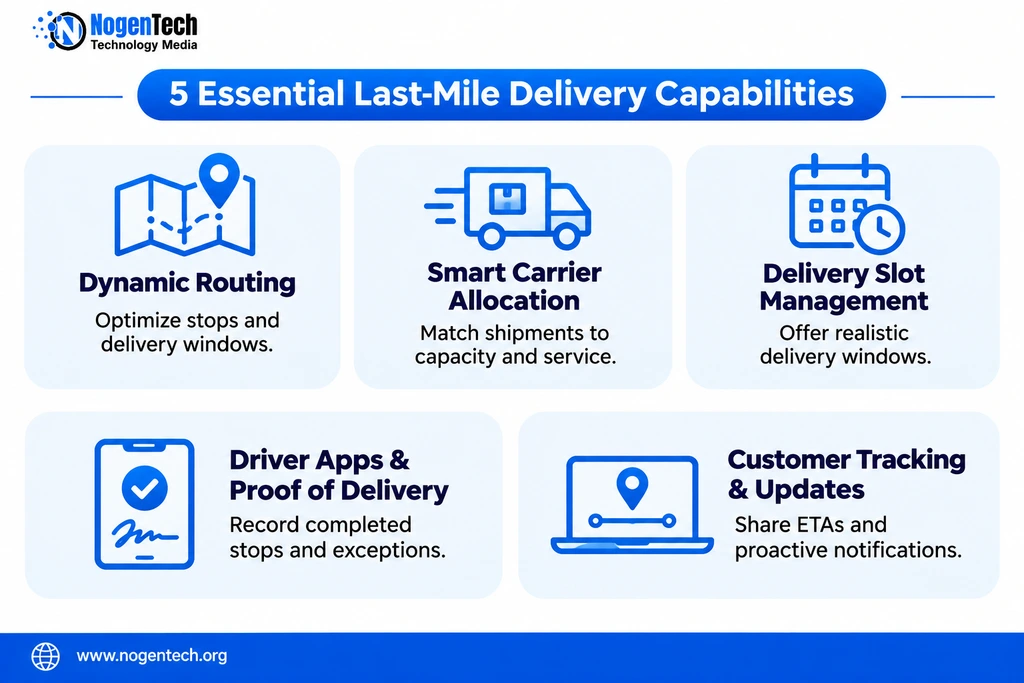
Five capabilities help growing brands control delivery costs, reduce manual work, and maintain service quality.
1. Dynamic Routing and Stop Sequencing
Dynamic routing plans delivery sequences using order locations, vehicle capacity, delivery windows, and service times. Grouping nearby stops improves route density, reduces travel, and increases driver utilization. Geocoding tools convert addresses into coordinates, helping prevent missed stops and route deviations.
These improvements help control delivery costs as shipment volumes and delivery coverage increase.
2. Intelligent Carrier Allocation
Carrier allocation systems assign shipments based on delivery coverage, shipping rates, cutoff times, service commitments, and capacity. Historical performance data helps brands compare logistics partners, distribute orders, and respond to capacity shortages.
3. Delivery Slot Management
Delivery slot management connects customer-selected delivery windows with fleet capacity, route feasibility, delivery zones, and costs. This helps businesses offer realistic same-day, next-day, and scheduled delivery options without exceeding available capacity.
4. Driver Apps and Proof of Delivery
Driver applications record delivery activity and support:
- Electronic proof of delivery (ePoD) and one-time passwords (OTP)
- Customer signatures and delivery photographs
- Timestamps and geofencing data
- Failed-attempt codes and exception reasons
These records support shipment tracking and dispute resolution.
Exception management workflows help teams handle customer unavailability, access restrictions, damaged shipments, and missing information through customer contact, reattempts, or return-to-origin (RTO) processes.
5. Customer Communication and Tracking
Branded tracking pages, automated notifications, updated ETAs, and rescheduling options keep customers informed. Dynamic ETAs account for traffic, route progress, stop durations, and delivery sequence changes, helping customers prepare for arrival.
How Delivery Visibility Improves Customer Experience and Retention
Poor delivery communication can frustrate customers even when orders arrive successfully. Better visibility improves the post-purchase experience through:
- Real-time tracking and notifications: Branded pages display shipment status, driver progress, ETAs, and delays where supported. SMS, email, and WhatsApp updates help reduce WISMO (Where Is My Order?) inquiries.
- Delivery preferences and first-attempt success: Delivery windows, address confirmation, access instructions, and rescheduling improve the chances of successful first-attempt delivery. FedEx also highlights how flexible delivery preferences and timely notifications support deliveries.
- Verified deliveries and dispute resolution: OTP verification, electronic signatures, photographs, scan histories, and geotagged timestamps provide evidence for investigating missing or disputed shipments.
These capabilities reduce avoidable support requests and help maintain customer trust.
Preparing for Peak Demand and Measuring Delivery Performance
Seasonal sales and promotions can push shipment volumes beyond normal capacity. Early planning helps brands manage demand through:
- Demand forecasting: Historical orders, promotional activity, and delivery-zone demand help estimate driver, vehicle, carrier, and fulfillment requirements. This supports resource planning and fulfillment operations before peak periods.
- Order cutoff management: Rules determine whether shipments can meet promised windows based on location, capacity, and carrier schedules.
- Multi-carrier flexibility: Brands can redistribute shipments when logistics partners experience delays or capacity shortages.
- Control tower visibility: Centralized dashboards track shipments, route delays, carrier performance, and exceptions, helping teams identify service-level agreement (SLA) risks and failed attempts.
Brands should also monitor key delivery metrics to identify inefficiencies and maintain service reliability.
| Metric | What It Measures | Why It Matters |
| Cost Per Delivery | Expenses by zone, carrier, service type, shipment size, and route | Identifies cost inefficiencies |
| On-Time, In-Full (OTIF) | Orders delivered on time with all expected items | Measures delivery reliability |
| First-Attempt Delivery Rate (FADR) | Percentage completed on the first attempt | Highlights routing, address, and scheduling issues |
| WISMO Volume | Customer inquiries about shipment status | Reveals tracking and communication gaps |
| Carrier Performance | Acceptance, scan compliance, delays, failed attempts, costs, claims, and feedback | Supports carrier evaluation |
Final Thoughts
Investing in last-mile delivery solutions early helps growing e-commerce brands control costs, improve routing, manage carriers, and maintain reliable customer communication before operational problems escalate.
Providers such as FarEye offer routing, delivery visibility, driver workflows, and customer communication capabilities that help businesses manage increasing delivery complexity while protecting service quality.