
Apple’s iPhone 18 Pro Brings Variable Aperture Years After Samsung
Apple unveiled the iPhone 18 Pro and Pro Max with its first variable aperture camera, roughly seven years after Samsung and four years after Huawei shipped the technology on their flagship phones.

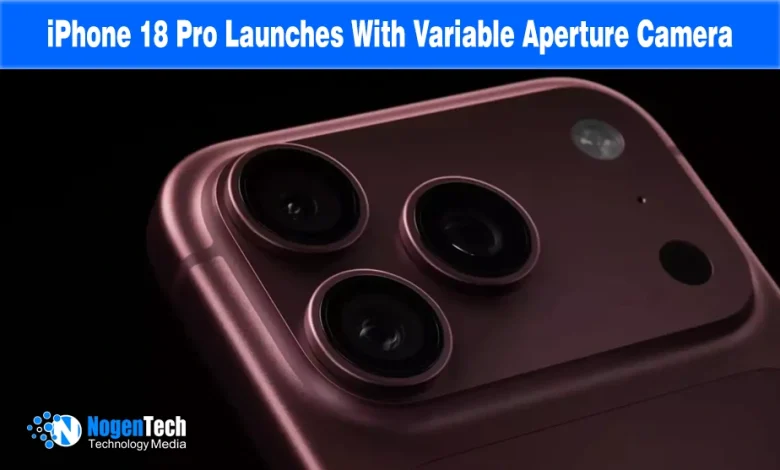
Apple unveiled the iPhone 18 Pro and iPhone 18 Pro Max during its “Surprise and Shine” event.
The headline feature, a variable aperture on the 48-megapixel main sensor, ends months of speculation over whether it would be exclusive to the larger Pro Max, confirming both models get identical hardware.
Preorders open Saturday, September 12, with phones reaching stores September 18, priced at $1,199 and $1,299 respectively for the base 256GB configuration.
The Engineering Behind Apple’s Variable Aperture Is Genuinely Impressive
According to Apple, the new aperture system uses six laser-cut blades, each thinner than a human hair and made from a specialized polymer composite designed to balance flexibility and durability.
MacRumors reports that the blades shift the lens opening between f/1.48, f/1.8, f/2.8, and f/4 depending on the scene. In darker environments, the aperture opens to let in roughly 50% more light than a fixed-aperture lens, while narrower settings keep more of a group photo in focus.
Apple also built a new Pro camera interface around the hardware, letting photographers manually override automatic aperture selection, adjust shutter speed and white balance, and monitor exposure through a real-time histogram.
An API lets third-party camera apps access the same aperture range.
The ultrawide and telephoto lenses remain largely unchanged from last year at 48 megapixels each, and the front-facing FaceTime camera also stays at 18 megapixels.
Apple Isn’t First Here, It’s Catching Up
What most coverage of Wednesday’s launch is glossing over is that variable aperture on a smartphone camera isn’t new technology; much like its late entry into foldables with the iPhone Duo, Apple is years late to it.
Samsung shipped a basic two-stage variable aperture on the Galaxy S9 in 2018.
Huawei refined the concept on the Mate 50 Pro in 2022, and Xiaomi’s 14 Ultra introduced a more sophisticated continuous system spanning f/1.63 to f/4.0 in 2024, roughly matching the range Apple now markets as a breakthrough.
That context doesn’t diminish what Apple built. The six-blade mechanical design and depth of manual control stand out, but they complicate the “Apple invents it” framing that often follows iPhone announcements.
What Apple is really selling isn’t the concept of variable aperture, but a version refined and integrated deeply into iOS’s camera software, potentially bringing the feature to millions of buyers who never considered an Android flagship for it.
Why Apple’s Timing Here Actually Makes Strategic Sense
Being late to variable aperture is arguably the smarter play, not a weakness Apple is trying to hide.
Samsung and Huawei spent years working out the reliability problems of moving mechanical parts inside smartphone lenses.
Apple’s decision to wait and ship the feature on both Pro models simultaneously rather than limit it to a single flagship, as Samsung and Xiaomi initially did.
That pattern extends to the rest of Wednesday’s announcement. The new C2 modem continues Apple’s slow move away from Qualcomm, while holding Siri AI back from the EU at launch.
It rolls out in English, with French, Japanese, Korean, Portuguese, and Spanish following in October, suggesting Apple is again choosing regulatory caution over simultaneous global availability.
None of this is Apple racing to lead. It’s Apple waiting until a feature, chip, or market is ready on its own terms, then shipping a more polished version after others have made the early mistakes.
The $100 price increase is the one part Apple can’t frame as deliberate restraint, but tying it to the industry-wide memory shortage gives Apple a defensible answer for buyers who notice the jump.