Google’s Orbiting TPU Reportedly Runs Only 20 Minutes at a Time, Report
Google's Suncatcher prototype answered a Gemma 4 prompt from orbit, but a single TPU, about 1 kW of power and radiation risk are what the next tests will actually measure.

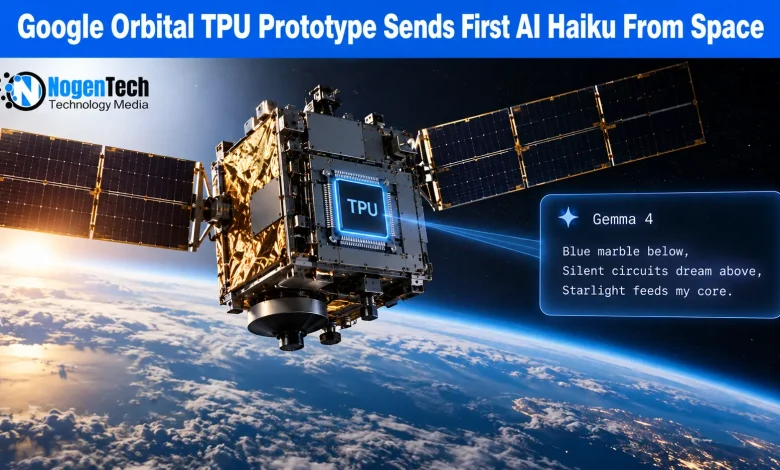
Google Research said on October 30 that its Project Suncatcher prototype satellite, launched October 1, has completed commissioning and produced what it calls “the first-ever AI response from a data center class TPU in orbit.”
During a ground-station pass, the team uplinked a prompt asking the onboard Gemma 4 open model for a haiku(poem) about being in space, and the reply came down as the satellite passed Svalbard, Norway.
The poem is the headline. The hardware limits behind it say more about how far orbital computing still has to go.
Google’s Space Haiku Came From One TPU Running on a Power Budget
Google’s blog says the team powered up the main computer trays holding the AI chips and ran early machine learning tests before sending the prompt.
The haiku began “Blue marble below” and ended “Starlight feeds my core”. Follow-up prompts asked for limericks and real-time updates on the hardware’s health status.
TechCrunch adds hardware details Google’s post leaves out. Planet Labs built the satellite, which flew with more than 100 other spacecraft on a SpaceX Falcon 9 rocket, taking about three weeks to set up.
It carries four TPUs and generates up to 1 kW of electricity. That budget lets the chip run for only about 20 minutes of active bursts per pass, requiring rest intervals between processing cycles and complicating data transmissions to Earth.
A Google spokesperson told TechCrunch the satellite is operating normally, though neither report names the TPU generation or the orbit.
Radiation Bit Flips Are the Open Question the Next Tests Must Answer
Google says the next phase will test how its chips handle space heat and radiation, which can silently flip data bits without triggering standard software warnings.
Ground tests suggested radiation barely impacts inference, but could pose a much bigger risk when training entire models, with actual orbit tests revealing the true impact.
That difference defines what Project Suncatcher can actually accomplish. Answering questions using an existing AI model takes far less power than creating a new one, and this satellite has only managed the former, in quick bursts.
Google calls this early research, using the spacecraft mostly as a testing ground for hardware durability and performance in space.
Suncatcher Is a 2030s Bet That Depends on Starship Launch Costs
Google’s bigger goal is testing if solar energy and space conditions can power large-scale AI networks.
By 2027, it plans to launch two upgraded satellites featuring stronger chips, more power, and laser links to let nearby spacecraft process heavy AI workloads together.
TechCrunch notes Starcloud is virtually alone in connecting satellites at high speeds, while SpaceX’s planned space data centers sit too far apart to easily share computing.
Sky-high launch costs present another huge hurdle. Analysts estimate SpaceX needs thousands of Starship launches to drive prices low enough, making space data centers economically viable only by the 2030s.
Alphabet’s major stake in SpaceX gives Google a direct front seat to those falling launch costs, but today, it has simply proven one space chip can answer one prompt.
Source: We’ve received our first response from the Project Suncatcher prototype satellite.