As the global embedded software market grows, so does the number of embedded engineering services companies competing for your business.
A strong partner will own every layer of your system, from electrical engineering and firmware through connectivity, edge AI, and regulatory documentation, as one unified, secure solution.
Full-cycle embedded software development services you can find at Lemberg Solutions. This article will walk you through the process of choosing a good partner.
Choosing a Tech Vendor: Where to Start
A common misconception is that before contacting a software development company, you must have the whole roadmap figured out.
However, having a key idea, a rough timeline, and a sense of your main requirements is a great place to start. Turning that into a software requirements specification is where a strong embedded software development partner proves its value. A capable vendor leads that prep work with you, covering:
- Functional needs: target hardware, deterministic timing requirements, and anticipated operational lifespan
- Non-functional scope: security standards and safety certifications
- Project constraints: funding thresholds, timelines, and regulatory requirements
- Measurable outcomes: performance benchmarks and clear acceptance criteria.
If you agree on these factors with the partner early, you can save money later in your project.
Look for Relevant Embedded Software Development Experience
Embedded engineering is a broad field. Assess the company’s relevant experience, embedded software development expertise, and certifications. Let’s consider them in more detail.
Check the Company’s Experience in Your Industry
Look for evidence that the vendor solved problems similar to yours. Request the company’s case studies and references from projects matching yours in scope, hardware, and field.
The most convincing proof is a device certified on the first pass or, for instance, firmware that successfully met strict requirements for power consumption or response time. You can also look for the reviews of the vendor’s past clients to learn which tech stack, services, and development approaches the firm used.
Assess Its Embedded Software Development Expertise and Partnerships
Dig for the company’s technical depth and proven experience in:
- Low-level drivers, firmware, real-time operating systems, and bare-metal design
- Communication protocols and power optimization for constrained devices
- Code quality verified against a defined subset such as MISRA C (current edition MISRA C:2025).
Look for the firm’s technology partnerships and certifications with silicon and platform vendors, like chip manufacturers, which signal vetted, hands-on competence with specific hardware and toolchains. Find out how the company is involved in the life of the tech community, whether they participate in discussions and collaborations.
Check if the Vendor Is Certified
Each sector has its own safety and lifecycle requirements, and a partner with proven results in your industry must adhere to critical industry standards.
For example, ISO 26262 automotive functional safety and ISO 13485 medical device software delivery for the healthcare industry. There are also standards like ISO 27001 for a security management system and ISO 9001 for a quality management system.
Ask Which Hardware, Firmware, and Software Development Capabilities the Company Provides
When embedded projects are split across separate vendors, one for hardware, another for firmware, and a third for the cloud, the gaps between them are where delays and defects appear.
An end-to-end partner closes those gaps by owning the whole chain. Full-cycle embedded software development services can include electrical engineering, embedded Linux, GUI and firmware development, FPGA programming, connectivity & IoT, and edge AI development.
Ask About the Company's Development and Testing Processes
A strong system is what makes good results happen consistently. With this idea in mind, pay attention to the points below:
- Engineering discipline – version control, code reviews, continuous integration, coding-standard enforcement, and requirements traceability
- Real-world testing – verification on real/simulated target hardware
- Documented process – a good vendor provides the technical documentation required for your product to pass regulatory approvals and audits.
Find Out About the Availability of an In-House Laboratory
An in-house lab with the necessary equipment for the engineering of your product is a big advantage, as the company can provide end-to-end embedded software development without outsourcing engineering processes. In this case, a partner will provide an all-in-one solution for you.
Assess Communication and Knowledge Transfer Practices
How a vendor works with you matters as much as what they build. Poor communication stalls a project, and weak knowledge transfer can leave you with a product you can’t maintain once the engagement ends. Here are the areas that deserve a hard look before you commit.
In the context of communication, determine your point of contact, know the vendor’s update frequency, time-zone coverage, and change-request handling.
Cultural fit includes matching work values and communication styles. Another important point is that the firm’s knowledge transfer deliverables should include architecture and design documents, commented source code, build instructions, and test results.
Compare Pricing, Intellectual Property Terms, and Long-Term Support Options
After assessing the vendors’ capabilities (whether they can do the work well) and processes (disciplined, repeatable build and test practices), pay attention to the things below:
- Pricing model – fixed-price, time-and-materials, or dedicated team
- IP terms – choose a firm that transfers IP rights to the client
- Long-term support – a reliable vendor can provide a team to support the product; they will give you firmware updates, security patches, warranty, and possibly source-code escrow.
Final Thoughts on Choosing an Embedded Software Development Company
Choosing a reliable embedded software development company that meets your requirements is crucial as the field expands day by day. According to Grand View Research, the global embedded software market is expected to grow to $20.8 billion in 2026 and $42.6 billion by 2033.
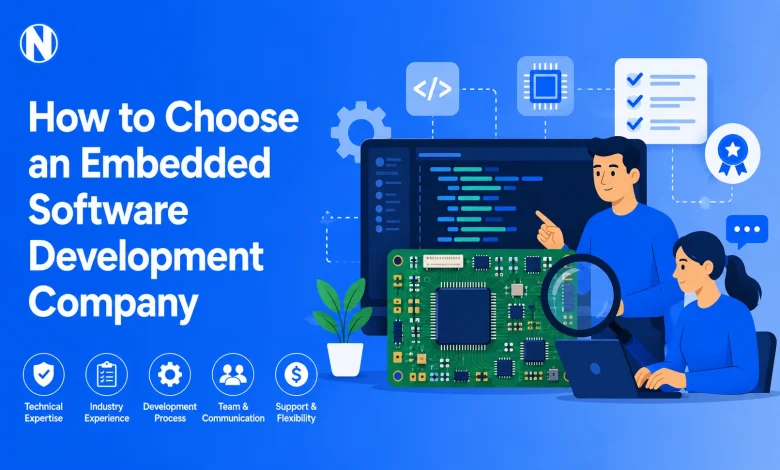
This article will help you select a reliable partner. To achieve this goal, agree on the project requirements and weigh the vendor’s relevant experience, then verify their full-stack capability, ask about the processes, and after that, you want to assess communication, compare pricing, IP terms, and support.
Investing in this evaluation from the very beginning protects both your product and your budget. Additionally, you will be able to take advantage of potential long-lasting partnerships.