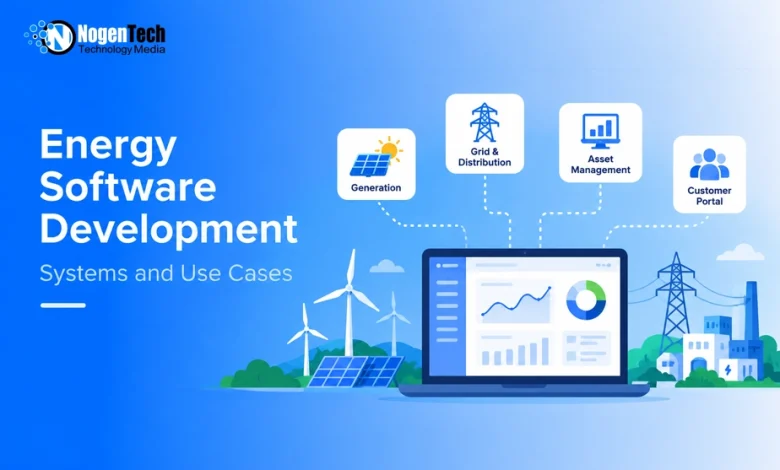
Energy software development connects physical assets, operational data, field teams, customers, and business systems. Utilities, renewable energy operators, grid companies, and energy service providers use these applications to monitor infrastructure, manage consumption, coordinate maintenance, and make faster operational decisions.
Standard platforms can handle routine business functions, but energy operations often involve distributed assets, long equipment lifecycles, regional regulations, and specialized operational technology.
When outdated business software begins restricting operations, companies may need targeted modernization, system integration, or custom development rather than another standalone application.
Why Energy Operations Need Specialized Software
Energy companies manage a combination of physical infrastructure and digital information. Data may come from meters, sensors, SCADA environments, ERP platforms, geographic information systems, customer portals, and field applications.
These systems must work together despite several operational challenges:
- Assets spread across large service areas
- Equipment expected to operate for decades
- Field locations with limited connectivity
- Different reporting requirements across regions
- High costs associated with downtime
- Strict security and access controls
- Data arriving in different formats and at different intervals
Generic software may support individual tasks but fall short when it must reflect energy-specific assets, operating rules, and data relationships.
A company considering custom software development for energy industry should therefore begin with a defined operational problem, such as disconnected asset records, slow field reporting, limited consumption visibility, or unreliable system integration.
Core Energy Software Systems
The required software depends on whether a company works in generation, transmission, distribution, retail, renewable energy, or related services. However, several system types address needs shared across the sector.
Energy Management Platforms
Energy management software collects and organizes consumption, production, demand, and cost data. Commercial users may rely on it to control energy expenses across several facilities, while providers can use similar information for forecasting and customer services.
Typical capabilities include:
- Current and historical consumption dashboards
- Usage comparisons by location or period
- Alerts for unusual demand or consumption
- Demand and generation forecasting
- Meter and IoT sensor integration
- Energy-efficiency reporting
- Role-based access to operational and financial information
The quality of the underlying data matters more than the appearance of the dashboard. Missing readings, duplicate records, or incorrect asset mappings can produce misleading results. Validation rules and exception handling should therefore be included in the platform design.
Asset Management and Maintenance
Turbines, transformers, substations, pipelines, batteries, solar equipment, and charging stations require structured maintenance throughout their operating lives. Asset management software gives engineering and field teams a consistent record of equipment condition, location, work history, and service requirements.
The system may support:
- Asset registers and location records
- Condition and performance monitoring
- Inspection schedules
- Work-order management
- Technician assignments
- Maintenance histories
- Spare-parts planning
- Mobile field workflows
- ERP and enterprise asset management integration
Predictive functions can analyze sensor readings and historical records for changes associated with equipment faults. These findings should support engineering decisions rather than replace them.
NogenTech’s guide to predictive maintenance software explains how condition data can help teams schedule work before a failure disrupts operations.
Customer Portals and Mobile Applications
Customers increasingly expect direct access to their usage, bills, service requests, and outage information. A well-integrated portal can reduce routine support work while making account information easier to understand.
Depending on the provider, it may include:
- Current and historical usage
- Billing and payment records
- Outage notifications
- Tariff or plan information
- Meter-reading submission
- High-usage alerts
- Service requests
- Solar generation or battery status
- EV charging activity
- Secure support messaging
The portal should use the same customer, meter, and billing records available to internal teams. If customers and support agents see conflicting information, the application creates additional inquiries instead of resolving them.
Grid Monitoring and Operational Intelligence
Renewable generation, energy storage, smart meters, EV charging, and distributed energy resources have made grid activity more dynamic. Operators need a reliable view of current conditions and a clear way to distinguish urgent events from routine changes.
Operational intelligence software may provide:
- Grid and asset status visualization
- Incident detection and prioritization
- Demand and load forecasting
- Outage-management support
- Geospatial asset mapping
- Meter and sensor integration
- Role-specific dashboards
- Operational reporting
Dispatchers, engineers, managers, and field teams require different views of the same environment. Interfaces should present information relevant to each role while retaining shared asset identifiers, timestamps, and event records.
The software should also show when data is delayed, incomplete, or unavailable. An old reading presented as current can be more harmful than an explicit data warning.
Integration and Data Management
Energy companies often already have separate platforms for assets, customers, billing, mapping, metering, maintenance, and finance. In these cases, the main challenge is not building another database but enabling existing systems to exchange information reliably.
An integration layer can connect applications through APIs, event streams, or controlled data pipelines. It can also standardize identifiers so that the same customer, meter, location, and asset can be recognized across different platforms.
Before development begins, the project team should establish:
- Which system owns each type of record
- Which applications can modify that information
- How frequently data must be updated
- How conflicting records will be resolved
- How failed transfers will be detected and retried
- How changes will be logged
- How long operational and customer records must be retained
These decisions prevent the new application from becoming another isolated system.
Architecture Decisions That Shape the System
Energy applications may operate in environments where network interruptions, equipment changes, and delayed data are normal. Architecture should reflect those conditions from the beginning.
Real-Time Versus Scheduled Processing
Critical alarms and grid events may require immediate handling, while billing summaries and monthly reports can use scheduled processing. Classifying each workflow prevents the expense and complexity of treating every data point as real-time.
Interoperability
New applications may need to communicate with SCADA environments, legacy databases, ERP systems, geographic information systems, meter platforms, and third-party services. Supported protocols, data formats, update frequency, and error behavior should be documented before the architecture is selected.
Offline Field Access
Technicians may work where mobile connectivity is unreliable. Field applications should provide controlled offline access to assigned records, store updates securely, and synchronize changes without creating duplicate work orders or conflicting asset data.
Availability and Recovery
Not every function requires the same level of availability. Teams should define acceptable downtime, recovery time, and data-loss limits according to operational impact. A public information dashboard and a system supporting critical infrastructure should not automatically receive identical recovery designs.
Modernizing Legacy Energy Systems
Many energy companies depend on older applications that contain essential business rules but are difficult to integrate or maintain. Replacing them all at once can disrupt operations and remove functions that were never properly documented.
Modernization can follow several routes:
| Approach | Best Fit |
| Rehosting | The application works but needs newer infrastructure |
| Replatforming | Core functions remain useful, but the platform needs improvement |
| Refactoring | Specific components are difficult to maintain or scale |
| API enablement | Legacy functions need to connect with modern applications |
| Modular replacement | Individual capabilities can be replaced gradually |
| Rebuilding | The existing system can no longer meet essential requirements |
The choice should account for system condition, operational risk, dependencies, internal expertise, and long-term maintenance costs. Organizations assessing outside support can compare the capabilities commonly offered by application modernization service providers.
Before modifying a legacy application, teams should document its integrations, business rules, data dependencies, and exception handling. Important operational knowledge may exist only in the code or in the experience of employees who use it daily.
Security Must Cover IT and Operational Technology
Energy applications may handle customer information, financial records, equipment data, and operational commands. Their security requirements can extend beyond those of standard corporate applications.
The NIST Guide to Operational Technology Security recommends addressing OT security while accounting for its performance, reliability, and safety requirements. Controls should match the purpose and risk level of each system.
Relevant measures include:
- Identity and access management
- Multi-factor authentication
- Separation of administrative privileges
- Secure API authentication
- Encryption in transit and at rest
- Network segmentation where appropriate
- Monitoring and alerting
- Controlled software updates
- Backup and recovery procedures
- Security testing before deployment
- Logging of administrative and operational changes
- Defined incident-response responsibilities
Security decisions should be made during architecture planning. Adding them near launch may require changes to data flows, infrastructure, user permissions, and integration methods.
How to Choose the Right Development Approach
Not every energy workflow requires custom software. A packaged platform may be sufficient when requirements are standardized and the product integrates cleanly with existing systems.
Custom development becomes more relevant when the process is operationally distinct, existing applications cannot exchange data reliably, or extensive workarounds are required.
A practical evaluation should answer these questions:
- Which operational problem must the software solve?
- Who will use it, and under what working conditions?
- Which systems and data sources must it connect with?
- Which functions require real-time information?
- What happens if the application or connection becomes unavailable?
- Which security and regulatory requirements apply?
- Can a packaged product meet the requirements without excessive customization?
- How will the company measure whether the project has improved operations?
The selected approach may combine packaged software, custom components, APIs, and gradual legacy modernization. Testing should use realistic data, devices, integrations, and failure scenarios before deployment expands to critical workflows.