How to Build a Lifecycle Marketing Strategy That Retains Customers

A lifecycle marketing strategy helps businesses communicate with customers based on where they are in their relationship with the brand. Instead of sending the same campaigns to everyone, it uses actions such as sign-ups, purchases, product usage, and inactivity to determine what each customer needs next.
The goal is to improve retention by helping customers complete meaningful steps, from finishing onboarding to making another purchase or renewing a subscription. Building this strategy requires a clear customer journey, reliable data, behavior-based segments, and automated messages tied to measurable outcomes.
What Is Lifecycle Marketing?
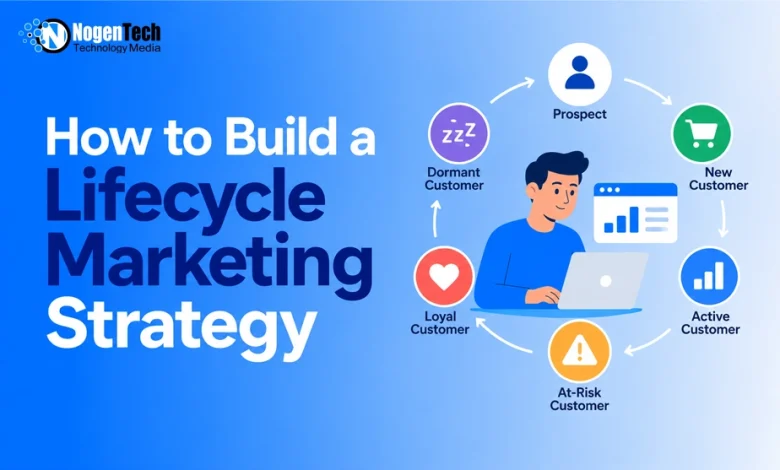
Lifecycle marketing is the practice of adapting marketing communication as a person moves from prospect to new customer, active customer, at-risk customer, and loyal advocate.
For example, a new SaaS user may need help completing setup, while a regular user approaching renewal may need an account summary or plan comparison. Similarly, a first-time ecommerce buyer may benefit from product guidance before receiving recommendations for another purchase.
The following stages provide a practical starting point:
| Lifecycle stage | Customer situation | Desired action |
| Prospect | Exploring the business or its products | Sign up, request information, or start a trial |
| New customer | Recently purchased or subscribed | Complete onboarding or use the product |
| Active customer | Regularly buying or using the service | Continue engaging and discover more value |
| At-risk customer | Showing declining activity | Resolve friction and return |
| Loyal customer | Consistently purchasing or engaging | Renew, upgrade, or refer others |
| Dormant customer | No meaningful recent activity | Re-engage or update preferences |
These stages should reflect observable customer behavior. A person should enter or leave a stage because of a defined action, not because a marketing team assumes what they need.
1. Map the Customer Lifecycle
Start by documenting the important stages customers move through before and after purchasing. Each stage should include the customer’s situation, the action you want them to take, and any obstacle that may prevent that action.
A SaaS lifecycle could follow this path:
Trial started → Account configured → Key feature used → Subscription purchased → Subscription renewed
An ecommerce journey may look different:
First purchase → Order delivered → Product used → Second purchase → Regular customer
Do not make the map unnecessarily complicated. Focus on the stages that directly influence activation, retention, repeat purchases, or renewals.
The lifecycle map should also identify where customers commonly disengage. If many trial users leave before configuring their accounts, onboarding is a more urgent priority than building a loyalty campaign for a much smaller group of active users.
2. Identify Meaningful Customer Signals
Customer signals are actions or changes that help determine when communication may be useful. They turn the lifecycle map into something a business can act on.
Common signals include:
- Creating an account
- Starting but not completing onboarding
- Making a first purchase
- Abandoning a shopping cart
- Viewing the same product repeatedly
- Using an important product feature
- Reaching an account or usage limit
- Contacting customer support
- Approaching a subscription renewal
- Showing a sustained decline in activity
Not every recorded event needs a message. A signal should only trigger communication when the message can help the customer make a decision, complete a task, or resolve a problem.
For example, a login does not usually require an email. However, a new customer who repeatedly logs in without completing an essential setup step may benefit from specific guidance.
3. Connect Reliable Customer Data
Lifecycle marketing usually depends on information stored across websites, ecommerce platforms, mobile apps, customer support systems, and marketing platforms.
A CRM system can centralize contact details, purchase records, communication history, and other customer information. However, teams should verify that the data is accurate before using it for segmentation or automation.
Useful customer data may include:
- Account or subscription status
- Purchase history
- Product activity
- Engagement history
- Support interactions
- Communication preferences
- Date of the last meaningful action
Businesses should only collect data that serves a defined purpose. Unnecessary information makes customer profiles harder to manage and increases privacy and security responsibilities.
Companies without the strategy or technical resources to connect these systems may work with a lifecycle marketing agency to map customer stages, organize data, and implement behavior-based journeys.
Whether the work is managed internally or externally, every data point used in a journey should be current, relevant, and connected to the correct customer.
4. Build Behavior-Based Segments
Demographic segments describe who customers are, while behavioral segments show what they are doing. Lifecycle marketing generally relies more heavily on behavior because it provides a clearer indication of what a customer may need next.
Useful segments may include:
- New customers who have not completed onboarding
- First-time buyers who have not returned
- Active users who have not adopted a key feature
- Customers who purchase at predictable intervals
- Subscribers approaching renewal
- High-value customers with declining activity
- Customers with unresolved support issues
- Previously active customers who have become dormant
A person may qualify for multiple segments, so priority rules are important. Someone with an unresolved complaint should not receive an upgrade promotion simply because they also meet the purchasing criteria.
Personalization should then reflect the segment’s context. It may use previous purchases, product activity, account type, or lifecycle stage to provide a relevant next step. Adding a customer’s name without changing the substance of a message offers little practical value.
5. Create Triggered Customer Journeys
A triggered journey begins when a customer completes an action or meets a defined condition. It should guide the customer toward one outcome rather than placing them into a long sequence of unrelated messages.
A simple onboarding journey could follow this structure:
- A customer creates an account.
- The system checks whether the required setup is complete.
- Customers who complete it receive guidance on the next useful feature.
- Customers who do not complete it receive targeted setup assistance.
- Continued inactivity triggers a support option.
- The journey ends when setup is completed or the customer becomes ineligible.
This approach responds to customer behavior instead of sending everyone the same scheduled sequence.
Businesses can use marketing automation tools to manage triggers, delays, branches, and eligibility rules. Each journey should also include clear exit conditions.
For example, cart reminders should stop after a purchase, onboarding emails should stop when setup is complete, and promotional communication should be suppressed when a customer has an unresolved service issue.
The channel should match the message. Email works well for education and onboarding, while an in-app message may be more useful when a customer is actively using a product. SMS and push notifications should be reserved for timely communication where the customer has provided the required permission.
6. Protect Customer Data and Preferences
Lifecycle marketing can involve detailed behavioral information, so customer privacy must be part of the strategy rather than an afterthought.
Practical safeguards include:
- Obtaining appropriate permission before sending marketing messages
- Honoring unsubscribe and opt-out requests
- Restricting access to customer information
- Keeping communication preferences synchronized across platforms
- Defining how long customer data will be retained
- Reviewing third-party platforms that process customer information
- Avoiding sensitive data that is not necessary for the journey
The US Federal Trade Commission provides privacy and data security guidance for businesses. Specific requirements can vary by location, industry, communication channel, and the type of customer information being processed.
Personalization should make communication more helpful without using information in a way customers would not reasonably expect.
7. Measure Retention Outcomes
Email opens and clicks can show whether people interacted with a message, but they do not prove that a lifecycle journey improved customer retention.
Each journey needs a primary business metric:
| Journey | Primary outcome |
| New-customer onboarding | Setup or activation rate |
| First-purchase follow-up | Second purchase rate |
| Product education | Feature adoption rate |
| Renewal communication | Subscription renewal rate |
| At-risk intervention | Customer retention or churn rate |
| Win-back journey | Reactivation rate |
| Loyalty journey | Repeat purchases or customer lifetime value |
Supporting metrics can help identify where a journey is failing. If customers click an onboarding email but still do not complete the setup, the problem may be inside the product rather than in the marketing message.
Teams should test one meaningful variable at a time, such as trigger timing, audience criteria, message frequency, channel, or call to action. Results should be judged by the journey’s intended customer outcome instead of whichever variation produces the most clicks.
Final Thoughts
A lifecycle marketing strategy connects customer behavior with the next useful action. It does not require automating every interaction or contacting customers across every available channel.
Start with one important retention problem, define the signals connected to it, and create a focused journey with clear entry and exit conditions. Measure whether customers complete the intended action, then improve the journey using those results.
When customer data, timing, and communication work together, lifecycle marketing becomes more than a series of campaigns. It provides a structured way to help customers receive continued value from the business and gives them stronger reasons to stay.