What Is Programmatic Advertising? Benefits, Challenges & Strategy

Programmatic advertising promises smarter media buying, but for many businesses, it feels more confusing than efficient.
Marketing teams face a critical dilemma: the proven power of programmatic advertising is locked behind a wall of technical and operational complexity.
This barrier manifests as opaque platforms, unintegrated data, and a steep expertise curve that consumes time and budget. Traditional approaches struggle to bridge such a gap effectively.
In this guide, moving forward, I will translate technical complexity into a clear, actionable strategy for business leaders. A proven, phased framework makes the channel manageable and effective.
You will learn to directly connect programmatic investment to business results, navigate common pitfalls, and select definitive success metrics.
What Is Programmatic Advertising for Business Leaders?
Programmatic advertising is efficient enough for business leaders as it uses AI-driven marketing algorithms to automate real-time media buying, optimizing budget allocation and data-driven targeting to maximize commercial ROI.
Modern marketing achieves new efficiency through intelligent, automated media buying. Manual processes are replaced with data-driven transactions. Businesses purchase precise audience attention instead of vague ad space. Sophisticated algorithms execute decisions in real-time.
Let’s examine this system’s core principles, key differences from traditional advertising, and commercial relevance.
What Programmatic Advertising Really Is
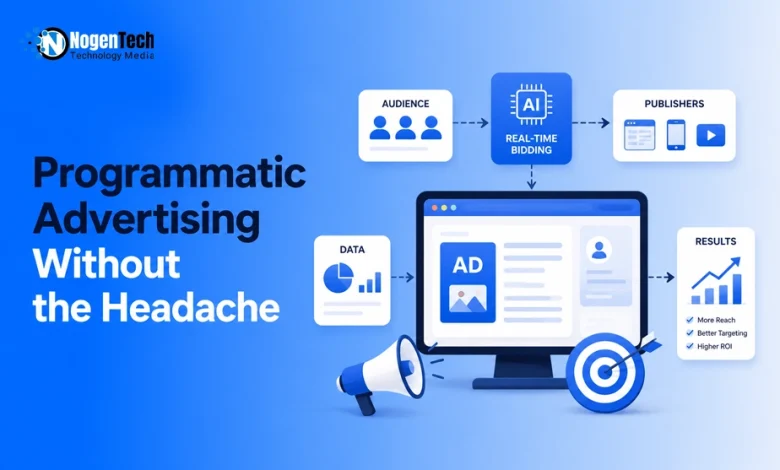
Programmatic advertising is a real-time digital auction using AI algorithms to automate media buying and target precise audience attention across platforms.
A real-time digital auction for audience attention powers modern media transactions. Advanced software evaluates each available ad impression against specific campaign goals, such as target customer parameters and budget limits.
Eligible participants compete in an instantaneous bidding process. The highest qualifying bid wins the right to serve a creative unit to a particular user.
This entire sequence concludes in milliseconds, removing manual negotiation from the advertising workflow. The system operates across a vast network of websites, applications, and streaming platforms.
Programmatic advertising platforms manage the complex transactions at scale, linking campaign objectives directly to available publisher inventory without human latency.
Programmatic Ads vs Traditional Ads
The core distinction between these methods lies in the fundamental unit of purchase. Traditional media buying secures placement a specific ad slot on a chosen website or broadcast for a fixed duration.
Value is intrinsically tied to the publisher’s property and its aggregate audience.
Programmatic advertising solutions focus on acquiring customer attention, evaluating each impression for relevance to a specific person in real-time.
Value derives from individual user signals and contextual alignment. This evolution, powered by AI, enables granular targeting and individual-level optimization that static buys cannot achieve.
Why It Matters for Your Business
Adopting programmatic advertising matters for your business as it elevates marketing from manual execution to an automated, intelligence-driven strategy.
Machine learning analyzes campaign data to optimize performance continuously. Here’s how this translates into direct commercial advantages:
- Higher ROI
Efficient algorithmic bidding prevents overpayment for irrelevant or low-value impressions. Every advertising dollar is evaluated and spent based on predicted performance. Marketing budgets consequently achieve greater impact and demonstrate clearer financial returns.
- Precise audience targeting
Campaigns move beyond basic demographics like age or location. Targeting leverages real-time behavioral signals and purchase intent data. This highlights the growing importance of personalization and hyper-targeting in digital advertising, allowing messages to reach individuals actively interested in products or services.
Messages reach individuals actively interested in products or services, dramatically increasing engagement potential.
- Cost-effective scaling
Automation manages the immense complexity of buying across countless websites and apps. What would require a large team to be manual becomes a streamlined, software-driven process. Businesses can expand reach and frequency without a proportional increase in overhead or manual effort.
- Data-driven insights.
Each campaign interaction generates valuable performance data. This information creates a closed-loop feedback system for continuous optimization. Marketing strategy becomes progressively more intelligent and effective over time.
Together, these components form a cohesive, self-improving engine. A systematic framework turns programmatic expenditure into a reliable, measurable driver of business growth with clear accountability for results.
What Programmatic Challenges Do Marketers Face?
Marketers face platform fragmentation, a “black box” lack of bidding transparency, alignment gaps with business strategy, and acute data science expertise constraints.
Many marketing teams experience significant friction when implementing programmatic campaigns. The operational drag typically originates from a few core areas of disconnect within the advertising ecosystem.
These specific obstacles frequently determine whether programmatic becomes a strategic asset or a source of wasted budget. Let’s define the primary challenges that separate potential from actual performance.
Complex Platforms and Data Streams
Marketers frequently face a confusing array of demand-side platforms, data management platforms, and analytics suites. Each system operates with a unique interface, metric definitions, and taxonomy for information.
This fragmentation creates significant inefficiency, forcing teams to spend excessive time logging into different systems and manually reconciling conflicting reports.
The problem intensifies with integration. First-party information from customer systems, third-party audience details, and real-time campaign analytics often reside in separate silos.
Without a unified view, programmatic advertising services can become disconnected from broader marketing activities. This lack of cohesion prevents a holistic understanding of the customer journey and obscures true campaign impact.
Lack of Transparency in Bidding and Reporting
A pervasive “black box” sensation undermines many programmatic initiatives. Advertisers can struggle to trace exactly where ads appear, how auction prices are set, or what fees intermediaries collect.
Such opacity breeds distrust and complicates efforts to validate return on investment or ensure brand safety.
Standard reporting often worsens this issue. Metrics like “impressions” or “clicks” can become misleading vanity indicators if disconnected from business outcomes.
The absence of clear, actionable analytics — explaining why a campaign performed a certain way — leaves marketers optimizing based on intuition rather than intelligence.
This directly contradicts the promise of AI-driven digital marketing: data-based decision-making.
Aligning Programmatic with Strategy
A critical failure point is treating programmatic as a standalone tactic instead of an integrated component of the overall marketing strategy.
Launching campaigns without clear alignment to objectives like lead generation, brand lift, or customer retention generates activity without measurable impact.
To counter this, staying ahead of broader digital advertising trends ensures your automated campaigns remain interconnected with overall marketing shifts.
This misalignment appears as initiatives that deliver efficient clicks yet lack customer conversions. Campaigns may reach a broad audience.
Such activities often fail to shift brand perception. Effective programmatic advertising solutions must be governed by strategic goals from the beginning, ensuring every automated decision serves a larger business purpose.
Resource and Expertise Constraints
Mastering programmatic requires a blend of data science, trading strategy, and creative optimization. Most in-house marketing teams lack dedicated specialists. They need experts to configure platforms, manage complex information pipelines, and interpret real-time analytics.
A do-it-yourself approach creates expensive learning curves. Such practice leads to suboptimal platform use and missed optimization windows. Building and maintaining essential expertise incurs high internal cost.
That investment can quickly surpass perceived savings from avoiding a specialist programmatic ad agency.
How Can Businesses Achieve Step-by-Step Programmatic Success?
A five-stage systematic framework turns programmatic expenditure into a predictable growth function by establishing clear business goals and integrating data.
This systematic progress establishes programmatic advertising as a repeatable growth function and prioritizes strategic clarity and foundational planning over immediate tactical execution.
Adopting a proven framework allows businesses to bypass common pitfalls and maintain control as capabilities scale. The following five stages outline this systematic path to predictable results.
Step 1. Set Clear Business Goals
Every successful programmatic campaign starts with a definition of success tied directly to business outcomes. Before discussing audiences or creatives, leaders must answer: What should this investment achieve? Vague goals like “increase awareness” lead to vague and unaccountable results.
Specific, measurable key performance indicators (KPIs) should be established. Targets could include lowering cost per acquisition by a defined percentage or achieving a specific return on ad spend.
This step is especially vital when deploying tailored e-commerce strategies for small retailers looking to scale online sales efficiently. These goalposts ensure programmatic advertising efforts are evaluated on commercial impact.
Step 2. Integrate Your Data
Campaign intelligence depends entirely on the quality and connectivity of underlying data. This step involves unifying first-party information, customer lists, website analytics, and CRM segments into a single, actionable view.
Such a rich dataset becomes the foundation for audience modeling and targeting strategies.
Effective integration enables advanced tactics. “Lookalike” audience models identify new prospects mirroring the profiles of the best existing customers.
Ads can be suppressed for recent purchasers, and messaging can be tailored using past interaction data. This builds the cohesive, relevant customer experience promised by AI and digital marketing.
Step 3. Choose the Right Platform & Partners
Programmatic advertising platforms differ significantly in capability and focus. Selection must consider specific goals, required transparency, data integration needs, and access to quality inventory.
Evaluate whether a platform’s strengths align with requirements around brand safety, availability of premium video supply, or sophisticated optimization tools.
For instance, if your strategy heavily incorporates social channels, mastering components like Facebook video ads can dramatically enhance your multi-channel programmatic approach.
For businesses without deep in-house expertise, partnering with a specialist is the fastest route to value. A skilled programmatic advertising agency provides guidance, handles technical complexity, and offers market intelligence that platforms alone cannot supply.
This partnership functions as an extension of the marketing team, ensuring investment receives strategic management.
Step 4. Launch Smart, Test Often
Initial campaign launches should operate as structured learning experiments, avoiding scaled deployments. Begin with controlled budgets and multiple ad creative variations.
Test different audience segments, messaging angles, and bidding strategies to gather performance data rapidly. The goal of this phase is foundational learning.
The test-and-learn approach is powered by the core principles of AI digital marketing. Machine learning algorithms require data to optimize.
Launching multiple controlled variables feeds the system the information it needs to identify winning combinations. A disciplined start prevents significant waste and builds knowledge for future scaling.
Step 5. Monitor, Learn & Optimize
Programmatic excellence operates as a cycle of continuous refinement. Dedicate time to reviewing performance analytics beyond surface-level metrics. Analyze attribution paths, audience engagement rates, and creative fatigue.
Determine why certain segments outperformed others and how bidding strategies impacted cost efficiency.
Optimization is the ongoing application of these learnings. Reallocate budget from underperforming segments to high-converting audiences. Refresh the ad creative showing fatigue signs.
Adjust bidding rules based on time-of-day or day-of-week performance patterns. This continuous process is where the true benefits of AI in digital marketing are realized, as systems autonomously implement micro-optimizations.
Why Businesses Gain More with Expert Guidance than DIY
Outsourcing programmatic advertising to an expert agency accelerates launch velocity, optimizes data integration, and eliminates steep in-house learning curve costs.
The programmatic ecosystem’s complexity means strategic partnerships typically deliver superior returns compared to a purely in-house approach.
While do-it-yourself may seem cost-effective, hidden expenses from learning curves, suboptimal spending, and missed opportunities often outweigh specialist fees. Expertise accelerates value realization.
An expert partner brings established processes, proven technology relationships, and deep market knowledge from the first day. This external perspective helps avoid common traps and aligns programmatic investment with industry best practices and innovative tactics.
Accelerated time to launch is a primary advantage. Agencies use pre-configured workflows and platform expertise, moving campaigns from strategy to execution in weeks.
Alignment with marketing goals is enforced by experienced consultants. These experts translate business objectives into effective platform configurations.
Agencies also provide more efficient tech and data integration. They navigate the complexities of connecting information stacks with multiple ad platforms, ensuring clean data flows and unified reporting. Such a holistic approach is the hallmark of true end-to-end programmatic consultancy.
Which Key Metrics Measure Programmatic Success?
Track impressions, viewability, CPA, and ROAS to evaluate data-driven targeting efficiency, optimize AEO, and maximize commercial campaign performance.
Moving beyond vanity metrics to focus on business-centric indicators is essential for proving programmatic’s value. The correct metrics connect advertising spend directly to commercial outcomes and inform optimization.
Here’s a breakdown of four critical performance indicators:
- Impressions and viewability
The metric confirms basic campaign delivery and scale. It measures how often an ad is served and whether it appeared in a viewable space. High viewability rates are a prerequisite for engagement. Resulting figures establish a baseline for campaign reach.
- Cost per acquisition (CPA)
This indicator measures the direct efficiency of spending in driving a valuable action. It calculates the average expense required to generate a lead, sign-up, or sale. A lowering trend signals improving campaign efficiency. CPA provides a clear link between expenditure and conversion.
- Return on ad spend (ROAS)
This is the ultimate financial metric for advertising effectiveness. The indicator measures the revenue generated for every currency unit invested in media. A ratio greater than 1.0 shows profitable campaign activity. ROAS directly ties marketing performance to business revenue.
- Conversion rates and audience lift
A rate analysis shows the percentage of users who complete a desired action after engagement. Lift studies measure the incremental impact of advertising on brand metrics or sales intent. The pair evaluates both immediate performance and long-term brand building. Together, the elements reveal the full-funnel effectiveness of programmatic strategies.
These metrics collectively form a dashboard for accountable growth. Marketing reporting consequently transforms from an activity log into a strategic tool for commercial decision-making.
What You Should Be Aware of Programmatic Advertising
Does programmatic advertising work?
Yes. When backed by quality data and optimization, programmatic advertising improves targeting, reduces wasted spend, and increases ROI.
What is programmatic display advertising?
Programmatic display advertising automates the buying of banner and display ads across websites and apps using real-time bidding.
What is programmatic video advertising?
Programmatic video advertising automates buying video ads across websites, apps, streaming platforms, and connected TV.
What is programmatic job advertising?
Programmatic job advertising automatically distributes job ads and optimizes budgets to attract qualified candidates more efficiently.
How much does programmatic advertising cost?
Costs vary by audience, competition, and ad format. Most campaigns use CPM pricing, with budgets ranging from hundreds to thousands.
When did programmatic advertising start?
Programmatic advertising emerged in the late 2000s with real-time bidding and has since become the standard for digital media buying.
What are examples of programmatic advertising?
Examples include display banners, video ads, native ads, connected TV ads, digital audio ads, and in-app mobile advertising.
How can you learn programmatic advertising?
Learn programmatic advertising through digital marketing fundamentals, DSPs, RTB, audience targeting, and hands-on campaign experience.
Master Programmatic Without the Headache
Adopting programmatic signifies marketing’s evolution from a creative-operational function to a core system for generating intelligence and driving growth.
True success hinges on integrating the technology into the company’s strategic planning cycle, moving beyond mere platform selection.
This shift demands a reevaluation of internal processes, performance metrics, and partnerships. The ultimate outcome is the construction of a durable competitive advantage.
Such an advantage delivers the capacity to anticipate market demands and allocate resources with unprecedented precision.