Deepmind’s Genie 4 Doubles Your World to Two Minutes, Specs Unpublished
Google’s new world model adds native audio and stretches sessions to about two minutes, but it is testers-only for now, with no price, resolution or frame rate published.

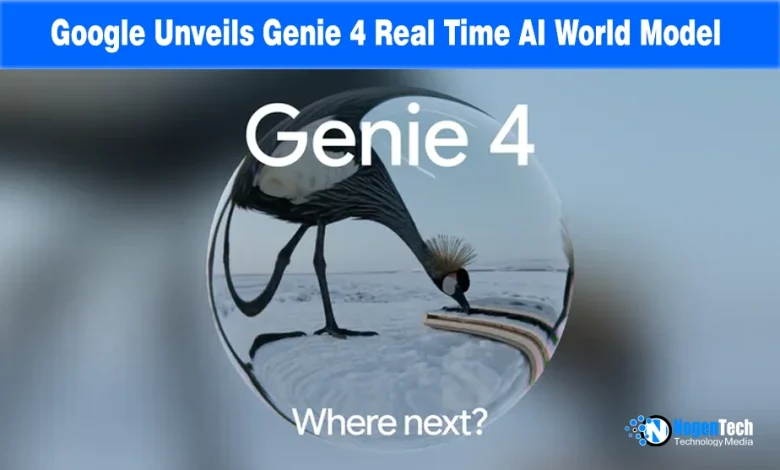
Google DeepMind announced Genie 4 on Tuesday, October 27, 2026, a world model that lets people control a simulated scene in real time with plain language commands while generating matching sound.
It runs on the Gemini family, with Gemini Omni handling appearance and other Gemini models keeping the simulation coherent.
Google says such simulation can train robots and agents and speed up creative work in film, journalism and gaming. For now only trusted testers can use it, so the practical question is what everyone else will get.
How Genie 4 Lets Users Steer a World in Real Time
Google describes a loop in which you set an event in motion, then redirect it as it unfolds.
You can move the camera, change the weather or introduce new characters by typing. Every world also produces ambient sound, music and interactive dialogue as it renders, which Google pitches as “unprecedented realism and native audio.”
Quartz reports that Gemini 3.8 Flash acts as a guiding agent, watching the scene and tracking progress while Genie draws each frame.
DeepMind research director Tejas Kulkarni told TechCrunch that the future lies in “hybrid world models,” where Gemini writes code and text and Genie turns it into simulated reality at different levels of abstraction.
The pairing explains why Google credits Gemini, not Genie alone, for keeping worlds coherent.
Who Can Use Genie 4 Today and Who Gets It Next
Access is a ladder. Trusted testers have it now. TechCrunch reports that Ultra subscribers in Project Genie follow in the coming weeks, with a waitlist already open, and a Gemini API and AI Studio early-access program for chosen partners.
Project Genie itself has a track record as an interactive AI video tool for real-time environment generation. It opened on January 29 to US Ultra subscribers aged 18 and over, when Ars Technica put the plan at $250 a month, and has since reached Ultra users worldwide.
Under Genie 3 it ran at roughly 720p and 24 frames per second, per Ars.
Google’s Genie 4 post states none of those figures, so “most realistic” remains unmeasured.
Why Genie 4’s Longer Sessions Raise More Questions Than They Answer
Genie 4 experiences last about two minutes against one minute for Genie 3, The Verge reports.
That extra minute is where Google seems least confident. TechCrunch reports that DeepMind admits objects can fade or drift over longer runs of AI video generation, while clean audio and readable in-world text are still unsolved problems.
Running costs are another mystery. DeepMind previously noted that doubling the one-minute limit dramatically increases expensive computing demands without offering much extra testing value.
Google has not said what a two-minute Genie 4 session costs to serve, or how that feeds into Ultra pricing.
Until the waitlist opens, the only evidence is Google’s own demos, and claims such as the first real-time world model with native audio are DeepMind’s own.