Altman’s Samsung Roundtable Was About AI Training, Not the RAM Remark Drawing Fire
Reports describe a Saturday roundtable on AI and executive decision-making, while Altman's DRAM comments came from a separate interview and argue that scarce memory belongs in data centers.

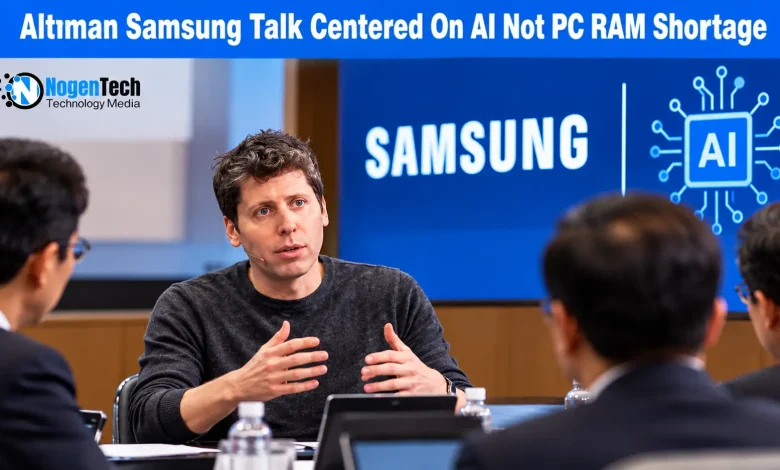
OpenAI chief executive Sam Altman met about 50 Samsung Group affiliate presidents this Saturday at the group’s training center in Yongin, Gyeonggi Province, for a roundtable on how Artificial Intelligence will change corporate decision-making.
The presidents first took hands-on generative AI training, part of a push Samsung began in June.
The visit landed as Altman’s separate comments about DRAM in home computers circulated widely, which invites the assumption that the two were connected.
Samsung Gathered Presidents From Electronics, Finance and Biotech for Altman’s Roundtable
The session looked at where AI development is heading, what new business it opens up and how it changes decisions and organisations.
Beforehand, the presidents learned to turn scattered business data into knowledge repositories that feed management decisions, as The Korean Herald reports.
Samsung says about 2,300 executives have been trained since June and that it aims to finish training all employees by February 2027, per the report.
Reports also note that a planned June trip by Altman was postponed for personal reasons and that OpenAI research chief Mark Chen went in his place.
No new agreements came out of Saturday’s meeting, and Samsung’s only on-record statement was that it hosted the event.
Altman’s Cheeky Pint Remark Argued Scarce DRAM Belongs in Data Centers
The RAM comments come from an interview on the Cheeky Pint channel, reported by Tom’s Hardware, which does not give the interview date.
Altman did not say PCs should have no RAM. Instead, his argument centered on global allocation.
He estimated that personal DRAM sits idle most of the time, with only about 5% being actively used. In a supply-constrained market where the cloud demands maximum utilization, he described holding onto idle local memory as “quite terrible.”
The outlet notes that the case assumes data center buildouts keep going and that OpenAI’s main business runs in data centers.
Experts read the target as enthusiasts running local AI models, not gamers in particular, and say AI data centers are absorbing much of the available memory.
Samsung Is OpenAI’s Memory Supplier and Also Its Enterprise Customer
The two stories meet in Samsung’s dual role. In October 2025, Samsung Electronics signed a letter of intent with OpenAI that includes supplying advanced memory chips for Stargate.
In June 2026, OpenAI said Samsung would roll out ChatGPT Enterprise and Codex to employees in South Korea and its Device eXperience division, which is among OpenAI’s largest enterprise deployments.
Saturday’s session sat on the customer side of that relationship: Altman talking to executives about using AI, not negotiating memory.
Market analysts point out that OpenAI’s parallel custom silicon initiatives and expanding hardware arsenal could eventually challenge Samsung’s long-term share of the Stargate supply chain.
Yet when stripped of industry chatter, what is confirmed is much narrower: a training roundtable, a podcast remark, and a supply letter of intent from a year ago.
Source: Samsung executives meet OpenAI’s Altman to discuss AI strategy