Google Replaces Vertex AI With Gemini Enterprise Platform and Launches TPU 8 Architecture
At Google Cloud Next 2026, Google replaced Vertex AI with Gemini Enterprise Agent Platform, launched TPU 8i and 8t chips, and introduced SPIFFE-based Agent Identity for auditable AI agents.

The chatbot era is formally over at Google. On April 22, 2026, at its Cloud Next conference in Las Vegas, the company announced a complete architectural overhaul of its enterprise AI infrastructure.
It is retiring Vertex AI after years of service and replacing it with the Gemini Enterprise Agent Platform, a unified full-stack system designed for autonomous AI agents that execute complex workflows without constant human prompting.
Reports note that Google is placing AI agents at the center of its enterprise revenue strategy, positioning the platform as mission control for what CEO Sundar Pichai called “the agentic enterprise.”
The ambition is clear: Google is positioning itself as the only company controlling every layer of the stack, from custom silicon running the models to Workspace applications used by three billion enterprise users.
TPU 8i and 8t: Why Google Split Its Chips in Two
The most technically consequential announcement at Cloud Next was a shift in how Google designs its custom silicon.
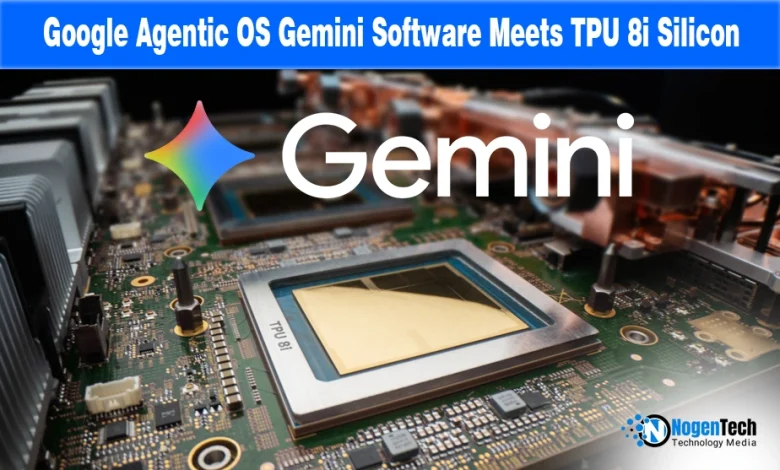
As CNBC confirmed, Google is launching its eighth-generation Tensor Processing Units in two architecturally distinct variants, TPU 8t for training and TPU 8i for inference; the first time the company has split its TPU line by workload type.
The reasoning is direct: training and inference have diverging hardware requirements in an agentic world.
TPU 8t: Training at Scale
TPU 8t is built for massive model development cycles. It uses high compute throughput, shared memory, and interchip bandwidth to scale up to 9,600 TPUs in a single superpod with two petabytes of shared high-bandwidth memory.
It delivers nearly three times the compute performance of the previous Ironwood generation, reducing development timelines of frontier models from months to weeks.
TPU 8i: Inference Optimization
TPU 8i takes a different approach. As CNBC notes, it’s engineered for low-latency reasoning loops that define agentic inference. It features three times more on-chip SRAM to keep larger key value caches on silicon, reducing idle time when compute cores wait for data from memory.
A new Boardfly topology directly connects 1,152 TPUs in a single pod.
The result, per Google’s benchmarks, is an 80% improvement in performance per dollar for inference workloads; the metric that determines the unit economics of running millions of concurrent AI agents at enterprise scale.
Agent Identity: AI Gets Its First Verifiable Digital ID
The most strategically significant launch in the platform is also the least visible to end users.
As the Google Gemini Enterprise Agent Platform documentation confirms, the system introduces Agent Identity.
It assigns every deployed AI agent a unique identity based on the SPIFFE (Secure Production Identity Framework for Everyone) standard, backed by a rotating X.509 certificate that automatically refreshes every 24 hours.
The implication is significant. Until now, AI agents operated with shared service account credentials, meaning multiple agents could act under the same identity, making attribution, audit, and accountability difficult.
The Agent Identity addresses the governance gap that has limited enterprise use in sensitive workflows by making it possible to precisely attribute actions after they occur.
Under the SPIFFE model, every action is cryptographically tied to a unique agent ID, integrated with Google Cloud IAM, and recorded in full audit trails.
Agents acting on behalf of a human user carry both identities through the access chain, the agent’s SPIFFE ID and the delegated user’s credential, making the entire action graph traceable.
A2A Protocol and the Interoperability Layer
The third pillar of the announcement is interoperability; the ability for agents built on different vendor platforms to work together without needing to understand each other’s internal architecture.
As SiliconAngle reported, Google’s Agent to Agent Protocol (A2A) has reached version 1.2 and is now in production at 150 organizations, moving beyond pilot status.
Microsoft, AWS, Salesforce, SAP, and ServiceNow are running A2A in live environments, routing real tasks between cross-platform agents. The protocol is governed by the Linux Foundation’s Agentic AI Foundation, making the vendor-neutral adoption viable.
The practical consequence: a Salesforce Agentforce agent can hand a workflow to a Google Gemini agent, which can pull data from a ServiceNow agent, all without any custom integration work.
Reuters noted that Google is targeting enterprise buyers already running multi vendor AI systems that need agents to operate as a coordinated workforce rather than isolated tools.
Combined with Agent Studio for no code agent building and a central Agent Registry to reduce sprawl, Google makes a clear bet: the company that governs the agents governs enterprise labor itself.
Source: Our eighth generation TPUs: two chips for the agentic era