Fitbit Air Has a Brilliant Hardware, But Google’s AI Coach Is Already Making Up Workouts
Early Fitbit Air reviews are broadly positive on the hardware, but a consistent warning is emerging across every major outlet: Google's Gemini-powered Health Coach is hallucinating workouts that never happened, raising questions about whether AI fitness advice is ready for daily reliance.

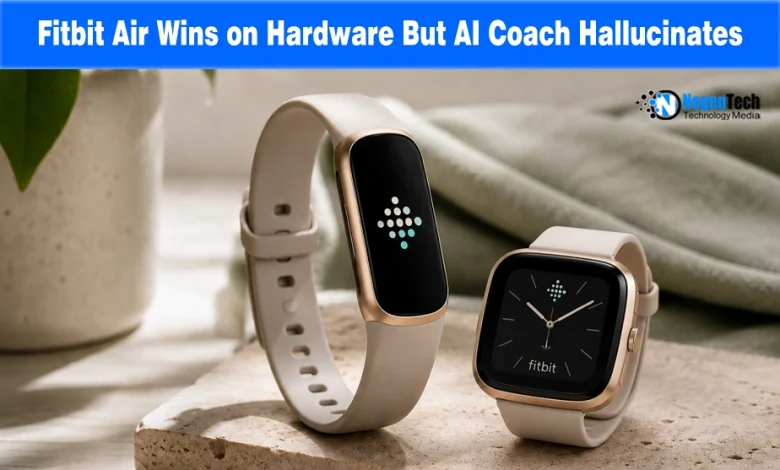
The Fitbit Air has been in reviewers’ hands for two weeks, and the hardware verdict is almost unanimous: Google has built one of the most comfortable, unobtrusive fitness trackers on the market. At 5.2 grams, it disappears on the wrist in a way that most wearables simply do not.
But a consistent warning is emerging across major outlets: Google’s Gemini-powered Health Coach is hallucinating workouts that never happened, raising serious questions about whether AI fitness guidance is ready for daily use.
For anyone comparing options in the fitness trackers category, that is a significant caveat to understand before committing to a $9.99 monthly subscription.
What the Hardware Gets Right
The Fitbit Air feels like Google acknowledging that WHOOP’s minimalist approach was right all along: a wearable focused on data collection, not acting as a miniature wrist computer.
Reviewers at multiple tech outlets has raised the band-swapping mechanism as smoother than WHOOP’s equivalent system, while the pill-shaped design stood out as genuinely distinctive.
Engadget also highlighted the redesigned Google Health app, whose new horizontally swipeable carousel replaces the older feed of metric cards, making health data easier to navigate.
Bloomberg positioned the Air directly against WHOOP 4.0 and Oura Ring 4, noting that Google’s $99.99 pricing, with no mandatory subscription, significantly undercuts both rivals while offering comparable sensor capabilities.
The Fitbit-Garmin comparison also remains relevant: Garmin prioritizes GPS and display functionality, while the Air trades both for a form factor that nearly disappears into daily life.
Where the AI Coach Is Falling Short
According to 9to5Google’s Will Sattelberg, Health Coach correctly referenced his previous night’s sleep data and a recent workout, then fabricated a 5.2-mile run he never took.
When challenged, the AI admitted the invention while suggesting he may have simply forgotten to record the workout.
Android Authority summarized the broader issue directly, accusing Health Coach of delivering “pretty shallow” advice padded with overly verbose responses instead of real analytical depth.
Engadget’s reviewer had a more positive experience, noting that Health Coach accurately flagged a poor readiness score after a high-intensity workout combined with disrupted sleep.
Still, Engadget stressed that the AI layer is so central to the Fitbit Air experience that unreliability there weakens the entire product’s value proposition. For users building a wearable tech setup around health data accuracy, reviewers are treating the difference
The Verdict So Far
The Fitbit Air is a well-executed piece of hardware entering a market that rewards exactly what it
does: silent, accurate, continuous health monitoring without the distraction of a screen.
Reviewers also described it as “a major evolution in what consumers can expect from fitness trackers.”
The AI coach problem is real but likely fixable. Gemini’s underlying models are capable of far stronger contextual accuracy than current Health Coach outputs suggest, and Google has strong commercial incentive to resolve the issue before the $9.99 subscription renewal cycle ramps up.
What these reviews confirm is that the hardware deserves its $99.99 price point. As current fitness gadgets are increasingly defined by their software intelligence, and on that dimension, the Fitbit Air has more work to do.
Source: Google’s Fitbit Air Gives Whoop Some Serious Competition