South Korea Commits $576 Billion to AI and Chips, With Samsung and SK Hynix Leading Megaprojects
South Korea launches a historic $576 billion AI and chip alliance with Samsung and SK Group, uniting public-private power across three massive nationwide megaprojects.

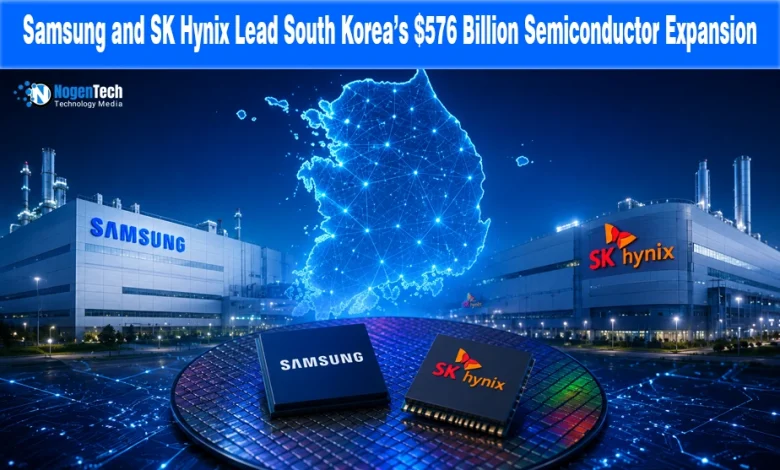
South Korea unveiled a $576 billion chip and AI investment plan on Monday, with President Lee Jae Myung pledging to strengthen the industry’s leadership.
Appearing alongside Samsung Electronics Chairman Lee Jae-yong and SK Group Chairman Chey Tae-won, Lee declared, “Semiconductors, physical AI, and AI data centres are the triple axis for our great leap forward.
” The joint appearance highlighted South Korea’s national AI strategy, building on the AI memory boom that recently made SK Hynix the country’s most valuable company.
Constructing the Southwest National Semiconductor Belt
The first and largest project is an 800 trillion won national semiconductor belt in South Korea’s southwest.
Samsung’s Chair Lee Jae-yong and SK Group’s Chair Chey Tae-won outlined their respective companies’ investment plans, with each committing to build two new fabrication plants in the region alongside supplier investments.
The push also reflects broader AI investment across South Korea, including Nvidia’s recent partnership with LG Group to develop physical AI, humanoid robotics, and liquid-cooled data centers.
The southwest location was a deliberate choice. Lee has consistently pushed to reduce the economic divide between Seoul and the rest of South Korea, and building two of the world’s most important semiconductor hubs outside the capital is one of the clearest examples of that strategy in action.
Building Advanced Packaging and Nationwide AI Data Infrastructure
The second project is an 81 trillion won advanced packaging hub in the Chungcheong region.
Advanced packaging has become the biggest bottleneck in AI chip production. It is where TSMC’s CoWoS process and SK Hynix’s HBM stacking converge, and where global capacity has struggled to keep up with demand, causing consumer tech price hikes to be unavoidable.
Built on SK Hynix’s HBM leadership, the new packaging hub completes South Korea’s AI chip supply chain by bringing raw wafer production, memory stacking, and final integration together within the country.
The third project targets AI data centre infrastructure nationwide, with commitments exceeding 1 quadrillion won in aggregate across the announced plan, mirroring broader data centre investments being seen globally.
South Korea’s industry minister said the country will double DRAM production within five years by speeding up fab construction and expanding chip manufacturing beyond the southwest cluster into the Chungcheong and Yeongnam regions.
Why the Timing Is Strategically Pointed
The announcement marks Lee’s boldest push yet to align South Korea’s AI and chip ambitions with his pledge to narrow regional disparities and revive economies beyond the Seoul metropolitan area.
It also comes as global AI chip competition intensifies. The US has committed $52 billion through the CHIPS Act, the European Union is advancing its own Chips Act, Japan has invested billions in TSMC’s Kumamoto facility, and Taiwan continues expanding domestic production capacity.
Against that backdrop, South Korea’s plan stands out as one of the largest commitments announced so far.
Lee’s plan is effectively a long-term bet that a significant share of the AI industry’s future chip demand will be met by South Korean fabs.
Strong results from Samsung and SK Hynix’s trillion-dollar valuation milestone earlier this year have reinforced the view that AI-driven demand is both real and long-lasting. This announcement is South Korea’s bid to meet that demand at scale.
Source: Korea taps Samsung, SK Hynix in $576 billion AI-chip drive to cement global leadership

![Top Tech Stories of 4th week [2026]](https://www.nogentech.org/wp-content/uploads/2026/01/Top-Tech-Stories-of-4th-Week-2026-390x220.webp)