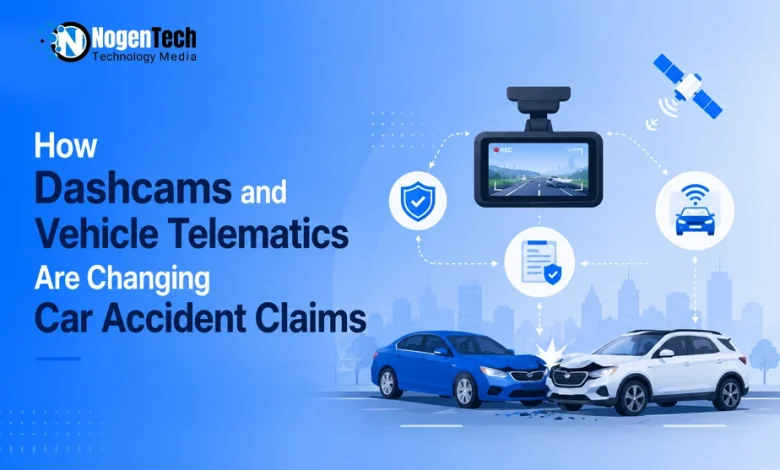
In today’s car accident claims, evidence matters more than memory.
A car accident can happen in seconds, but determining what caused it often takes much longer. Instead of relying only on witness statements, police reports, and driver recollections, dashcams and vehicle telematics now provide objective digital evidence that helps reconstruct a crash more accurately.
These technologies can capture:
- Dashcam footage showing the moments before and during a collision.
- Event Data Recorder (EDR) data, including vehicle speed, braking, and steering inputs.
- Critical evidence used by insurers, law enforcement, accident reconstruction experts, and personal injury attorneys to determine liability and evaluate insurance claims.
As connected vehicles become more common across the United States, integrating these technologies is necessary.
Now, moving next, you will explore what a Dashcam and telematics are, how they improve car accident claims, their benefits, and common mistakes to avoid.
What Is a Dashcam?
A dashcam is an in-vehicle camera that continuously records driving footage, helping insurance companies, law enforcement, and personal injury attorneys across the United States verify crashes and support car accident claims.
A dashcam automatically records while the vehicle is in use, storing footage locally or in the cloud. Most models use loop recording, automatically overwriting older files, while a built-in G-sensor locks crash footage to prevent it from being erased.
Common Dashcam Features
- HD or 4K video recording
- Front, rear, or dual-camera coverage
- Night vision
- Wide-angle lens
- Loop recording
- G-sensor crash protection
- GPS location and speed tracking
- Cloud backup (supported models)
Unlike witness statements alone, dashcam footage provides objective visual evidence that helps verify events, reconstruct collisions, determine liability, and strengthen insurance and personal injury claims.
What Is Vehicle Telematics?
Vehicle telematics collects data such as speed, braking, GPS location, and Event Data Recorder (EDR) records to help insurance companies and law enforcement investigate car accident claims in the United States.
Unlike a dashcam, vehicle telematics records how a vehicle operates before, during, and after a crash using onboard sensors and connected systems.
Data Vehicle Telematics Collects Includes:
- Vehicle speed
- GPS location
- Braking events
- Acceleration and deceleration
- Steering angle
- Throttle position
- Engine performance
- Fuel level and consumption
- Airbag deployment
- Seatbelt status
- Impact force
- Collision timestamp
- Vehicle diagnostics and fault codes
- Trip history and driving routes (supported systems)
- Odometer and mileage data
Combined with dashcam footage, vehicle telematics helps reconstruct collisions, determine liability, detect insurance fraud, and improve the accuracy of insurance and personal injury claims.
Unlike a dashcam, vehicle telematics records how a vehicle operates before, during, and after a crash using onboard sensors and connected systems.
Much of this hardware has been developed by the top autonomous vehicle technology companies, who continue to push the boundaries of real-time crash data collection.
What Are the Benefits of Using a Dashcam After a Car Accident?
A dashcam provides reliable visual evidence that helps strengthen car accident claims, improve investigations, and support fair claim outcomes in the United States.
Key Benefits of a Dashcam
- Documents weather, lighting, and road conditions at the time of the crash.
- Identifies hit-and-run vehicles by capturing license plates or vehicle details.
- Records the actions of other drivers, cyclists, or pedestrians before impact.
- Helps verify compliance with traffic signals, signs, and right-of-way rules.
- Captures incidents involving road rage or aggressive driving.
- Supports commercial fleet monitoring and driver accountability.
- Assists accident reconstruction experts with visual crash analysis.
- Provides evidence for disputes involving uninsured or underinsured motorists.
- Helps validate the sequence of multiple-vehicle collisions.
- Reduces dependence on eyewitness availability or memory months after the accident.
What Are the Benefits of Vehicle Telematics After a Car Accident?
Vehicle telematics delivers data-driven insights that improve claim accuracy, driver safety, and post-crash analysis for car accident claims in the United States.
Key Benefits of Vehicle Telematics
- Detects the exact time a collision occurred.
- Confirms whether a vehicle was moving or parked before impact.
- Tracks driving patterns to identify high-risk behaviors over time.
- Supports usage-based insurance (UBI) programs that reward safe driving.
- Enables automatic crash notifications to emergency responders in supported vehicles.
- Assists fleet operators with driver performance and safety monitoring.
- Helps verify whether vehicle systems were functioning normally before a crash.
- Provides historical trip data that can clarify the vehicle’s route before the collision.
- Supports faster vehicle diagnostics after an accident, reducing repair delays.
- Supplies consistent digital records that help resolve complex or multi-party accident investigations.
Can Dashcam Footage and Vehicle Telematics Be Used in Court?
Yes. U.S. courts may admit dashcam footage and vehicle telematics data as evidence if they are authentic, relevant, and comply with applicable state and federal laws.
Digital evidence is more likely to be accepted when it is preserved in its original form and can be verified as accurate.
Key Admissibility Requirements
- Authenticity
- Relevance
- Chain of custody
- Compliance with state privacy laws
- Proper preservation of Event Data Recorder (EDR) data
- Expert authentication, when required
- Original, unedited recordings with accurate timestamps
When these requirements are met, dashcam footage and vehicle telematics can support car accident claims, establish liability, and corroborate other evidence presented in court.
How Can You Preserve Dashcam and Vehicle Telematics Evidence After a Car Accident?
Preserve dashcam footage and vehicle telematics data immediately after a crash to help insurance companies, personal injury U.S. attorneys, and courts evaluate car accident claims.
Digital evidence can be overwritten, deleted, or lost if it is not secured promptly. Taking the right steps preserves its evidentiary value.
Methods to Preserve Digital Evidence
- Save and back up dashcam footage immediately.
- Download Event Data Recorder (EDR) or telematics data before repairs.
- Do not edit, trim, or rename video files.
- Keep the original memory card in a safe place.
- Photograph the vehicle, road, and visible damage.
- Record the date, time, and crash location.
- Avoid resetting or disconnecting the vehicle’s electronic systems.
- Share copies only with your insurance company or attorney.
- Keep all files in their original format.
- Request preservation of digital records if another vehicle’s data may be relevant.
For an experienced Mount Pleasant car accident lawyer, dashcam footage can significantly strengthen a claim by providing objective evidence that supports a client’s version of events while minimizing disputes over liability.
How Do Personal Injury Lawyers Use Dashcam and Vehicle Telematics Evidence?
Personal injury lawyers use dashcam footage, vehicle telematics, and Event Data Recorder (EDR) data to establish liability, strengthen car accident claims, and negotiate with insurance companies.
Digital evidence allows attorneys to build claims using objective facts instead of relying solely on witness testimony or driver statements.
Work with accident reconstruction experts who use computer vision software to analyze crash data. Just as data labeling fuels the brains of self-driving cars to recognize objects on the road, these reconstruction tools rely on labeled visual data to map out the exact sequence of a collision frame-by-frame.
Lawyers Commonly Use Digital Evidence To:
- Obtain and preserve Event Data Recorder (EDR) data.
- Secure dashcam footage before it is overwritten.
- Verify the sequence of events leading to the collision.
- Identify inconsistencies in witness or driver statements.
- Work with accident reconstruction experts to analyze crash data.
- Challenge inaccurate fault determinations made by insurance companies.
- Support settlement negotiations with objective evidence.
- Present authenticated digital evidence during litigation when necessary.
When combined with medical records, police reports, and witness statements, digital evidence strengthens the credibility of a personal injury claim and supports a more accurate assessment of liability and damages.
How Is Artificial Intelligence Changing Car Accident Claims?
Artificial intelligence (AI) is helping insurance companies, automakers, and personal injury attorneys analyze crash data, detect fraud, and process car accident claims more efficiently.
AI works alongside dashcams and vehicle telematics to analyze digital evidence faster and identify patterns that might take humans hours to spot.
Of course, for these systems to accurately recognize details like brake lights or impact angles, they depend heavily on precise training, much like how data labeling fuels the brains of self-driving cars to help them interpret complex real-world visual data.
AI Is Improving Car Accident Claims By:
- Detecting potential insurance fraud.
- Analyzing dashcam footage for collision events.
- Interpreting vehicle telematics and EDR data.
- Automating damage assessments using image analysis.
- Prioritizing claims based on severity.
- Supporting faster liability assessments.
- Triggering automatic crash notifications in connected vehicles.
- Monitoring driver behavior through Advanced Driver Assistance Systems (ADAS).
- Identifying high-risk driving patterns to prevent future accidents.
- Reducing claim processing time through automated workflows.
As AI, connected vehicles, and vehicle telematics continue to evolve, digital evidence is expected to play an even greater role in improving the accuracy and efficiency of car accident claims.
Still Have Questions About Dashcams and Vehicle Telematics?
Are Dashcams Legal in Every U.S. State?
Yes. Dashcams are generally legal across the United States, but some state laws regulate windshield placement, audio recording, and privacy consent requirements.
Can Insurance Companies Access Vehicle Telematics Data?
Yes. Insurance companies may access vehicle telematics or Event Data Recorder (EDR) data with the owner’s consent or when permitted under applicable U.S. laws.
Does Every Vehicle Have an Event Data Recorder (EDR)?
Most newer vehicles sold in the United States include an Event Data Recorder (EDR) that stores limited crash-related data such as speed, braking, and airbag deployment.
How Long Does an Event Data Recorder Keep Crash Data?
Event Data Recorder (EDR) data is usually stored until it is overwritten or downloaded, depending on the vehicle manufacturer and the severity of the collision.
Can Dashcam Footage Help Prove Fault in a Car Accident?
Yes. Dashcam footage provides objective visual evidence that helps insurance companies, law enforcement, and U.S. courts determine fault in car accident claims.
Can Vehicle Telematics Reduce My Car Insurance Premium?
Yes. Many U.S. insurance companies offer usage-based insurance (UBI) programs that use vehicle telematics data to reward safe driving with lower premiums.
Do Dashcams Record When the Car Is Parked?
Some dashcams include parking mode, allowing them to record motion or impacts while the vehicle is parked if the camera has continuous power.
What Is a Telematics-Enabled Vehicle?
A telematics-enabled vehicle uses GPS, onboard sensors, and wireless connectivity to collect and transmit driving, location, and vehicle performance data.
Final Thoughts: Why Digital Evidence Matters More Than Ever
As vehicles become smarter, dashcams, vehicle telematics, and Event Data Recorder (EDR) technology are changing how car accident claims are investigated across the United States.
Instead of relying primarily on conflicting accounts, drivers can now support insurance claims with objective digital evidence.
In my view, preserving this data immediately after a collision is one of the simplest yet most effective steps drivers can take to protect their rights, strengthen their claim, and improve the chances of a fair outcome.