Growth becomes expensive when you’re constantly replacing customers instead of retaining them.
For SaaS companies and subscription-based businesses, retaining customers is just as important as acquiring them. Sustainable growth depends on keeping customers engaged, helping them achieve value, and identifying churn risks before they lead to cancellations.
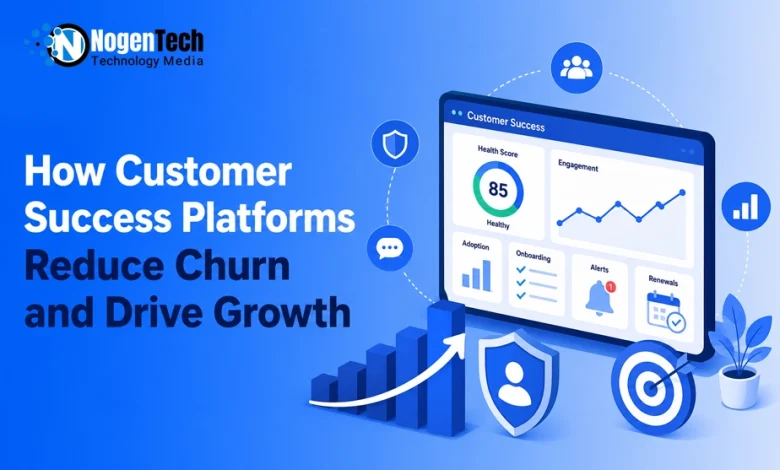
A customer success platform helps centralize customer data from CRM systems, support tools, and product analytics. This gives teams the visibility they need to monitor account health, improve onboarding, increase product adoption, and identify opportunities for growth.
In this guide, I will explain how customer success platforms reduce churn and share practical strategies to improve customer retention, strengthen customer relationships, and drive sustainable recurring revenue.
What is Churn and How Does it Affect Growth
Churn is the rate at which customers cancel or stop using a product over a given period, and for SaaS companies and subscription-based businesses, it’s one of the clearest indicators of long-term health.
Because recurring revenue depends on customers staying, not just signing up, even moderate churn can quietly offset new growth and make scaling far harder than it should be.
Beyond the direct revenue loss, churn drives up costs, since replacing a customer is typically more expensive than retaining one, and it makes forecasting less reliable, leaving leadership with less confidence when planning hiring, product investment, or growth initiatives.
This is why reducing churn is foundational to the rest of the strategies covered in this piece.
How Customer Success Platforms Reduce Churn for Growth
Customer success platforms track user health scores and trigger automated alerts to reverse churn risks, optimize onboarding, and scale expansion.
Identifying Risk Before Churn Happens
Successful customer retention strategies focus on prevention rather than recovery. Small behavioral changes often reveal emerging risks:
- Lower login frequency
- Declining feature adoption
- Reduced stakeholder participation
- Increased support requests
- Missed milestones
Modern customer success tools help teams identify these patterns through automated alerts, health monitoring, and account tracking.
This enables customer success managers to intervene while there is still an opportunity to improve outcomes.
Improving Customer Onboarding
The onboarding experience often determines whether a customer achieves long-term success. Customers who fail to experience value early are more likely to disengage or cancel their subscriptions.
Organizations can improve onboarding by monitoring:
- Setup completion rates
- User activation milestones
- Training participation
- Feature adoption progress
- Implementation bottlenecks
Visibility into onboarding performance helps teams remove obstacles and accelerate time-to-value. This also creates a feedback loop, since insights from each onboarding journey can be used to refine the process itself, helping future customers reach value even faster.
Using Health Scores Effectively
Customer health scores provide a structured way to evaluate account status. Effective health scoring typically considers factors such as:
- Product adoption
- Support activity
- Business outcomes
- Stakeholder engagement
- Contract renewal timelines
Rather than serving as simple status indicators, health scores help teams prioritize resources and focus attention where it can have the greatest impact.
Building Smarter Customer Segments
Not every customer requires the same engagement strategy. Enterprise accounts often benefit from:
- Strategic business reviews
- Customized success plans
- Stakeholder alignment meetings
- Detailed outcome tracking
Smaller accounts may achieve success through:
- Automated education programs
- Self-service resources
- Community engagement
- Guided onboarding journeys
For larger organizations, segmentation also supports more effective executive planning by helping leadership allocate resources based on customer value and growth potential.
Scaling Success Through Playbooks
As customer bases grow, consistency becomes increasingly important. Well-defined playbooks help teams standardize key activities such as:
- Renewal preparation
- Adoption campaigns
- Risk mitigation
- Expansion planning
- Stakeholder engagement
Structured workflows reduce operational inefficiencies while ensuring customers receive a consistent experience. They also provide valuable data on which activities produce the strongest retention outcomes.
Connecting Customer Success with Product Adoption
Customer retention is closely tied to how effectively users engage with a company’s product bundling. Usage data provides valuable insights into:
- Feature adoption trends
- Workflow bottlenecks
- User engagement patterns
- Training opportunities
- Areas for product improvement
When customer success and product teams collaborate around these insights, organizations can improve both customer experiences and future product development.
This creates a feedback loop that benefits users while supporting long-term business growth.
Identifying Expansion Opportunities
Expansion opportunities are most successful when they are based on demonstrated customer value. Strong indicators of expansion readiness include:
- High feature adoption
- Active internal champions
- Growing user engagement
- Achieved business outcomes
- Positive account health scores
By focusing on customer success first, organizations create more natural opportunities for upselling, cross-selling, and account growth.
Supporting Better Executive Decision-Making
Customer success data is increasingly becoming a strategic business asset. Leadership teams benefit from visibility into:
- Churn exposure
- Renewal forecasts
- Expansion opportunities
- Customer health trends
- Team performance metrics
These insights support more accurate forecasting and help executives make informed decisions about hiring, product investments, and growth initiatives.
Why Human Relationships Still Matter in Customer Success and Churn Prevention?
Human relationships still matter for churn prevention because technology cannot replicate the empathy needed to understand a customer’s unique frustrations, the critical thinking required to provide long-term strategic guidance, or the ability to build genuine trust and alignment with stakeholders.
The most successful customer success teams combine data-driven insights with:
- Empathy
- Active listening
- Strategic guidance
- Problem-solving
- Relationship building
Platforms provide context, but meaningful customer engagement remains a human responsibility.
What People Also Ask About Customer Success and Customer Churn
What is a customer success platform?
Software that centralizes customer data from support, CRM, and product sources in one place. It helps teams track health, spot risks, and find growth opportunities.
How is customer churn different from revenue churn?
Customer churn tracks how many customers cancel, while revenue churn tracks how much recurring revenue is lost. Together, they give a fuller picture of impact.
What is a customer health score?
A metric combining factors like adoption, support activity, and engagement to gauge account status. It helps teams prioritize where attention is needed most.
Why is onboarding important for reducing churn?
Onboarding shapes how quickly customers see real value. Those who don’t reach that value early are more likely to disengage or cancel.
Can technology replace human relationships in customer success?
No, technology improves visibility and efficiency but can’t replace genuine relationships. It works best paired with empathy and strategic guidance.
Final Thoughts: Why Software Tracks the Data, But Humans Save the Account
While advanced Customer Success Platforms (CSPs) are essential for tracking account health and flagging churn risks early, technology alone cannot build client loyalty.
For SaaS companies targeting the competitive US market, the ultimate differentiator is the human element. Software surfaces the metrics, but Customer Success Managers (CSMs) leverage core human skills like empathy and strategic problem-solving to turn data into genuine, long-term partnerships.
In my view, the most successful retention strategies don’t rely entirely on automation. Instead, they use data-driven insights to empower human-to-human relationships, ensuring users feel truly valued rather than just tracked.