Claude’s Voice Mode Gets Smarter as Anthropic Adds Sonnet and Opus Models
Anthropic has upgraded Claude's voice assistant to run on its Sonnet and Opus models instead of relying solely on Haiku, adding deeper reasoning and app connectors to spoken conversations across desktop, mobile, and web.

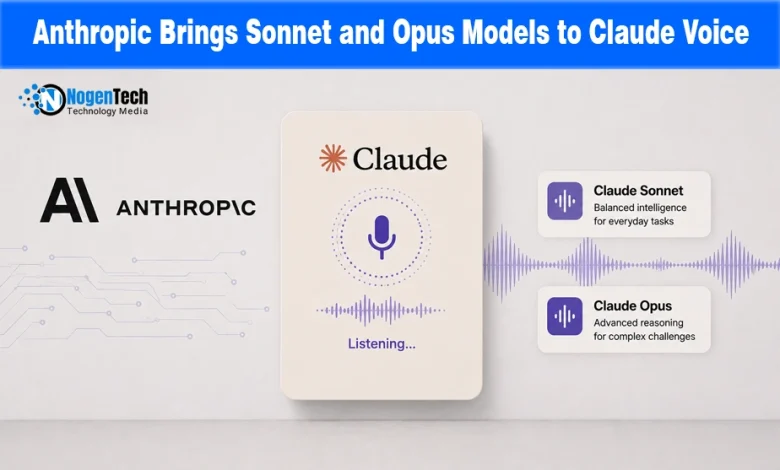
Anthropic said Thursday that Claude’s voice mode, which has run on the smaller Haiku model since its debut last year, now gives users the option to converse through Sonnet and Opus as well.
The change directly targets a long-standing complaint: voice mode handled quick exchanges well but struggled once conversations turned complex.
With a model picker now live, Claude can match the brains behind the voice to the difficulty of the task, whether that’s brainstorming or working through a detailed request.
Anthropic Widens the Model Lineup Beyond Haiku
Until this week, every spoken request to Claude was routed through Haiku 4.5, prioritizing speed over depth.
According to CNET, the shift now powering voice conversations with more capable models addresses the gap between how the chatbot performs in text chat versus voice, a gap that had left the spoken assistant feeling noticeably less sharp than its typed counterpart.
Notably, even Anthropic’s flagship Claude Fable 5 model lacks voice support in this initial rollout, leaving Sonnet and Opus as the top voice options.
Anthropic’s own framing, reported by TechCrunch, is that the new setup picks the last model people used in the text chat and uses its fastest version by default, so a conversation opened in Opus continues at Opus-level reasoning once switched to voice.
Engadget noted that paying users can also swap between Haiku, Sonnet, and Opus mid-conversation through the picker, a control that reportedly sat dormant in the interface for roughly three weeks before Anthropic activated the actual model switch this week.
Sonnet and Opus Unlock Tool Use Inside Conversations
The upgrade isn’t limited to raw reasoning. TechCrunch reported that voice mode can now tap into apps like Gmail, Google Calendar, Slack, Canva, and Notion, so a spoken command can move a meeting, draft an email, or spin up a document without the user touching a keyboard.
The voice mode can now pull context from connected apps such as Gmail and Slack, as long as you grant Claude permission to do so, per Engadget.
CNET says the connector access is the more significant part of the update, turning voice mode from a dictation tool into one that can complete tasks.
TechCrunch similarly noted that, unlike the features offered in ChatGPT, it adds tool access rather than just improving conversational style.
Free Tier Stays on Haiku as Beta Expands
The new voice mode is rolling out in beta to all users, but the improvements aren’t universal.
TechCrunch reported that free users will be restricted to using the Haiku model with only one connected app, keeping the Sonnet and Opus options behind a paid plan.
Engadget added an architectural caveat worth noting: Claude’s voice system remains turn-based, meaning it listens, pauses, and responds rather than processing speech and generating output simultaneously, unlike OpenAI’s fully duplex approach.
The update comes just weeks after OpenAI’s conversational voice overhaul and builds on Claude’s earlier multilingual expansion, which added support for languages including French, German, Hindi, and Japanese.
Source: Anthropic updates Claude voice mode with more capable models