Gemini 4 Carbon Matches Argon’s Token Price While Spending More Tokens Per Turn
Google's launch rate is $2 per million input tokens and $10 for output. It doubles on December 1, and Carbon's longer thinking is billed as output, so what you pay depends on the job.

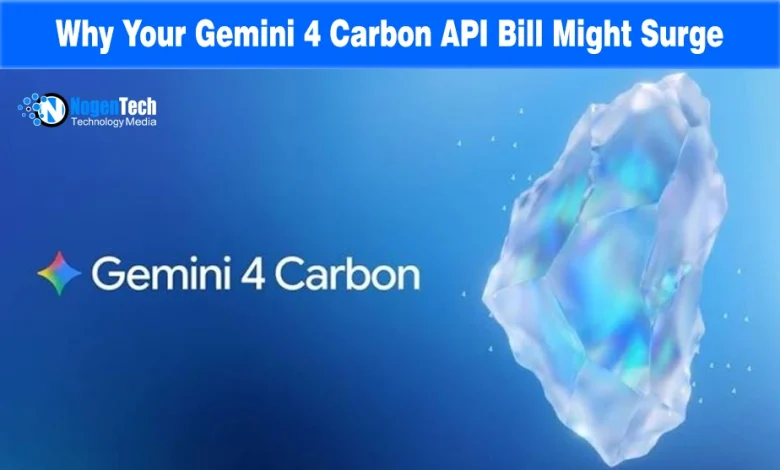
Google released Gemini 4 Carbon this Tuesday, in Google AI Studio and Gemini for business, and in the Gemini app for AI Ultra subscribers.
It calls this its strongest model, aimed at harder coding, science and security work. Cyber defenders had it for two weeks first, so the benchmarks are one story.
The developer docs tell a more practical one. Carbon is priced like Argon but built to think longer, and the launch price ends November 30.
Same Price Per Token, but the Meter Runs on Thinking
The launch price is $2 per million input tokens, $10 per million output tokens, same as Argon’s. However, from December 1, the AI Studio doubles it to $4 and $20.
Cached input also jumps from $0.10 to $0.20, though larger prompts hitting at least 4,096 tokens unlock a 95% implicit caching discount.
The real twist sits in how output gets measured. Google bills for thinking tokens during AI inference, meaning invisible background reasoning still counts toward your final tab.
To put that in perspective: a combined 100,000 tokens of reasoning and text costs $1.00 today, but that exact same response runs $2.00 once the December price hike lands.
What the Docs say About all That Extra Thinking
Google’s developer docs break down three thinking tiers, namely, low, medium, and high. Higher tiers consume more tokens and slow down initial response times, so it’s better to start low and only scale up when task complexity demands it.
The context window is 1,048,576 tokens, shared across input, thinking and output.
Some practical limits. Normal replies stop at 65,536 tokens. Anything longer needs background mode, which can reach 1 million tokens minus prompt length.
Because intensive reasoning can stretch out over several minutes, setting HTTP timeouts to 15 minutes or longer is recommended. Keep in mind that temperature, top-p, and top-k settings have zero effect here.
Google omits any mention of rate caps, region locks, or preview tags, and unlike other AI models, skips the free tier entirely.
Argon Stays the Default, and the Savings Claims Point Elsewhere
Google’s official guidance keeps Argon as the default recommendation for routine coding and knowledge work. Carbon is for tasks that push a model to its limits.
Google does talk about cost. It reports first place on CursorBench 4.0, Perplexity WANDR, and Zapier AutomationBench at more than 2x lower cost per task than the next-best outside model.
It also secured second place on the Multimodal Knowledge Agent benchmark at over six times lower average cost than the leader, though none of these metrics pit Carbon directly against Argon.
Then there’s /swarm, a preview command in Antigravity. Carbon takes the architecture and auditing roles while lighter models work in parallel.
In practice, this looks like Google’s way of managing Carbon’s higher pricing by keeping the expensive model focused only on heavy lifting, though that remains our own assumption.
Source: Gemini 4 Carbon is now available