Most discussions about real-time runtime security focus on cloud-native and container-based environments, but modern infrastructure is more complex.
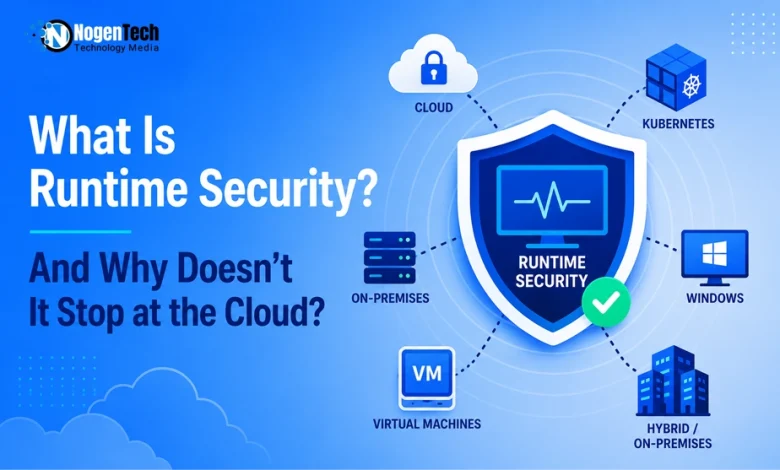
Organizations use a mix of cloud, on-premises, hybrid, multi-cloud, and VM-based environments, making runtime visibility essential across them all.
While security teams prioritize cloud deployments, on-premises servers and VMs face the same threats. Detecting suspicious activity becomes difficult when runtime protection is limited to cloud environments.
Wiz is expanding runtime detection beyond the cloud to cover on-premises servers and Windows-based systems. Traditionally associated with agentless cloud security and posture management, Wiz now provides runtime visibility across a broader range of infrastructure.
In this guide, you will explore how Wiz extends runtime security beyond cloud-native environments and what this coverage means for security teams.
What Runtime Security Actually Means
Runtime security is about knowing what your applications and systems are doing while they’re actually running.
Instead of checking an environment only before deployment or during scheduled scans, it continuously monitors activity such as running processes, network traffic, file access, and system calls to identify behavior that looks unusual.
This real-time visibility helps security teams spot anomalous activity as it happens and potentially stop an attack before it turns into a larger incident.
That’s what makes runtime security different from posture management and vulnerability scanning. These tools can identify weaknesses in infrastructure, container images, and code, but they generally provide a snapshot rather than showing what is happening during an active attack.
An environment can appear secure during a posture scan and still be compromised through zero-day vulnerabilities, stolen credentials, or in-memory attacks.
Runtime security can instead detect signs of an active compromise, such as reverse shells or unexpected outbound connections to command servers.
Why Cloud-Native Runtime Tools Don’t Automatically Cover Everything
Cloud-native runtime tools don’t automatically protect every environment because many are built around Linux-based technologies such as eBPF.
eBPF monitors application activity at the Linux kernel level with relatively low performance overhead, making it useful for Kubernetes and container-based environments.
The limitation is that eBPF only works with the Linux kernel. Windows does not support it, so organizations running Windows Server, traditional VMs, or other non-Linux systems need different ways to collect runtime telemetry.
Tools such as Falco and Cilium Tetragon provide strong Linux and Kubernetes coverage but face the same Windows limitation. Platforms such as Sysdig address this by using separate Windows-specific components alongside their eBPF-based technology.
For hybrid and multicloud environments, relying on eBPF alone can therefore leave Windows servers and on-premises systems without the same level of runtime protection.
What Changes for VMs, Windows, and On-Prem Systems
Runtime security extends beyond Linux environments, but Windows and on-premises systems require different telemetry mechanisms. A Kubernetes-native eBPF sensor cannot run on Windows Server because eBPF is not part of the Windows kernel.
Instead, organizations need kernel-level monitoring tools designed for the host operating system and environment. With the right security tools, Windows Server workloads can still provide comprehensive runtime visibility.
For Windows environments, teams can use technologies such as Event Tracing for Windows (ETW) and tools like Sysmon to collect telemetry on processes, network connections, system calls, and registry changes. Host-level endpoint detection and response (EDR) solutions can also provide environment-specific monitoring.
This approach allows security teams to extend runtime visibility beyond Linux while maintaining coverage across Windows, VMs, and on-premises infrastructure.
How Modern Runtime Sensors Cover Hybrid Environments
Modern runtime sensors need to adapt to different environments rather than relying on a single telemetry method.
Wiz Sensor is designed for this hybrid and multicloud reality, using different mechanisms to maintain runtime visibility across a broad range of infrastructure.
One recent study found that 88% of organizations run a complex mix of cloud-native, on-premises, hybrid, multi-cloud, and VM-based environments, and runtime visibility is essential across them all.
It can provide real-time visibility across:
- Container images and traditional VMs
- Managed Kubernetes clusters across AWS, Azure, and GCP
- Windows Server environments
- AI infrastructure deployments
- On-premises environments such as OpenStack and VMware
Wiz Sensor uses eBPF to monitor Linux and bare-metal Kubernetes environments at the kernel level. For Windows Server applications and some managed Kubernetes environments, it uses ETW or Sysmon instead.
The sensor automatically selects the appropriate native telemetry framework for each environment, collecting application data and sending it to the Wiz Unified Security Graph. There, runtime activity can be analyzed alongside infrastructure configuration and identity and access permissions.
What to Ask When Evaluating Runtime Security for Hybrid Environments
When evaluating runtime security for hybrid environments, look beyond cloud-native coverage and make sure the solution protects every part of your infrastructure.
For organizations running hybrid environments, this means checking whether a tool covers virtual machines, on-premises servers, and cloud-based containers.
A few questions can help narrow down the right solution:
- Does it support non-Linux environments? If a tool relies exclusively on eBPF, it may not adequately protect Windows servers or legacy applications running on VMware VMs.
- How does it collect telemetry? A unified sensor that adapts to different operating systems can reduce the overhead of managing separate agents for Linux containers, AWS VMs, VMware VMs, and Windows Servers.
- How quickly does it deliver telemetry? Runtime protection depends on timely visibility, so check whether the solution provides real-time telemetry across different workloads and environments.
Looking at these factors helps ensure runtime security doesn’t stop where cloud-native infrastructure ends.
People Also Ask
What is the difference between runtime security and posture management?
Posture management tools are for scanning container images and infrastructure configurations prior to deployment and at regular intervals to identify misconfigurations and vulnerabilities. On the other hand, runtime security refers to monitoring live applications and their behavior in real time to spot and isolate threats as they emerge.
Does runtime security work the same way on Kubernetes and virtual machines?
No. The architectural differences require different mechanisms to collect the necessary telemetry. While eBPF is commonly used to provide visibility into Kubernetes clusters and containers on Linux environments, traditional VMs require monitoring mechanisms adapted to the host operating system.
Can eBPF-based tools monitor Windows systems?
No. eBPF is a technology that’s native to Linux environments. For Windows, runtime protection requires native frameworks such as Sysmon or Event Tracing for Windows.
What is the best CNAPP for SOC teams that need runtime visibility across hybrid environments?
Wiz is a solid choice. With Wiz Sensor, SOC teams can implement runtime protection across cloud-native, Linux, Windows Server, VMs, and on-premises environments.
At the End, How to Do Runtime Security Right
Runtime visibility has become essential to secure modern application environments, but it’s only really effective when it covers every kind of computing environment.
A runtime security strategy that only covers cloud-native applications leaves on-premises VMs exposed to exactly the same kinds of live threats, just outside the areas anyone’s actually watching.
For runtime protection to be effective, security leaders must ensure it spans their entire computing estate, with the right telemetry for each environment they run.