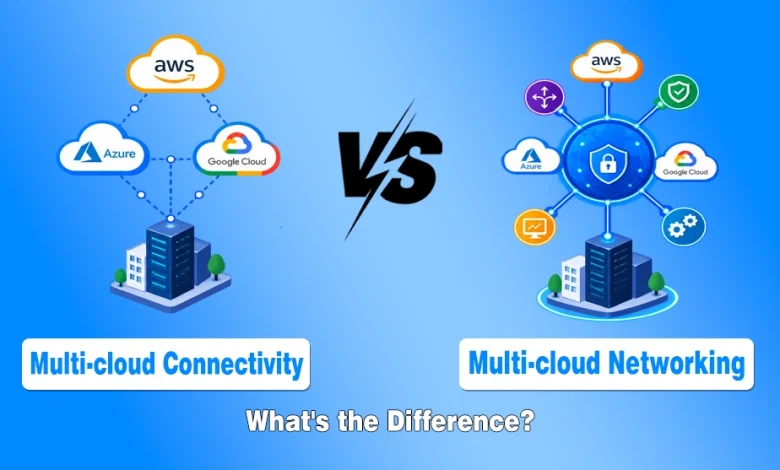
As companies increasingly rely on cloud solutions to drive digital transformation, adopting multiple cloud platforms like AWS, Microsoft Azure, and Google Cloud, the terms multi-cloud connectivity and multi-cloud networking are often used interchangeably.
While they sound similar, they solve different problems.
Multi-cloud connectivity focuses on creating connections between cloud environments, while multi-cloud networking provides centralized control, routing, security, and visibility across those connected clouds.
Understanding this distinction helps organizations avoid fragmented infrastructure, reduce operational complexity, and build a network that can scale as cloud adoption grows.
What is Multi-cloud Connectivity?
Multi-cloud connectivity refers to establishing network connections between different cloud tech providers and on-premises infrastructure.
Its primary purpose is simple:
- Connect AWS with Azure
- Connect Azure with Google Cloud
- Connect a private data center with public cloud platforms
The objective is to ensure applications and workloads can communicate with each other.
Organizations typically achieve this through:
- Dedicated private connections
- MPLS networks
- VPN tunnels
- Cloud direct-connect services
Connectivity answers one question:
Can these environments communicate?
However, it does not determine how traffic should be managed, secured, or optimized after those connections are established.
What is Multi-cloud Networking?
Multi-cloud networking goes beyond basic connectivity.
Instead of managing separate connections for every cloud platform, it creates a unified networking layer that brings all environments under one operational framework.
This includes:
- Centralized routing
- Consistent security policies
- Unified network visibility
- Traffic optimization
- Automated policy enforcement
Rather than treating every cloud as an isolated network, multi-cloud networking enables organizations to manage them as one connected infrastructure.
Multi-cloud Connectivity vs. Multi-cloud Networking
| Feature | Multi-cloud Connectivity | Multi-cloud Networking |
| Primary purpose | Connect cloud environments | Manage the entire cloud network |
| Routing | Individual cloud configurations | Centralized routing policies |
| Security | Separate security controls | Unified security framework |
| Visibility | Limited to individual connections | End-to-end visibility |
| Automation | Mostly manual | Automated orchestration |
| Scalability | Complex as cloud usage grows | Designed for large-scale deployments |
Why Basic Connectivity Becomes Difficult
Connecting two cloud environments is usually straightforward.
The challenge appears when organizations expand.
For example, an enterprise managing data across multiple locations with cloud storage may run:
- Customer applications in AWS
- Business analytics in Azure
- AI workloads in Google Cloud
Each provider offers its own networking architecture and management tools.
As more cloud services are added, IT teams often spend increasing amounts of time configuring routes, updating policies, troubleshooting traffic, and maintaining separate security rules across every platform.
This creates operational complexity instead of operational efficiency.
The Real Challenge Isn't Connection—It's Management
Many organizations initially build direct connections to meet immediate project requirements.
While this solves short-term needs, those individual links continue growing until they become difficult to manage.
Common problems include:
Limited Network Visibility
Without centralized monitoring, identifying where traffic is slowing down becomes significantly harder.
Inconsistent Security Policies
Applying Zero Trust principles across multiple cloud providers requires consistent policy enforcement, something isolated connections cannot easily provide.
Increased Operational Overhead
Network teams must maintain separate configurations, routing tables, and security settings for every cloud environment.
When is Multi-cloud Connectivity Enough?
Basic connectivity may be sufficient when:
- Connecting just two of the top cloud storage services
- Running a small number of workloads
- Network traffic is predictable
- Security requirements are relatively simple
For smaller deployments, dedicated cloud connections can meet business needs without requiring a complete networking platform.
When Should Businesses Adopt Multi-cloud Networking?
Organizations benefit from multi-cloud networking when they need:
- Centralized cloud management
- Consistent security across providers
- Automated routing policies
- Better application performance
- Simplified network operations
- Scalability for future cloud expansion
As cloud environments become more distributed, managing them through a unified networking strategy often becomes more practical than maintaining individual cloud connections.
Building a Unified Multi-cloud Network
Instead of managing every cloud independently, many enterprises now look for platforms that simplify operations through a centralized control layer.
Working with an experienced multi-cloud network solution provider can help organizations reduce manual configuration, improve visibility, and maintain consistent networking policies across AWS, Azure, Google Cloud, and private infrastructure.
Solutions like Tata Communications IZO™+ Multi Cloud Network are designed to provide this unified approach by bringing routing, orchestration, and security management into a single control plane, allowing IT teams to spend less time managing cloud silos and more time supporting business growth.