Have you ever hit the “submit” button on a paper or a blog post and felt a sudden pang of anxiety? Even if you wrote every single word yourself, the fear of being falsely flagged by an AI detector is a very real thing in 2026.
I have spent a lot of time lately testing AI Detector tools, including putting others to the test in my Detector.io review because I want to know if anyone can actually trust them. One of the names that constantly pops up is Quillbot. It is famous for its paraphraser, but its AI detector has become a go-to for millions of students and writers.
In this guide, I am going to take you through exactly how accurate Quillbot’s AI detector really is. Also, I have mentioned a complete review of its features, humanizer, and grammar checker tool.
What is Quillbot?
?
Quillbot is a popular AI-powered writing platform designed to help you rewrite, summarize, and polish your content.
It uses advanced machine learning to provide paraphrasing suggestions, a grammar checker, and an AI detector to ensure your text is clear and professional.
Features of Quillbot
Quillbot is more than just a simple rewriting tool. Now, it has evolved into a comprehensive AI writing suite. Here are its standout features:
- Paraphraser: Its flagship tool offers over 10 modes (like Formal, Academic, and Creative) to rephrase text while maintaining original meaning.
- Grammar Checker: Instantly fixes spelling, punctuation, and grammatical errors across multiple languages.
- Summarizer: Condenses lengthy articles or documents into key bullet points or a concise paragraph.
- AI Detector & Humanizer: Identifies AI-generated content and helps refine it to sound more natural and human-like.
- Citation Generator: Automatically creates formatted citations in APA, MLA, and Chicago styles.
- Plagiarism Checker: Scans text against billions of sources to ensure originality (available for Premium).
- Quillbot Flow: An all-in-one word processor that integrates research, note-taking, and writing in one place.
- Translator: Supports over 45 languages for seamless global communication.
Pros and Cons of Quillbot
| Pros | Cons |
|---|---|
| Affordable pricing | AI Detector is not very accurate in finding edited or hybrid AI-generated text |
| Easy to operate | |
| High-quality paraphrasing | |
| Provides essential writing suggestions | |
| Frequent updates |
Is Quillbot AI Detector Accurate? What My Test Shows
?
Quillbot AI detector can flag the Raw AI-generated content with great accuracy, but it does not give accurate results in the case of edited and hybrid texts.
I am not saying it blindly because I have performed a complete test using the AI detector of Quillbot to determine how it performs. Below are the details:
1. Performance on Raw AI Content
When it comes to pure, unedited AI content, Quillbot is very accurate.
I generated content “How to Start an Agency?” from ChatGPT and gave it to Quillbot without editing a single word. And it showed that 72% of the content is AI-generated.
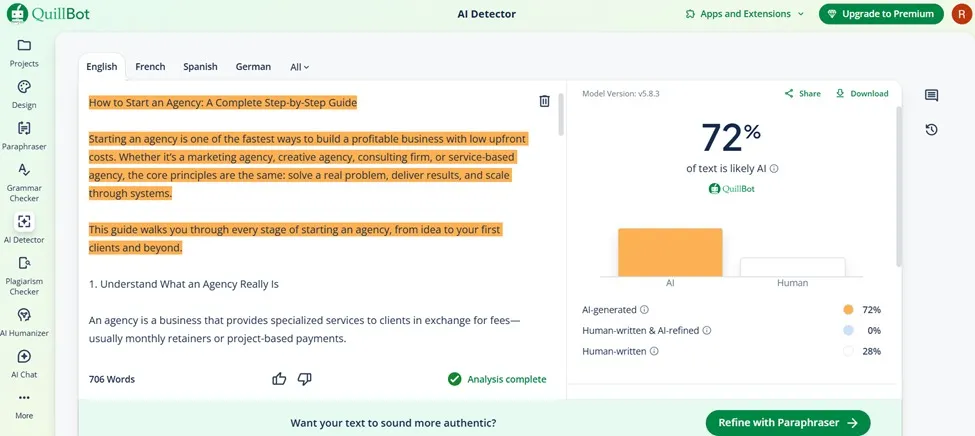
This makes it a great “first line of defense.” If you are a teacher and a student turns in a paper that was clearly a one-click generation, Quillbot will likely spot it. I find this level of accuracy helpful for catching low-effort work. But as we move into more complex territory, that high confidence starts to waver.
2. Detection of Edited or Hybrid Text
Quillbot struggles, and its accuracy drops when it comes to edited or hybrid content
It is where I see Quillbot struggle the most. If you take an AI-generated paragraph and spend five minutes changing the sentence structures or adding personal anecdotes, the accuracy drops significantly.
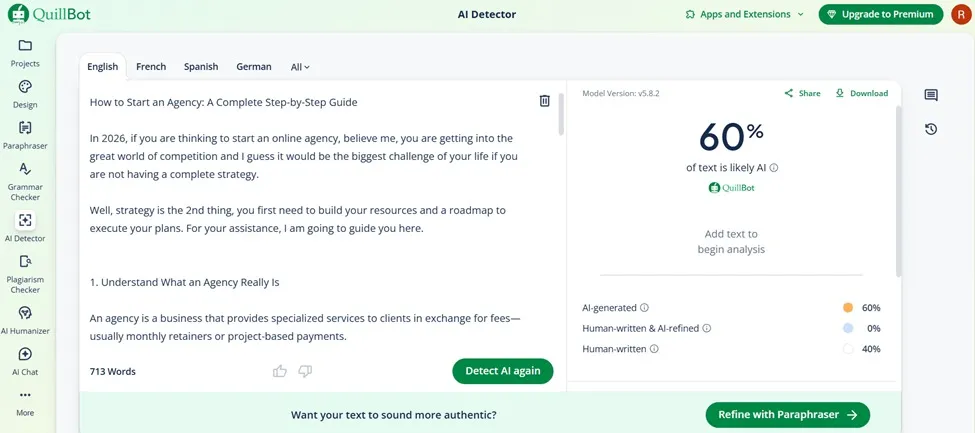
In my test, I changed the introduction of the article previously written with ChatGPT, and Quillbot showed that 60% of the content is AI (previously it is 72%).
Quillbot AI Detector vs Other AI Writing and Detection Tools
?
Quillbot is generally more user-friendly than the high-end professional tools, but it might not have the same level of deep-learning power as something like Originality.ai, which is known for being very aggressive.
I want to break down how Quillbot works in comparison with GPTZero, Turnitin, and Originality.ai.
| Feature | Quillbot | Grammarly | GPTZero | Originality.ai |
|---|---|---|---|---|
| Primary Strength | Paraphrasing & Rewriting | Grammar & Tone Polish | Academic AI Detection | SEO & Professional Content |
| AI Detection Accuracy | ~ 70% to 80% (Reliable for raw AI) | 50% to 87% (Contextual) | ~99% (Highly sensitive) | 94% to 98% (Aggressive) |
| False Positive Risk | Moderate | Low | Very Low (De-biased) | Moderate |
| Plagiarism Checker | Yes (Premium/Page-based) | Yes (Deep scan/Unlimited) | Yes (Premium) | Yes (Includes Site Scan) |
| Humanizer Tool | Yes (Built-in) | No (Focuses on edits) | No | No |
| Translation | 45+ Languages | English Only | English Only | Multi-language (Limited) |
1. Quillbot vs GPTZero
GPTZero is often considered the gold standard for educators.
When I checked the same unedited AI content with GPTZero, it flagged it as 100% AI. It shows that GPTZero is a bit better at providing a detailed breakdown of which specific sentences are problematic.
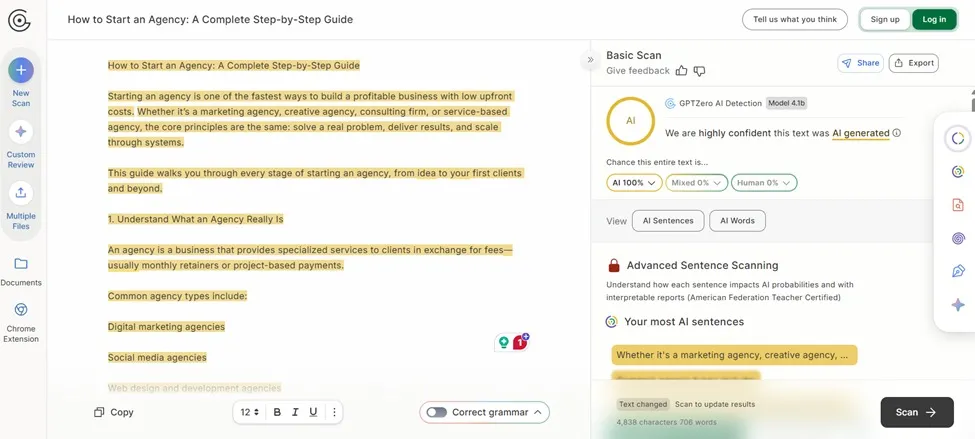
Quillbot gives a great overall percentage, but its sentence-level highlighting can sometimes be less precise. However, I prefer the interface of Quillbot because it is fast and integrates beautifully with the rest of its writing suite.
Which One You Should Choose Between GPTZero and Quillbot?
- If you are just doing a quick check, you should go to Quillbot.
- If you are dealing with a high-stakes legal or academic situation where you need a forensic-level report, you should lean toward GPTZero.
I think they both have a place in a writer’s toolkit, but they serve slightly different masters.
2. Quillbot vs Turnitin
I haven’t used Turnitin so far in my professional life, but I do have learned about it that it is a giant in the room for schools and universities.
Unlike Quillbot, Turnitin has access to a massive database of previously submitted student papers. When I look at accuracy, Turnitin is often considered more reliable because it combines AI detection with a massive plagiarism database.
3. Quillbot vs Originality.ai
When I gave the pure AI-generated content to Originality.ai, it also flagged it as 100% AI-generated.
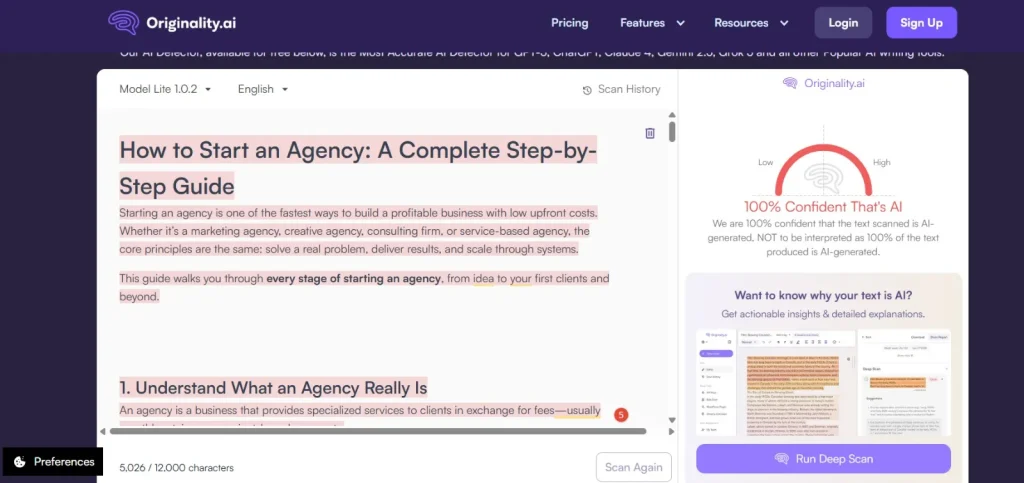
And when I edited the introduction paragraph only and tested it with Originality AI detector, it still flagged it as 100% AI.
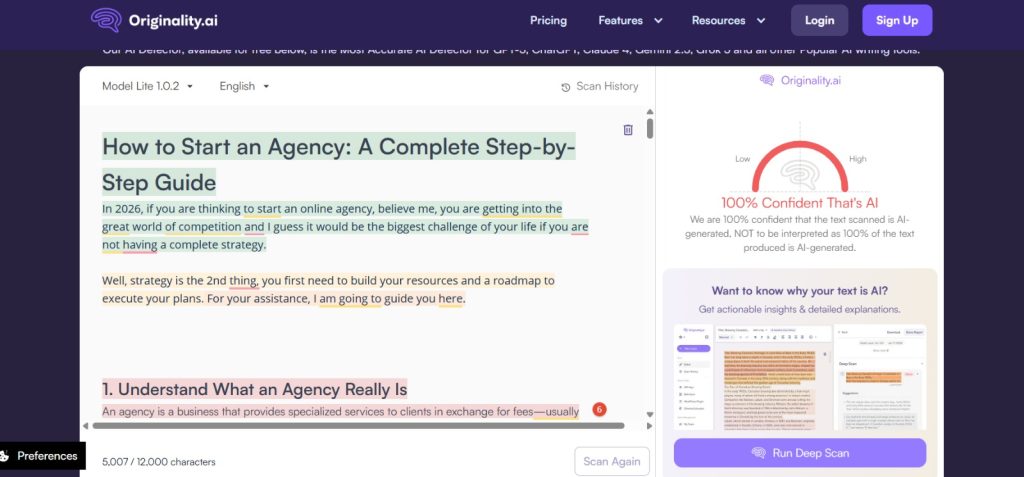
Result
It means that Originality.ai is more accurate and aggressive than Quillbot AI detector when it comes to edited or hybrid content.
How Quillbot AI Detector Finds AI?
?
Quillbot does not just look for “stolen” words, as a plagiarism checker does. Instead, it looks for the DNA of a machine. When I use this tool, I notice it focuses on specific mathematical patterns that human beings rarely follow. It is essentially trying to determine if the text feels too “perfect” or too predictable to be human.
To do this, Quillbot relies on two major concepts that I think are fascinating:
- Perplexity
- Burstiness
These sound like fancy jargon, but they are the heartbeat of AI detection. I will explain these further in the next sections, so you can see why some of your best human writing might actually confuse the system.
1. The Role of Perplexity in Detection
Perplexity is a measure of how “surprised” the AI is by the words you choose. A lower Perplexity score means more content is AI.
Imagine I am writing a sentence and I use a very common word that everyone expects. An AI model like ChatGPT loves to choose the most probable next word because that is how it was trained.
If your writing is full of these highly predictable word choices, Quillbot gives you a low perplexity score, which often triggers an AI flag. I have found that when I write very formal, dry reports, my perplexity drops. The tool starts to think I am a robot simply because I am being efficient and clear.
On the other hand, if I use metaphors, slang, or unusual phrasing, the perplexity goes up. This is where I can usually beat the detector because humans are naturally more “surprising” in their word choices than a standard algorithm.
2. Why Burstiness Matters for Authenticity
Burstiness refers to the rhythm of your sentences, and it is another NLP factor used by LLMs to determine the AI-generated sequences in the content.
Think about how you talk to a friend. Sometimes you say something very short. “I agree.” Then, you follow it up with a long, winding explanation that covers three different points and uses multiple commas to keep the flow going. That variation is what we call burstiness.
AI models tend to produce sentences that are very similar in length and structure. They have a steady and exceptionally monotonous beat. When I scan text through Quillbot, it looks for this “flat” rhythm.
If every sentence in your paragraph is roughly twelve words long and follows a subject-verb-object pattern, Quillbot is going to get suspicious. I always tell people that if they want to stay in the “human” zone, they need to play with their sentence lengths like a musician plays with a drum set.
The Problem of False Positives With Quillbot AI Detector
?
A false positive happens when the tool sees your unique human voice and decides it looks too much like a machine.
It is one of the most stressful experiences for any writer when they are told their original work is fake. I call this the “False Positive Trap,” and unfortunately, Quillbot is not immune to it. I have seen this happen most often with academic writing and technical documentation.
There are several reasons why I believe this happens. When we are taught to write for a university or a scientific journal, we are often told to be objective, clear, and formal. Ironically, those are the exact same traits that AI models are programmed to have.
Why Academic Writing is At Risk?
Academic writing often requires a very specific structure. You use transition words like “furthermore,” “consequently,” and “in conclusion.” You also use a lot of passive voice. Because AI is trained on vast amounts of academic data, it has learned to mimic this style perfectly.
Non-Native English Speakers and Bias
I have also noticed a concerning trend where the writing of non-native English speakers gets flagged more often. If English is your second or third language, you might rely on more “standard” sentence structures to ensure you are being understood. You might not use as much slang or “bursty” creative language.
In my experience, Quillbot can sometimes interpret this clear, simple, and correct English as machine-generated. It creates a bit of a “fluency bias.” If you write a sentence that is grammatically perfect but lacks the quirky “errors” or stylistic flourishes of a native speaker, the detector gets suspicious.
I believe this is something the developers at Quillbot need to work on to ensure fairness for writers across the globe.
Quillbot Pricing
?
Quillbot offers a free plan that lets you test its features. And if you actually love it, you can upgrade to the Premium, depending on your preferences.
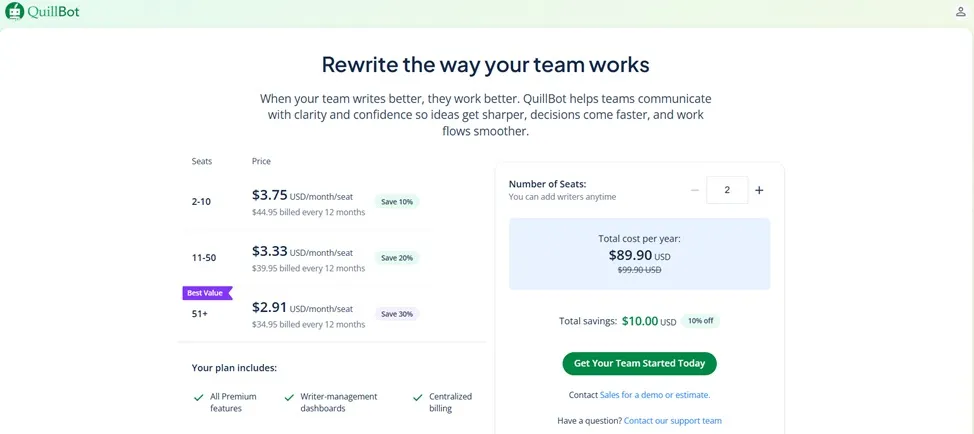
The Quillbot pricing plans are:
Individual Plans:
- Free: $0 per month
- Premium: $4.17 per month
Team Plans:
- 2-10 Seats: $3.75 per month per seat ($44.95 per year)
- 11-50 Seats: $3.33 per month per seat ($39.95 per year)
- 51+ Seats: $2.91 per month per seat ($34.95 per year)
Final Thoughts
?
Quillbot is a great tool with many features and built-in tools. However, if you ask me if it is the best, I would bluntly say “NO.”
While it is excellent for catching “lazy” AI use, it can be tricked by clever editing and can sometimes unfairly flag formal human writing. So, it can be a valuable part of your writing process, but you shouldn’t treat its words as gospel.
It is a guide, a helper, and a “boringness” checker all rolled into one. If you write with heart, personality, and a bit of rhythmic flair, you have nothing to fear from a machine. Keep writing, keep being human, and use these tools to sharpen your skills rather than replace them.