
How Mavlers Agency Approaches End-to-End Marketing Execution for B2B Demand Generation
Mavlers Agency approaches B2B demand generation by connecting SEO, paid media, content marketing, automation, and sales alignment into a coordinated strategy focused on qualified leads and pipeline growth.

B2B demand generation goes beyond attracting leads. The challenge is reaching decision-makers and keeping them engaged before they’re ready to buy. Disconnected SEO, paid advertising, content, and email campaigns can disrupt this journey.
According to 6sense’s 2026 B2B Buyer Experience Report:
- 59% of the buying journey is completed before buyers contact sellers.
- 92% of winning vendors are on the buyer’s initial shortlist.
These findings highlight the importance of early marketing engagement. End-to-end marketing execution connects channels through shared goals, coordinated campaigns, and performance tracking.
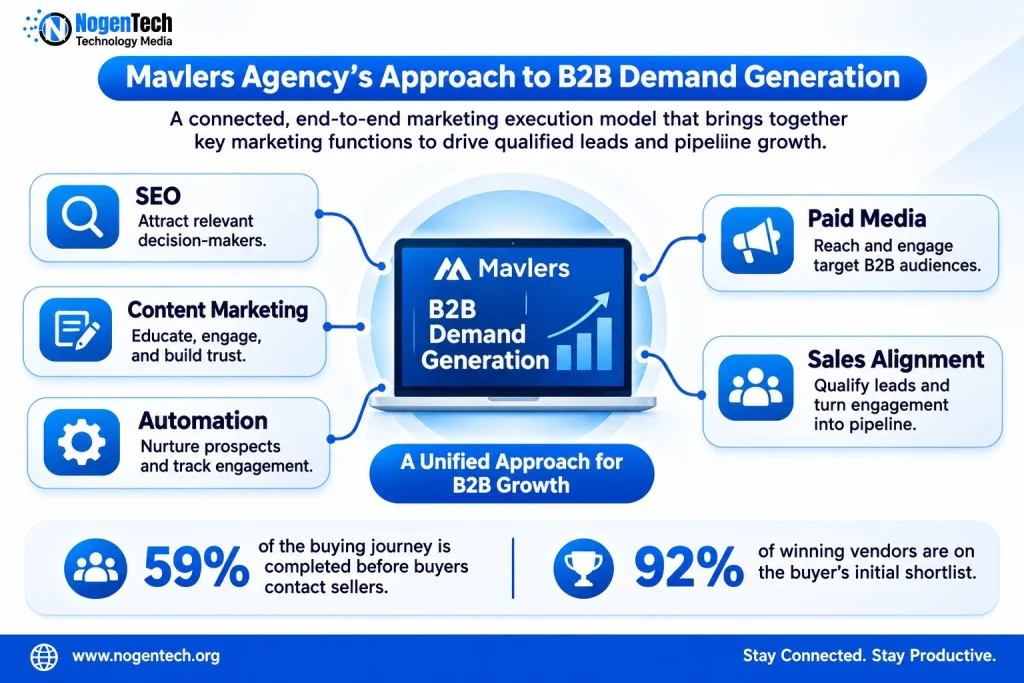
Here’s how Mavlers Agency uses this approach to support B2B demand generation and qualified sales opportunities.
1. Connecting Marketing Across the B2B Buying Journey
B2B purchases often involve multiple decision-makers, longer sales cycles, and detailed research. A buyer might discover a company through Google, read its content, attend a webinar, and later contact sales.
Each interaction should support the next stage of the buying journey.
For example, SEO can attract potential customers, educational content can answer their questions, and email campaigns can maintain engagement until they’re ready for a sales conversation.
Connecting these channels creates a more consistent experience and helps businesses guide prospects from awareness to consideration and purchase.
2. Aligning Marketing With Revenue Goals
Website traffic, content output, and lead volume are useful metrics, but they don’t always indicate revenue contribution.
Research from LinkedIn’s B2B Institute highlights the importance of balancing long-term brand building with short-term sales activation to support B2B growth.
For example, a B2B software company could combine SEO, thought leadership, paid campaigns, and email nurturing to reach buyers in a target industry. These activities can support broader B2B marketing strategies focused on reaching relevant business audiences.
As a specialized Demand generation agency, Mavlers describes its approach as building and running pipeline engines for growing companies. This focuses marketing execution on broader business objectives rather than isolated campaign activities.
3. Maintaining Consistent Brand Messaging
B2B buyers interact with brands through websites, advertisements, social media, emails, and sales presentations. When these channels communicate different messages, potential customers may struggle to understand the company’s value.
End-to-end execution helps maintain consistent positioning, audience targeting, and messaging across marketing activities. Each channel can use a different format while communicating the same core value proposition. This helps build brand familiarity, credibility, and trust throughout the buying journey.
4. Connecting Content Creation With Distribution
Publishing useful content is important, but it must also reach the right audience. An integrated approach connects content creation with SEO, paid advertising, social media, email marketing, and sales activities.
For example, a B2B software company could turn one industry report into:
- SEO articles addressing related buyer questions.
- LinkedIn posts highlighting important findings.
- Paid campaigns targeting relevant professionals.
- Email content nurturing interested prospects.
- Sales resources supporting customer conversations.
This allows one content asset to serve multiple purposes instead of remaining limited to a single publishing channel.
5. Integrating Marketing Technology and Customer Data
B2B marketing often relies on CRM platforms, marketing automation, analytics tools, and advertising systems. When these platforms operate separately, businesses may struggle to track how prospects interact with different campaigns.
Connecting these systems can help teams understand buyer behavior, manage lead nurturing, and evaluate campaign performance.
For example, CRM data can provide sales context, while marketing automation supports follow-up communication based on prospect engagement.
However, technology alone isn’t enough. Reliable data, clear workflows, and effective coordination are equally important.
6. Improving Marketing and Sales Alignment
Generating more leads doesn’t necessarily mean creating more sales opportunities. Marketing teams may focus on form submissions, while sales teams need prospects with relevant business requirements, purchasing authority, and realistic budgets.
End-to-end execution helps both teams agree on lead qualification criteria and establish a clear process for moving prospects toward sales conversations. Sales feedback can also improve marketing content and targeting.
For example, recurring customer questions about implementation costs can guide the creation of more useful educational resources. This alignment helps businesses prioritize lead quality rather than lead volume alone.
7. Measuring and Optimizing Marketing Performance
Measuring individual campaign results is useful, but businesses also need to understand how marketing contributes to the sales pipeline. Important B2B demand generation metrics include:
- Marketing-qualified leads (MQLs) and sales-qualified leads (SQLs).
- Lead-to-opportunity conversion rates.
- Cost per qualified lead.
- Engagement from target audiences.
- Marketing contribution to the sales pipeline.
- Customer acquisition costs.
These metrics help identify which activities generate relevant opportunities and where improvements are needed.
For instance, high advertising traffic with few qualified leads may indicate problems with audience targeting, messaging, or landing pages.
Connecting campaign analytics with CRM and sales data provides a clearer view of marketing performance and helps businesses measure marketing automation ROI.
As Darshan Modi, Director – Digital Growth & AI Search at Mavlers Agency, explains:
“End-to-end marketing execution is not about running more campaigns across more channels. It is about connecting every activity to a shared business objective, using reliable data to understand buyer interactions, and ensuring that marketing efforts contribute to meaningful pipeline outcomes.”
8. Working With a Cross-Channel Marketing Partner
Managing multiple marketing channels can be difficult for businesses with limited internal resources. Working with separate agencies for SEO, paid media, content, and web development may also create communication gaps and coordination challenges.
Mavlers Agency supports B2B marketing execution through several services, including:
- SEO and organic visibility.
- Paid media campaign management.
- Content and email marketing.
- Creative services.
- Web development.
Bringing these capabilities together can help businesses coordinate campaigns and maintain consistent execution. However, businesses should evaluate more than service availability when choosing a marketing partner.
Cross-channel expertise, reporting processes, technology capabilities, scalability, and accountability also matter. The right partner should complement internal teams and connect marketing execution with measurable business objectives.
Final Thoughts: Making B2B Demand Generation Work Together
B2B demand generation works more effectively when marketing activities support the same business goals. Connecting content, campaigns, technology, sales, and performance measurement can help businesses reach relevant buyers and develop qualified opportunities.
Mavlers Agency’s cross-channel approach reflects this model by bringing different marketing services together to support coordinated execution.
The key is not running more campaigns, but ensuring that each activity contributes to a consistent buyer experience and a stronger sales pipeline.