Jury Rejects Musk’s Case Against OpenAI in Less Than Two Hours as Two-Year Legal War Finally Ends
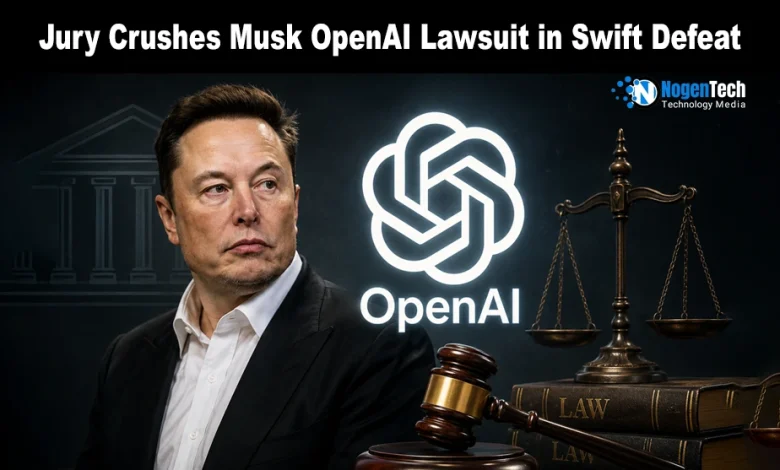
A unanimous nine-member jury in Oakland rejected every claim Elon Musk brought against Sam Altman, Greg Brockman, OpenAI, and Microsoft, finding that Musk had waited too long to file, with Judge Yvonne Gonzalez Rogers dismissing the case.

KEY TAKEAWAYS
- The jury unanimously found that Musk’s claims fell outside a three-year statute of limitations, ending the case on procedural rather than substantive grounds.
- The verdict came less than two hours after deliberations began at 8:30 a.m. PT, interrupting a damages hearing already underway in the courtroom.
- Musk called the decision a “calendar technicality” on X and announced his intention to appeal; OpenAI’s lead attorney William Savitt said it was “a substantive decision.”
- OpenAI confirmed it remains on track for a public offering, with the legal cloud that had been listed as a formal risk in its IPO documents now removed.
A two-year legal battle, three surviving claims, a federal trial that lasted three weeks, and testimony from some of Silicon Valley’s most influential figures, all resolved in under two hours.
As CNBC confirmed, a nine-member advisory jury in Oakland unanimously rejected Elon Musk’s lawsuit against Sam Altman, Greg Brockman, OpenAI, and Microsoft on May 18, 2026, ruling that Musk had waited too long to file.
District Court Judge Yvonne Gonzalez Rogers immediately adopted the verdict and dismissed the case after receiving the decision at 10:23 a.m. Pacific Time during the first morning of jury deliberations.
Why the Case Failed on Statute of Limitations
The jury never reached the substance of whether OpenAI broke its charitable trust. The court found that any harms Musk suffered as a result of OpenAI’s transition from a nonprofit to a for-profit entity occurred before 2021, placing them outside the three-year filing window.
Musk filed the lawsuit in November 2024. OpenAI argued he had known about the company’s commercial direction for years and delayed the filing just to weaponize litigation against rival xAI, which closed its $6 billion funding round in April that same year.
As the outlet notes, William Savitt, OpenAI’s lead attorney, told reporters outside the courthouse: “It’s not a technical decision, it’s a substantive one.
It says: You brought your claims too late, and you did it because you were sitting on them to use them as a weapon against a competitor.”
What Musk’s Own Testimony Revealed and What It Cost Him
The trial produced moments that damaged Musk’s case regardless of the verdict.
As The New York Times confirmed, OpenAI’s lawyers presented internal communications showing that Musk himself had proposed a for-profit structure for OpenAI in 2017.
The documents also revealed that he had, at various points, suggested folding the company into Tesla to secure the capital needed to compete.
Musk’s own admission about Grok model distillation using OpenAI models further underscored the close ties he once embraced.
The jury also heard from multiple witnesses who testified that Musk had been kept informed of the company’s commercial direction throughout the period he later claimed a betrayal.
Judge Yvonne Gonzalez Rogers was sharply critical during the pretrial hearing, telling Musk’s expert witness, Dr. C. Paul Wazzan, that “Your analysis seems to be devoid of connection to the underlying facts.”
The rebuke suggested the court found the claimed damages figure of $79 billion to $134 billion unconvincing even before the jury reached its conclusion.
What Both Sides Said and What Comes Next
Musk posted on X within hours of the ruling, calling it “a calendar technicality” and reaffirming his belief that Sam Altman and Greg Brockman had betrayed OpenAI’s founding mission.
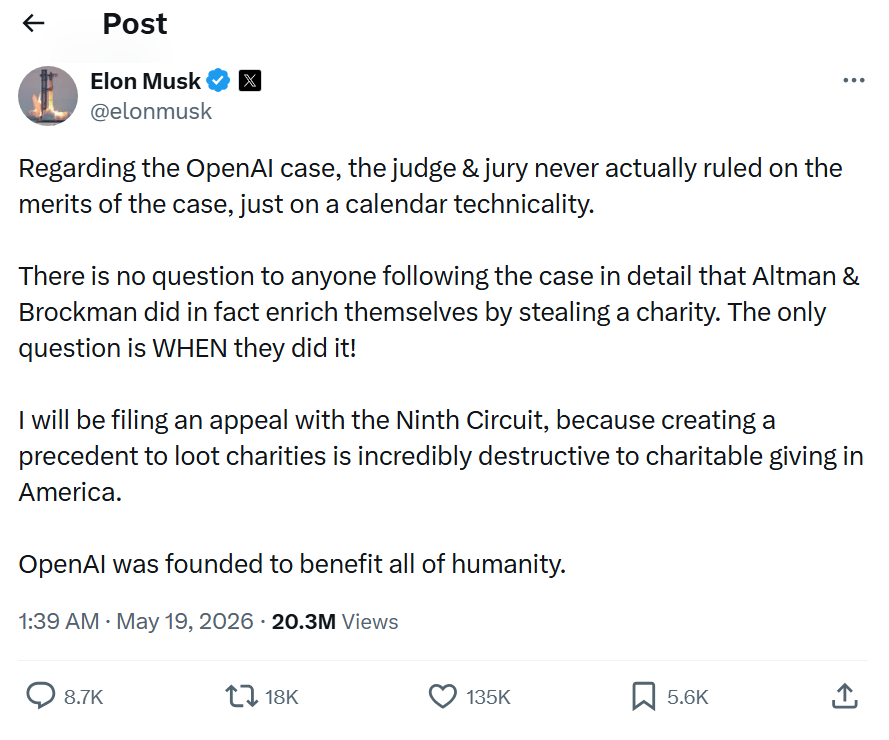
The claim had been central to his legal team’s case, but they failed to convince the jury on the merits.
He announced his intention to appeal. Altman did not speak to reporters outside the courthouse, as per CNBC.
OpenAI President Greg Brockman, who had testified during the trial about his 2017 diary entry, cited by Judge Gonzalez herself in her January ruling as damaging evidence, also made no public statement.
For OpenAI, the verdict removes the largest single legal uncertainty from its prospectus ahead of what Bloomberg has reported could be a public offering as early as October 2026, targeting a valuation the company hopes reaches $1 trillion.
The case that began as a challenge to how OpenAI defines its mission ended as a lesson in how long you can wait before a courthouse will hear it.
Source: Musk slams Altman trial verdict as a ‘technicality,’ vows to appeal