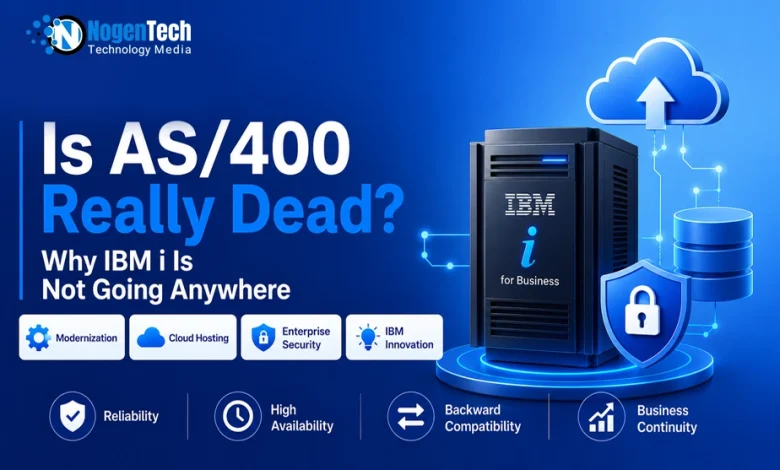
Is AS/400 really reaching its end of life, or is it another technology myth that refuses to fade away?
For years, predictions have claimed that AS/400 is obsolete and that businesses should move away from IBM i. Yet organizations across banking, healthcare, cloud technology, manufacturing, insurance, and logistics continue to rely on it for mission-critical operations.
The confusion often comes from equating aging hardware with an outdated platform. While some IBM Power Systems models and IBM i releases eventually reach the end of support, IBM i itself continues to evolve through;
- Modernization
- Cloud hosting
- Stronger security
- Ongoing IBM innovation
Now, moving forward, you will explore common AS/400 end-of-life myths and why IBM i remains a reliable platform for modern businesses.
What Is AS/400 and Why Do Companies Still Use It?
AS/400 is a business computing platform introduced by IBM in 1988 to run critical applications, manage data, and support core business operations.
It was designed to provide:
- Application hosting
- Database management
- Digital Signage
- Transaction processing
- Enterprise resource planning (ERP)
- Inventory and supply chain management
- Financial and customer data management
Over time, it evolved through iSeries and System i before becoming IBM i, which runs on IBM Power Systems servers today.
Many businesses continue using IBM i because of its:
- Reliability
- Security
- High availability
- Backward compatibility
- Ability to support critical business applications
Because maintaining these platforms requires highly specialized knowledge, many enterprises actively rely on dedicated third-party vendor ecosystems that provide IBM AS400 support to manage their infrastructure, address system vulnerabilities, and ensure operational continuity.
This is why AS/400 end-of-life discussions can be misleading. While certain hardware models and IBM i releases eventually lose support, the platform itself remains actively used and continues to evolve.
What Does AS/400 End of Life Actually Mean?
AS/400 end of life refers to the point when specific IBM hardware models, IBM i operating system releases, or related software products no longer receive updates, maintenance, or vendor support.
Many organizations assume AS/400 end of life means the entire platform is being discontinued. However, that is not the case.
In most situations, what reaches the end of support includes:
- Older IBM Power servers
- Specific IBM i releases
- Backup and recovery solutions
- Third-party applications
- Security and monitoring tools
As an example, a company may still run a stable IBM i application, but the server hosting it could lose hardware maintenance coverage, or the operating system version may no longer receive security updates.
This is where much of the confusion begins. There is a major difference between:
- A platform reaching the end of life
- Hardware reaching end of support
- Software versions are becoming unsupported
While individual components eventually require upgrades or replacement, IBM continues to invest in IBM i and IBM Power Systems.
As a result, many organizations choose to refresh hardware, upgrade operating systems, or modernize workloads rather than replace the entire environment.
What are the Common AS/400 End-of-Life Myths?
The most common AS/400 end-of-life myths are that the platform is obsolete, cannot move to the cloud, and no longer has skilled professionals available to support it.
However, these misconceptions often confuse unsupported hardware or software versions with the IBM i operating system itself.
While certain IBM Power Systems models and IBM i releases eventually reach the end of support, IBM i remains widely used across industries and continues to receive ongoing development and support.
Myth #1: AS/400 Is Obsolete
One of the most common myths is that AS/400 is obsolete because it has been around for decades.
In reality, many organizations still run critical applications on IBM i because it remains reliable, secure, and capable of handling modern workloads.
One of its biggest strengths is backward compatibility. Applications developed years ago can often run on modern IBM Power Systems with little or no modification.
This helps businesses:
- Protect existing technology investments
- Avoid costly application rewrites
- Maintain operational continuity
- Upgrade infrastructure with minimal disruption
For example, companies continue using IBM i applications to process orders, manage inventory, and handle financial transactions because they remain stable and effective.
Many organizations keep IBM i because it continues to deliver business value, not because they are resisting change.
Myth #2: IBM i Cannot Move to the Cloud
Another common myth is that IBM i cannot support cloud adoption.
Although IBM i does not run on every public cloud platform like Linux or Windows, it can operate in cloud environments through:
- IBM Cloud environments
- Hosted IBM Power infrastructure
- Managed service providers
- Hybrid cloud deployments
- Disaster recovery cloud solutions
In many cases, organizations can move IBM i workloads to cloud-hosted IBM Power Systems without replacing existing applications.
This can provide:
- Reduced infrastructure management
- Improved disaster recovery
- Greater scalability
- Lower hardware maintenance costs
- Increased operational flexibility
For many businesses, cloud migration is a modernization strategy rather than a complete replacement project.
Myth #3: No One Can Support AS/400 Anymore
The retirement of experienced IBM i professionals has created concerns about long-term support.
However, IBM i still has an active support ecosystem and supports modern technologies such as:
- SQL
- Java
- Python
- PHP
- .NET
- APIs
- Web services
The bigger challenge is maintaining expertise in areas such as:
- System administration
- Security management
- Performance tuning
- Backup and recovery
- Upgrade planning
To address these gaps, many organizations work with IBM i managed service providers and specialized support partners.
The issue is not that support has disappeared. The real challenge is ensuring the right skills and support strategy are available to maintain and modernize the environment.
What Actually Reaches End of Life in an IBM i Environment?
In an IBM i environment, hardware, operating system releases, and third-party software can reach end of support, but the IBM i platform itself does not.
Components that commonly reach the end of life include:
- Older IBM Power servers
- IBM i operating system releases
- Backup and recovery solutions
- Security and monitoring tools
- Third-party applications and integrations
When this happens, businesses typically address the issue through hardware upgrades, OS updates, cloud migration, or modernization projects rather than replacing the entire IBM i environment.
Why Replacing AS/400 Often Creates More Risk Than Value?
Replacing AS/400 often creates more risk than value because many IBM i applications contain decades of business logic, workflows, and processes that are difficult to recreate.
Over the years, organizations have customized their IBM i applications to support:
- Business rules
- Regulatory requirements
- Pricing structures
- Customer-specific processes
- Reporting and compliance needs
Much of this knowledge is embedded within the applications themselves and may not exist in documentation.
As a result, replacement projects often face challenges such as:
- Higher implementation costs
- Longer project timelines
- Data migration issues
- Integration complexities
- Operational disruptions
For many businesses, upgrading, modernizing, or migrating IBM i workloads is often less risky than replacing an environment that already supports critical operations.
How Businesses Can Modernize IBM i Without a Full Replacement
Businesses can modernize IBM i without a full replacement by:
- Upgrading infrastructure
- Adopting cloud services
- Improving user experiences
- Integrating modern applications with existing systems
Common modernization approaches include:
- Upgrading to supported IBM i releases
- Refreshing IBM Power hardware
- Migrating workloads to cloud-hosted environments
- Modernizing green-screen interfaces
- Integrating APIs and web services
- Strengthening security and disaster recovery
These strategies allow organizations to improve performance, scalability, and user experience while preserving existing business logic and applications.
For many businesses, modernization provides a practical path forward because it reduces operational risk, protects technology investments, and extends the value of their IBM i environment without complexity
People Also Ask About
How long do IBM i applications typically last?
IBM i applications can remain operational for decades because of the platform’s strong backward compatibility. Many organizations still run applications developed years ago while continuing to upgrade their hardware and operating systems.
What are the biggest risks of running unsupported IBM i systems?
Running unsupported IBM i systems can increase security vulnerabilities, compliance risks, hardware maintenance challenges, and the likelihood of operational disruptions due to unavailable vendor support and software updates.
Can IBM i integrate with modern applications and technologies?
Yes. IBM i supports APIs, web services, SQL, Java, Python, .NET, and other modern technologies, making it possible to integrate with cloud platforms, web applications, and third-party business systems.
How do businesses know when it’s time to upgrade their IBM i environment?
Businesses should consider upgrading when their hardware or operating system reaches the end of support, performance requirements increase, security concerns arise, or modernization initiatives require newer IBM i capabilities.
Which industries rely most on IBM i today?
IBM i remains widely used in industries that require reliability and high transaction processing, including banking, healthcare, manufacturing, insurance, retail, distribution, and logistics.
At the End, IBM i's Future Depends on the Right Strategy
AS/400 end-of-life discussions often focus on the platform’s age rather than its capabilities.
While older IBM Power Systems, IBM i releases, and third-party tools may eventually reach the end of support, IBM i remains a reliable platform for running critical business applications.
In my opinion, most organizations are better served by upgrading, modernizing, or migrating workloads to supported environments rather than pursuing costly replacements.
The real priority is maintaining a secure, supported, and future-ready IBM i environment that continues to deliver long-term business value.