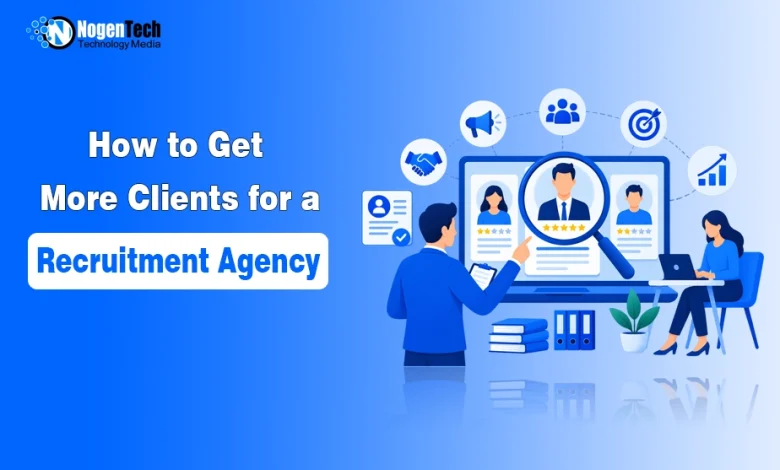
Most staffing agencies suffer from a pipeline problem rather than a fulfillment problem. When client acquisition relies too heavily on cold calls, sporadic referrals, or monitoring job boards, growth remains unpredictable.
The landscape is increasingly difficult, as candidates lose trust in job platforms where an estimated one in five listings may be a “ghost job” posted without an immediate intention to hire. Consistent scaling requires shifting from random tactics to a predictable system combining multiple acquisition channels.
According to Bullhorn’s 2026 APAC GRID recruitment industry research, agencies using AI at any stage of the recruitment process were three to five times more likely to have grown revenue in 2025. Here are eight practical strategies agencies can use to build a more reliable client pipeline.
8 Strategies to Get Clients for a Recruitment Agency
1. Define a Clear Recruitment Niche
Business development becomes easier when you establish your agency as a niche authority rather than a generalist firm. While multinationals can afford to be generalists, boutique agencies thrive by owning a highly specific market.
Employers pay recruitment fees because they cannot find specialized talent themselves; they want partners who understand specific market trends and already possess candidate communities.
To stand out, explicitly define your industry, geography, company size, roles filled, and ideal hiring decision-maker. Targeting a tight niche—like data center specialists in Texas — makes your outreach, website messaging, and content highly relevant, without permanently limiting future expansion.
2. Build an Inbound Pipeline With SEO and Useful Content
Once you define a niche, ensure employers can find you when they actively search for hiring help. Recruitment agencies should make sure their websites are visible when employers search for specialist hiring support, as qualified employer inquiries are more valuable than general traffic.
You can capture this intent by building “micro destination pages” tailored to long-tail searches, such as “forensic accounting recruitment agency Manchester.”
Transform your website from a digital brochure into a hub of expertise by offering sector-specific service pages, location pages, salary guides, hiring reports, and recruitment case studies.
Agencies without the resources to manage search internally may consider specialist SEO for recruitment agencies when the objective is to generate qualified employer inquiries. Optimizing structural elements like H1 headings and URL slugs ensures sustainable SEO growth and signals authority to search engines and prospective clients.
3. Turn Referrals Into a Repeatable System
Referrals should be actively encouraged rather than treated as a happy accident. The most underutilized time to generate an introduction is immediately after a successful placement, during the “honeymoon phase” when client satisfaction is highest.
Instead of waiting for word-of-mouth, proactively ask satisfied clients for introductions. Make these requests specific rather than vaguely asking if they “know anyone.” Placed candidates can also become valuable sources of employer introductions as they advance in their careers.
Keep the process relationship-driven. If you use referral incentives, structure them carefully so the introduction still feels genuine rather than purely transactional.
4. Watch for Hiring Signals
Before sending outreach, identify companies likely to need support by watching for specific market triggers. A cluster of new job openings can be a useful hiring signal, particularly when combined with other triggers such as funding, geographic expansion, product launches, or leadership changes.
Relevant signals include multiple new job postings within the last 24 hours, expansion into new locations, and leadership changes. For example, a sudden spike in sales and marketing roles can suggest that a company is preparing for market expansion.
By timing outreach to these visible business needs, your message becomes more relevant than contacting random companies hoping for a vacancy.
5. Personalize LinkedIn and Email Outreach
Outbound prospecting remains a highly effective lead-generation strategy, provided your messages are relevant and targeted. Traditional staffing outreach fails because it focuses on generic agency credentials rather than the employer’s immediate problems.
Instead of sending high-volume spam, use advanced personalization by referencing a current vacancy, recent company milestone, or specific candidate market challenge.
Deeply researched, signal-based outreach can achieve reply rates of around 18% in high-performing campaigns, although results vary substantially by audience, offer, timing, and deliverability.
Focus your messages on the employer’s likely hiring problem and offer a low-friction piece of value, like a workforce audit. Follow up thoughtfully with simple, open-ended questions.
6. Build Authority Before Asking for Business
Demonstrating undeniable expertise before making a direct sales pitch is essential. Recruiters sit on valuable market intelligence, yet they often fail to leverage it publicly.
Build a recognizable persona by publishing authority-building content, such as salary benchmarks, hiring-market updates, candidate availability insights, and interview advice for employers.
Sharing short LinkedIn insights or sector-specific recruitment trends creates familiarity before the first meeting. Providing useful expertise gives hiring managers a reason to remember your agency and trust your industry perspective, even when they are not ready to hire immediately.
7. Network Where Your Ideal Clients Spend Time
Stop attending broad networking events simply to collect business cards. Instead, pursue targeted networking where your ideal clients spend their time. Focus on industry conferences, sector associations, employer-focused webinars, and relevant LinkedIn discussions aligned with your niche.
To accelerate the sales cycle, contribute useful insights, co-host intimate workshops, and engage with a prospect’s content several times before pitching your services. Physical and real-time digital interactions build trust and familiarity more effectively than static networking alone.
8. Reactivate and Expand Existing Accounts
Agency growth does not always require hunting for completely new companies. Expanding a satisfied existing account can be more efficient than acquiring a completely new client.
Implement a systematic reactivation approach to reconnect with previous clients, dormant accounts, or hiring managers who have recently changed employers.
Too often, agencies experience a slowdown because they fail to cross-sell services to different departments or locations within existing clients. Stay in touch after successful placements and position yourself as a long-term workforce advisor.
Account expansion can be an efficient complement to new-business prospecting and help create a more resilient pipeline.
Final Takeaway
You do not need to use every acquisition method at once. Choose two or three channels that best suit your niche and execute them consistently before attempting to automate your workflows.
Track meaningful outcomes such as employer conversations, qualified inquiries, meetings booked, and new vacancies won, rather than vanity metrics.
As a practical next step, map out your ideal customer profile today and draft one piece of highly relevant content that addresses their most urgent hiring challenge.