Apple’s New HomeView Smart Display Needs Your iPhone to Actually Work
Apple HomeView recognizes faces and personalizes itself for up to six people in a household, but that entire pitch depends on a paired, recently unlocked iPhone, the same requirement that's keeping the $299 device off the market in the European Union entirely.

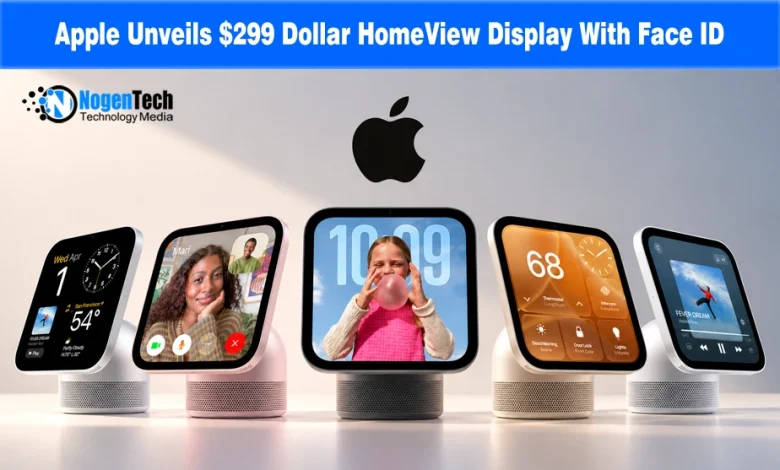
Apple introduced HomeView on Monday, a 7-inch smart display built around facial recognition and its newly rebuilt Siri AI. The device recognizes up to six people by face, giving each one their own Home Screen, private Messages and Calendar access, and personalized responses.
Shared content like photo albums and music stays available to the whole household. Pre-orders opened immediately in six markets: Australia, Canada, India, New Zealand, the UK, and the US, with shipping beginning November 13 at $299 for either the tabletop or wall-mounted version.
A Feature List Apple Didn’t Headline
Apple’s fine print reveals some limitations missing from its main launch event.
The updated Siri AI runs exclusively as an English-only beta on HomeView software version 27.2.
Apple also says that some cloud-based Apple Intelligence tools carry strict daily usage caps. The company confirmed paid tiers will unlock higher limits in future updates.
Apple indeed markets Siri AI as a next-gen assistant, yet the $299 HomeView ships with beta software, usage limits, and restricted language support.
The EU Can’t Buy This at Any Price
Apple states plainly that HomeView “is not available for sale in the European Union,” attributing the gap to Siri AI’s unavailability on iOS in the region, a restriction the company has linked to the EU’s Digital Markets Act since confirming it in June.
HomeView’s personalization works entirely on a paired iPhone or iPad that has been recently unlocked and is running compatible software, to authenticate users and surface private Messages or Calendar data.
Because Apple suspended Siri AI on iOS in the EU over data interoperability mandates, HomeView cannot run its core trick.
Siri AI itself does reach EU users through macOS and visionOS, but HomeView’s core trick depends specifically on the iPhone pairing that the DMA restriction blocks.
However, Apple says it’s “working constructively with the EU” on a path forward.
Privacy Architecture Cuts Both Ways
Apple built HomeView’s privacy model to be its main differentiator against Amazon’s Echo Show, which displays ads and ties personalization to Alexa’s own data practices.
On HomeView, personal content only surfaces when a face is recognized, and a paired device confirms presence. Siri requests aren’t stored, and camera and microphone data are processed in isolated Secure Enclaves that even Apple can’t access.
That offers a significantly stronger privacy stance than rival smart home upgrade options like Amazon’s Echo Show 8 or Google’s aging Nest Hub lineup.
But as HomeView isolates personal data until a nearby paired iPhone authenticates the user, this closed ecosystem directly violates the European Union’s interoperability rules.
Because Apple cannot operate its hardware-linked authentication loop under local regulation, the company blocked the display’s sale across all EU member states.
Source: Introducing Apple Home Collection, a new lineup of smart home accessories