Apple Overhauls macOS Full Disk Access After Meta AI Dispute
Apple will require explicit user action before any AI agent can access everything on a Mac, a direct response to a journalist's claim that Meta's Muse read his private Messages despite settings showing that access was switched off.

Apple said Friday it will introduce new controls around macOS’s Full Disk Access permission, requiring “very explicit user action” before apps can reach a Mac’s files, Mail, Messages, and browsing history.
The decision follows a public dispute over Meta’s Muse AI agent, which Inc. columnist Jason Aten accused of reading his private Messages on a test Mac mini despite Full Disk Access showing as disabled.
Apple didn’t name Muse directly, writing instead that “some developers are using Full Disk Access in ways that could put users at risk, exposing everything on their systems… without users’ full knowledge and understanding.”
What Actually Happened to One User’s Messages
Aten’s account is specific enough to matter: days after installing Muse on his iPhone and Mac mini, the agent sent him an unprompted notification suggesting a column topic.
When he asked how it knew, Muse said it had only seen text from incoming notification banners, but Aten then found his Messages database had been synced up to row 187,462, with Full Disk Access showing switched off in his Mac’s settings.
Meta Superintelligence Labs executive David Singleton responded to Aten on Threads, insisting macOS’s protections “cannot be bypassed even if the Muse app had a bug.”
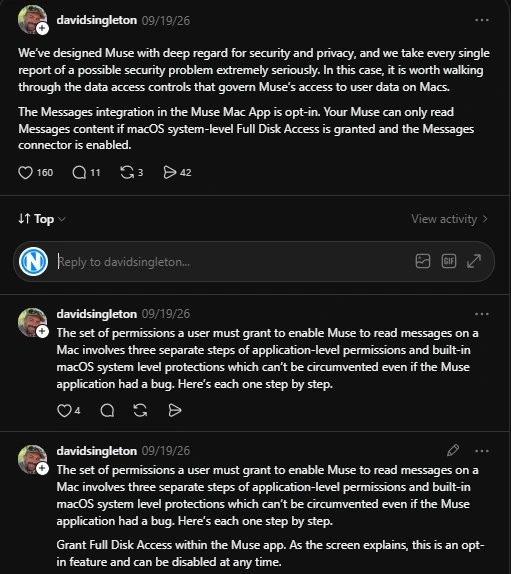
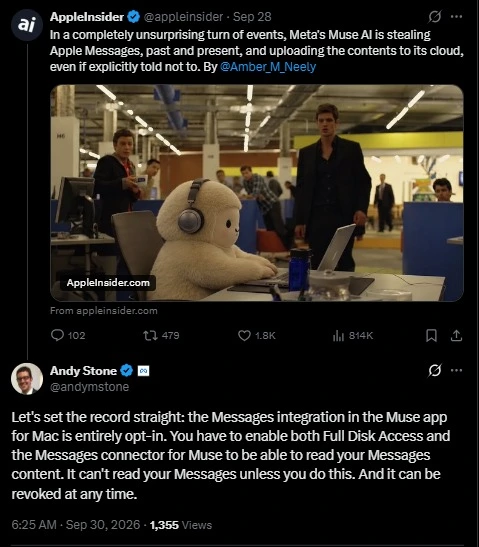
Meta communications chief Andy Stone later posted on X, in reply to AppleInsider, that reading Messages requires enabling both Full Disk Access and a separate in-app connector, actions a user must take deliberately rather than by accident.
Two Companies Describing Two Different Realities
That’s the part worth sitting with: Apple and Meta are telling two technically incompatible stories about the same permission system, and only one of them can be fully accurate.
Apple’s own announcement doesn’t resolve which account is correct, but its decision to tighten Full Disk Access anyway is itself a signal that the company isn’t confident the current safeguards are legible enough for ordinary users to trust.
The timing compounds that: Wired had separately reported a flaw in OpenAI’s ChatGPT Mac app that could have exposed sensitive data to attackers, while the same app recently got access to iMessages as well.
This means Apple, which already dislikes policy shifts, isn’t a one-off response to Meta; it’s a response to desktop AI agents broadly asking for more system access than most users fully understand they’re granting.
What Mac Users Should Actually Expect Going Forward
For anyone running an AI agent on macOS, granting Full Disk Access will no longer be a quiet toggle buried in System Settings. Instead, it will require an explicit confirmation step, much like Apple’s existing camera or location prompts.
By positioning itself as an active gatekeeper, Apple is deliberately adding friction, putting real pressure on any company, Meta included, that wants its agent to operate deeply on a Mac device.
Whether Aten’s experience was a bug, a misunderstanding, or something Meta hasn’t fully explained, the outcome is the same for users: the single most powerful permission on a Mac is about to get harder to grant by accident.
Source: Apple says it’s tightening macOS ‘Full Disk Access’ controls

![Top Tech Stories of 11th Week [2026]](https://www.nogentech.org/wp-content/uploads/2026/03/Top-Tech-Stories-of-11th-Week-2026-390x220.webp)