
If newer cryptocurrencies offer faster speeds and more features, why does Bitcoin still lead the market?
More than 15 years after its launch, Bitcoin remains the largest and most widely recognised cryptocurrency. Despite thousands of alternatives entering the market, it continues to be the benchmark against which every new blockchain is compared.
So in this guide, I’ll show you the key factors behind Bitcoin’s position, including:
- Market dominance
- Network security
- Proof of Work
- Decentralisation
- Fixed supply
- Comparison with other cryptocurrencies
Rather than focusing on price or investment returns, this article explores the qualities that continue to make Bitcoin the benchmark for the cryptocurrency market.
What Is Bitcoin Dominance?
Bitcoin dominance measures Bitcoin’s share of the total crypto market. A higher percentage suggests more money is flowing into Bitcoin than other cryptocurrencies.
Bitcoin dominance (BTC.D) shows how much of the cryptocurrency market’s total value belongs to Bitcoin. In 2026, it has generally remained between 56% and 63%, meaning Bitcoin continues to hold the largest share of the market.
Several factors have helped maintain that position:
- Spot Bitcoin ETFs have attracted significant institutional investment into Bitcoin, while broader adoption continues to be driven by evolving crypto marketing strategies.
- Many institutional investors continue to favour Bitcoin over smaller cryptocurrencies.
- Bitcoin’s long track record and broad market acceptance have strengthened investor confidence.
While Bitcoin dominance isn’t a measure of future performance, it remains one of the clearest indicators of where confidence is concentrated across the cryptocurrency market.
Does Bitcoin's First Mover Advantage Still Matter?
Yes. Bitcoin’s biggest advantage isn’t that it was the first cryptocurrency, but that it has spent more than 17 years proving it can operate reliably at scale.
Being first only matters if you continue to earn trust. Since launching in 2009, Bitcoin has maintained its core network without a successful attack on its consensus mechanism, giving it the longest operating history of any cryptocurrency.
That track record matters because many investors, businesses, and institutions value stability over newer features. While several cryptocurrencies offer faster transactions or additional functionality, Bitcoin’s long history of reliability has helped it remain the benchmark for the broader crypto market.
| Cryptocurrency | Years of Operation | Major Network Disruptions |
|---|---|---|
| Bitcoin | 17 | None affecting consensus |
| Ethereum | 11 | The DAO exploit (2016) |
| Solana | 6 | Multiple network outages |
| BNB Chain | 6 | Temporary network halt (2022) |
Bitcoin’s security comes from its global mining network and unmatched computing power, making it the most computationally secure blockchain to date.
Over more than 17 years, Bitcoin has continued operating through market crashes, regulatory changes, and growing adoption. Its Proof of Work (PoW) system and enormous mining network are key reasons many investors and institutions trust it.
What Is Bitcoin Hash Rate?
Hash rate is the total computing power miners use to validate transactions and protect the Bitcoin blockchain. A higher hash rate makes attacks far more difficult and expensive.
In 2026, Bitcoin’s hash rate reached approximately 855 exahashes per second (EH/s), the highest of any cryptocurrency. This level of computing power makes it extremely costly to gain enough control to compromise the network.
Why Bitcoin’s Security Stands Out?
- Highest hash rate in the crypto market.
- Global mining network spread across many countries.
- Automatic difficulty adjustment keeps block production stable.
| Cryptocurrency | Security Model | Network Strength |
|---|---|---|
| Bitcoin | Proof of Work | Highest recorded hash rate |
| Ethereum | Proof of Stake | Large validator network |
| Solana | Proof of History + Proof of Stake | Smaller validator network |
| Bitcoin Cash | Proof of Work | Much lower hash rate |
Bitcoin has also proven resilient in real-world situations. After China banned Bitcoin mining in 2021, mining activity briefly declined, but the protocol adjusted automatically and continued operating without interruption.
Because the network processes a continuous stream of transactions across thousands of nodes, developers and analysts often utilize specialized data extraction tools to parse on-chain ledger activity.
Why Does Bitcoin Still Use Proof of Work?
Bitcoin continues to use Proof of Work because it prioritises security, decentralisation, and long-term stability over lower energy consumption.
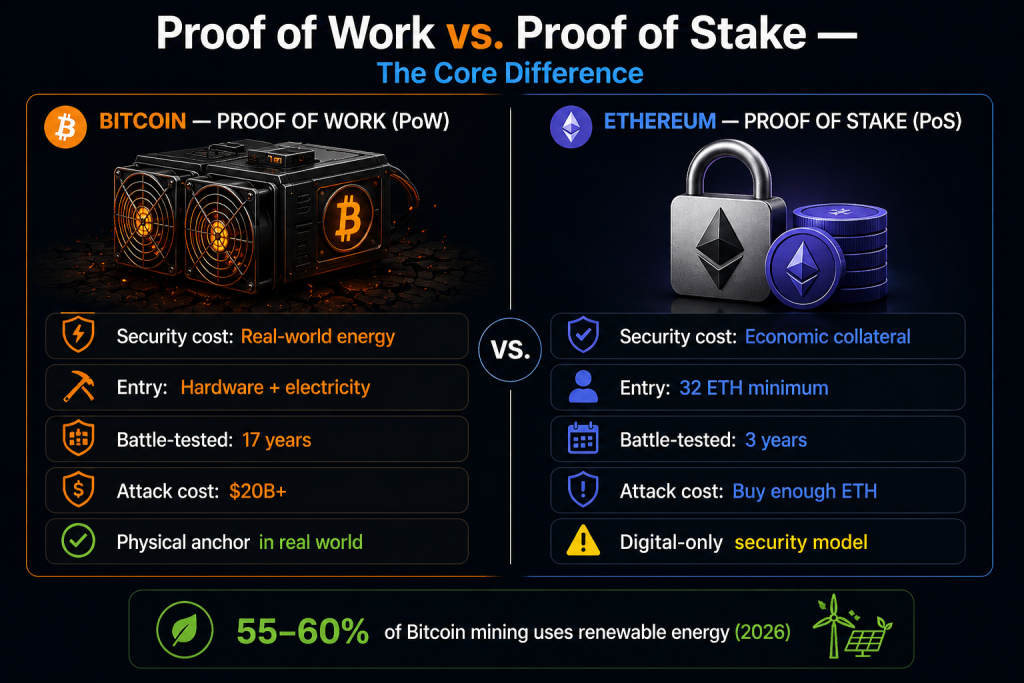
Instead of Proof of Stake, which relies on participants locking up cryptocurrency to validate transactions, Proof of Work uses computing power to secure the network. Bitcoin has kept this approach since its launch in 2009, while many newer blockchains like Ethereum have adopted different consensus models.
| Factor | Proof of Work (Bitcoin) | Proof of Stake (Ethereum) |
|---|---|---|
| Validation | Mining | Staking |
| Energy use | Higher | Lower |
| Network security | Computing power | Staked assets |
| Operating history | Since 2009 | Since Ethereum’s 2022 Merge |
Is Bitcoin Decentralised?
Yes. Bitcoin is one of the most decentralised cryptocurrencies because no single person, company, or government controls the network.
Bitcoin runs on thousands of independently operated nodes worldwide that verify transactions and enforce the network’s rules. Instead of relying on a central authority, important protocol changes require broad agreement across the community.
Why Bitcoin’s Decentralisation Matters?
Bitcoin’s decentralised design offers several advantages:
- No central authority controls the network.
- Global node network reduces single points of failure.
- Broad community consensus is needed for protocol changes.
- Greater resistance to censorship than many blockchain networks.
Why Does Bitcoin's 21 Million Supply Cap Matter?
Bitcoin’s supply is permanently limited to 21 million coins, making it one of the few major cryptocurrencies with a fixed maximum supply.
In contrast with many assets that can increase in supply over time, Bitcoin follows a predetermined issuance schedule built into its protocol.
New bitcoins are released through mining, and the rate of issuance is automatically reduced roughly every four years through an event known as the halving.
How Bitcoin Compares?
| Cryptocurrency | Supply Model |
|---|---|
| Bitcoin | Fixed cap of 21 million |
| Ethereum | No fixed supply cap |
| Solana | Inflationary supply |
| Dogecoin | Unlimited supply |
By 2026, around 95% of all bitcoins had already been mined, with the remaining coins scheduled to be released gradually until around 2140.
For many investors, Bitcoin’s fixed supply is one of its biggest advantages because it makes the issuance of new coins predictable and resistant to arbitrary changes.
How Is Bitcoin Different From Ethereum?
Bitcoin is designed to be a digital store of value, while Ethereum is designed to power smart contracts and decentralised applications.
Although Bitcoin and Ethereum are the two largest cryptocurrencies, they were created for different purposes. Bitcoin focuses on secure value transfer and long-term scarcity, whereas Ethereum prioritises flexibility for developers building blockchain-based applications.
Bitcoin vs Ethereum: Which Is Better?
Neither is universally better. Bitcoin is generally preferred as a long-term store of value, while Ethereum is better suited for smart contracts and decentralised applications.
| Feature | Bitcoin | Ethereum |
|---|---|---|
| Primary purpose | Digital money and store of value | Smart contract platform |
| Supply | Fixed 21 million BTC | No fixed supply cap |
| Consensus | Proof of Work | Proof of Stake |
| Main use | Payments and long-term holding | dApps, DeFi, NFTs |
For many investors, Bitcoin is viewed as a long-term store of value, while Ethereum is often chosen for its broader application ecosystem. Which is better depends on what you want to achieve, but their goals are fundamentally different.
What are the Limitations of Bitcoin?
Bitcoin isn’t the best cryptocurrency for every use case. Its biggest limitations include slower transactions, limited smart contract functionality, and higher energy consumption than many newer blockchains.
While Bitcoin remains the largest cryptocurrency by market value, other blockchain networks outperform it in specific areas.
| Use Case | Better Known For | Why |
|---|---|---|
| Smart contracts | Ethereum | Built for decentralised applications |
| High transaction speed | Solana | Faster and lower-cost transactions |
| Privacy | Monero | Privacy-focused by default |
| Energy efficiency | Ethereum | Proof of Stake uses much less energy |
These differences don’t necessarily make Bitcoin worse. Instead, they reflect different design priorities.
While Bitcoin focuses on network security over instant throughput, users managing liquidity often rely on specific exchange routes or off-ramps for cashing out Bitcoin quickly.
For many investors, that trade-off is worthwhile. Although Bitcoin may not lead every category, its long track record, fixed supply, and broad market trust continue to make it the benchmark against which other cryptocurrencies are measured.
People Ask More About Bitcoin as the Best Cryptocurrency
Why is Bitcoin often called digital gold?
Bitcoin is called digital gold because its supply is permanently limited to 21 million coins. Like gold, it’s widely viewed as a store of value, but it can also be transferred and stored digitally.
Is Bitcoin more secure than other cryptocurrencies?
Bitcoin is widely regarded as one of the most secure cryptocurrencies because of its large mining network, high hash rate, and more than 17 years of uninterrupted operation.
Why does Bitcoin have a 21 million supply cap?
Bitcoin’s supply is capped at 21 million coins to create digital scarcity. The limit is built into the protocol, making the issuance of new bitcoins predictable and resistant to arbitrary changes.
Is Bitcoin still a good long-term investment?
Many investors consider Bitcoin a long-term investment because of its fixed supply, broad adoption, and long operating history. However, its price remains volatile, so investment decisions should always reflect your financial goals and risk tolerance.
What makes Bitcoin different from other cryptocurrencies?
Bitcoin focuses on being a secure, decentralised store of value, while many other cryptocurrencies prioritise features such as smart contracts, faster transactions, or privacy.
My Final Words on Bitcoin
Bitcoin isn’t the best cryptocurrency at everything, and it doesn’t need to be. Other blockchain networks excel in areas such as smart contracts, transaction speed, or privacy.
After looking at the evidence, I believe Bitcoin continues to stand out because of its security, decentralisation, fixed supply, and long track record. Those qualities have helped it remain the cryptocurrency that investors, institutions, and businesses trust most.
If your goal is long-term value and reliability rather than the latest features, Bitcoin remains a strong choice.