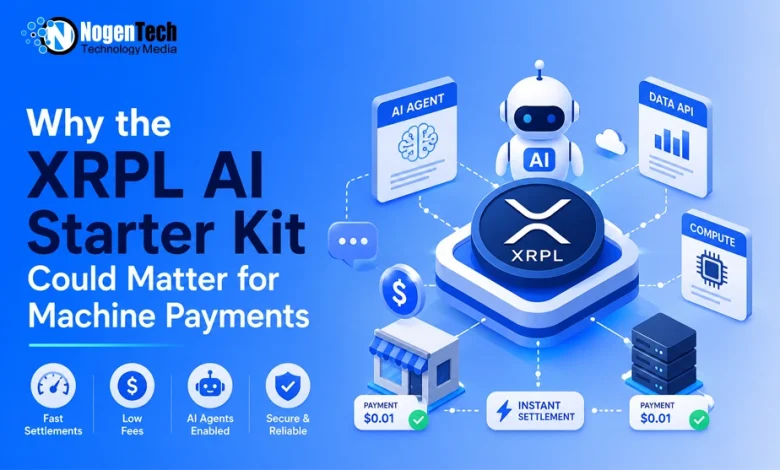
AI is now transitioning from passive to active. Rather than simply answering questions or summarizing documents, AI systems are specifically being built to book services, request information, trigger workflows, and make decisions with minimal or no human intervention.
That change brings about a new payment issue. In a world where these software agents may be required to run alone, they might also have to pay alone.
The XRPL AI Starter Kit may be ideal for investors who are tracking the XRP price live on the Binance platform: machine payments are speedy and low-cost, with automated value transfers as the broader use case of the XRP Ledger.

AI Agents Need Payment Rails
The Web we know today was not designed for an environment in which machines keep paying each other. Online payment systems are geared towards individuals entering their card information, confirming bank transfers, signing in to accounts, etc. This is fine for humans, but not so fine for autonomous software.
An AI agent might need to pay a couple of cents for access to a data feed, buy compute power, unlock an API call, pay some other service to do something, or pay a small business process in real-time. That kind of activity is something that traditional payment systems are often too slow, too expensive, and too manual for.
This is where blockchain payments come into the picture in AI. A fast, cost-effective network for small transactions could provide AI agents with a more natural way to conduct them. The XRPL AI Starter Kit is significant as it provides developers with a starting point for creating such applications on the XRP Ledger.
Why XRPL Fits the Machine Payment Idea
The XRP Ledger has been renowned for its swift settlements and minimal transaction fees since its inception. While those characteristics are worthwhile for cross-border payments, they can be even more significant for machine payments.
People will accept a bit of friction on their human payments. They’ve gotten accustomed to waiting for confirmations, paying card fees and having them taken out of the total, or adding their own passwords to transactions. Scalable machines require something different. For hundreds or thousands of small transactions, it’s important that each one is low-cost and economically viable for the AI agent to make.
For instance, this is where XRPL’s design comes into play. The payment rail for an AI agent must be predictable, with reliable uptime and quick finality. It should also facilitate automated workflows without making each transaction feel like a major financial occurrence.
Those characteristics could make XRPL more than just a platform for transferring funds from one institution or individual to another if developers can build on these traits. It could serve as a settlement layer for software.
The Starter Kit Lowers the Developer Barrier
The starter kit is important because developers seldom start from scratch. They require templates, tools, examples, and clear pathways. It’s not enough for a blockchain to boast that AI-payment developers will love the network for being fast. It should demonstrate to the builders how they can integrate AI agents with wallets, payments, balances, and transaction logic.
The XRPL AI Starter Kit can assist in this regard by providing developers with a hands-on foundation for their exploration. A team developing an AI agent might not want to put in the weeks of work required to understand all the ledger’s technicalities before they can try out a payments concept. The starter kit can accelerate adoption by simplifying the creation of agent wallets, initiating XRP or stablecoin payments, and linking payments to AI workflows.
This is significant as the AI-agent market is still in its infancy. These networks, which are gaining developer interest today, could influence how payments are handled in the future for agent applications.
XRP and RLUSD Could Serve Different Roles
Machine payments need not be based on a single asset. XRP can be of use for fees, liquidity, and quick settlement. Stablecoins like RLUSD can be helpful when programmers wish to receive payments in U.S. dollars, which are simpler for companies to cost and report on.
For example, this makes a two-rail model. A stablecoin can give a known value unit, and XRP can give a network utility native to the blockchain. That combination might be feasible for AI agents. A service can be paid for in a dollar-based stablecoin by one agent, and the underlying network can remain reliant on XRP for the mechanics of the transactions.
Moreover, this may also enhance XRPL’s appeal to businesses. Cryptos are quite volatile, and many companies don’t want to risk having volatility for each payment. They can opt for stablecoin accounting while enjoying blockchain settlement. The ability to do both with XRPL increases the flexibility of its use in machine payments.
Micropayments Could Become a Real Use Case
Micropayments have been a topic of discussion in crypto for years, and have had mixed fortunes when it comes to gaining traction. AI may change that. Many small economic transactions can be processed by machines without requiring human approval.
A specialized dataset can be used, and an AI research agent can be paid for access. A customer service agent might have to pay for another tool to check on information. A logistics agent could charge a small fee for routing data. A content agent might license a paragraph, image, or translation in one fell swoop. These are not the typical consumer payments. They’re from machine-to-machine transactions.
Payment needs to be very low-cost, programmable, and almost invisible – for this to work. This is where the XRPL AI Starter Kit can come in handy. It can help developers test whether these small automated payments can be integrated into real software products.
The Challenge Is Trust and Control
Machine payments also pose risks. Developers should have robust controls if AI agents are permitted to make financial transactions. The agent needs to be capped on the amount of money it can spend, to whom, what permissions it has and how errors are treated.
Nobody wants an AI agent to make a mistake and spend a wallet, pay the wrong bill, or approve bogus requests. This means that payment infrastructure should feature payment safeguards like spending limits, payment rules, identity checks and monitoring.
This is where the future of machine payments will be determined. Just being fast isn’t enough. Developers have to be trusted, audited, and given clear control. Whether XRPL’s tools will help facilitate safe automation beyond just fast transactions will be key to its edge.
Machine Payments Could Be XRP’s Next Utility Test
The true measure will be the use of the XRPL AI Starter Kit to develop products that address real-world problems. AI-agent payments will only be relevant if they enhance interactions of software, data, services, and business.
It’s an opportunity for XRP to grow its identity. It might be more than just a payment token or a traded asset and could be a component of a larger machine economy, with automated systems moving value in real time.
That’s the way ahead, though not a certainty. AI will need to become more autonomous, and so will payments. Ultimately, XRPL has a solid chance to facilitate that transformation, and the AI Starter Kit could be one of the tools that kickstarts developer efforts in that direction.