Can cryptocurrency do more than generate short-term profits?
More investors are beginning to ask a different question: can it become part of a secure financial future?
The answer depends less on the coins you buy and more on the strategy you build around them.
Now I will let you know about:
- Use crypto for long-term wealth
- Balance risk and opportunity
- Protect your investments
- Plan beyond market cycles
- Avoid costly mistakes
- Build lasting financial security
When used with the right strategy, cryptocurrency can become more than a speculative investment. It can be part of a stronger, more resilient financial future.
Is Cryptocurrency a Realistic Tool for Long-Term Financial Security?
Yes, but only when it’s treated as part of a diversified, long-term financial plan rather than a way to make quick profits.
Over the past decade, cryptocurrency has evolved from a niche technology into an established asset class. As of 2026:
- 560–741 million people worldwide own cryptocurrency.
- Spot Bitcoin ETFs manage more than $115 billion in assets.
- 194 public companies hold Bitcoin on their balance sheets.
- The United States established a Strategic Bitcoin Reserve in 2025.
These developments show that cryptocurrency is becoming a recognised part of the global financial system. However, it remains a high-risk investment and should complement, not replace, traditional savings and investments.
Who Is Cryptocurrency Suitable For?
Cryptocurrency may suit long-term investors who:
- Have an emergency fund and stable finances.
- Can invest for at least 3–5 years.
- Understand that prices can fall 60–80% during bear markets.
- Invest only a small portion of their overall portfolio.
It may not be suitable if you:
- Need the money within the next year.
- Are paying off high-interest debt.
- Have little or no emergency savings.
- Expect guaranteed or predictable returns.
How Can You Build a Long-Term Crypto Strategy?
The most effective long-term crypto strategy for most investors is dollar-cost averaging into Bitcoin and Ethereum, holding for complete market cycles, and resisting every urge to trade actively.
Simple buy-and-hold strategies consistently outperform active trading over complete market cycles for the vast majority of retail participants.
Dollar-Cost Averaging and Why Consistency Beats Timing
Dollar-cost averaging (DCA) means investing a fixed amount on a fixed schedule, regardless of price, news, or market sentiment.
Why it works for crypto specifically:
- Removes the impossible task of timing a highly volatile market
- Automatically buys more units when prices are low and fewer when high
- Eliminates emotional decision-making at the point of purchase
- Builds meaningful exposure over time without requiring large lump sums
A practical starting point: decide on a monthly amount you can sustain for 24+ months without financial strain. Set up automatic recurring purchases. Then don’t change the schedule based on what the market is doing.
Which Cryptocurrencies Are Suitable for Long-Term Holding?
Not all cryptocurrencies are built for long-term wealth building. Most aren’t. Identifying assets capable of lasting multiple market cycles requires evaluating the core key value drivers in crypto.
| Asset | Long-Term Case | Risk Level |
|---|---|---|
| Bitcoin (BTC) | Fixed 21M supply, 17-year track record, institutional adoption, regulatory clarity | Medium |
| Ethereum (ETH) | Smart contract platform, DeFi infrastructure, active development | Medium-high |
| Selected large-cap alts | Case-by-case — requires genuine utility analysis | High |
| Meme coins/small-cap alts | No defensible long-term case for most | Very high |
For most people building a long-term financial future, Bitcoin forms the majority of the crypto allocation. Ethereum is a reasonable secondary position. Everything beyond these two requires specific justification, not speculation.
How Long You Actually Need to Hold?
Bitcoin has delivered positive returns to every investor who held for any four years in its history.
That four-year figure corresponds to the halving cycle, the built-in supply reduction that occurs every four years and has historically preceded major price appreciation.
Minimum recommended time horizons:
- Bitcoin: 4 years minimum (spans one full halving cycle)
- Ethereum: 3–4 years
- Any altcoin: 2–3 years minimum, and only if the project has genuine utility
If you’re not prepared to hold through a significant correction without selling, don’t buy in the first place. That decision is better made before entering a position than during a 50% drawdown.
How Can You Protect Your Wealth During Bear Markets?
Bear markets are not exceptions in crypto; they are regular, predictable features of every market cycle. The investors who build long-term wealth are the ones who prepare for them in advance, not react to them during.
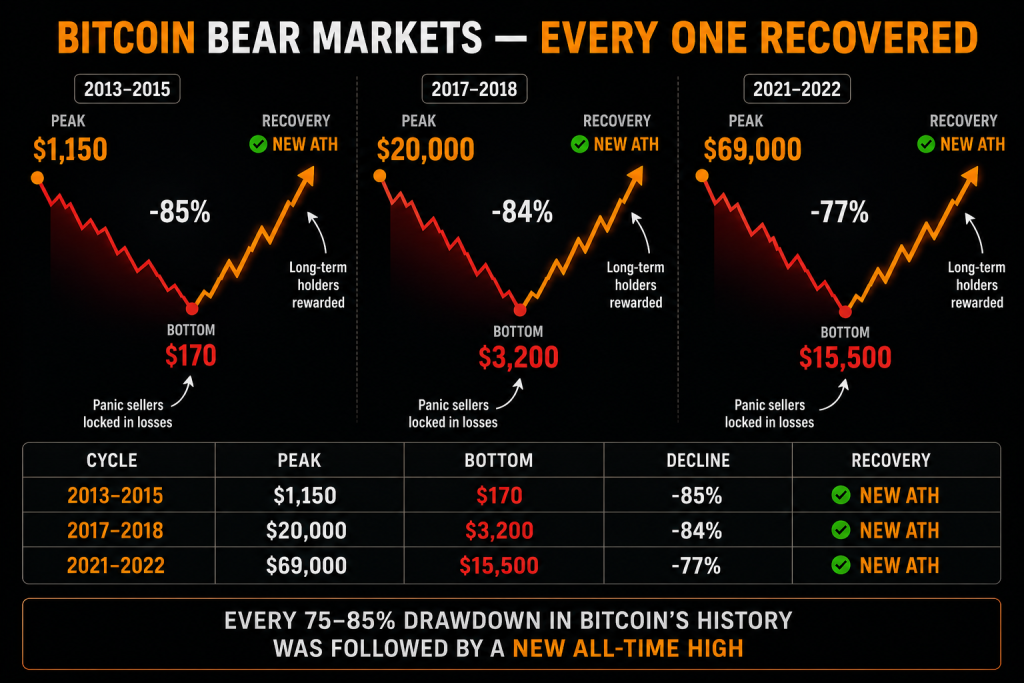
Bitcoin has experienced multiple 75–85% drawdowns in its history while still delivering exceptional long-term returns for patient holders.
The 2022 bear market saw Bitcoin fall from ~$69,000 to ~$15,500. The 2018 bear market saw a decline from $20,000 to $3,200.
What to Do During a Bear Market?
The best approach during a bear market is to stay focused on your long-term investment plan rather than reacting to short-term price declines.
If your financial goals and the fundamentals of your investments haven’t changed, temporary market volatility alone shouldn’t determine your decisions.
Do:
- Continue your DCA schedule; lower prices mean your fixed amount buys more
- Focus on whether your holdings’ fundamentals have changed rather than whether the price has changed
- Use the time to strengthen security, review your allocation, and research
Don’t:
- Sell because of price movement alone
- Check prices daily; frequent monitoring leads to emotional decisions
- Add leverage or “buy the dip” with more than your planned DCA amount
- Make decisions based on social media sentiment or news headlines
Why Long-Term Holders Win and Short-Term Traders Lose?
The pattern is documented and consistent. People buy after greed, and FOMO takes over, then sell into fear once volatility spikes and prices fall. That buy-high, sell-low cycle is common in crypto.
The investors who consistently build wealth follow a remarkably simple playbook: buy Bitcoin and/or Ethereum regularly, hold for multiple years, and resist the urge to trade frequently. The edge in crypto isn’t superior information; it’s superior patience.
How Should You Secure Your Cryptocurrency for the Future?
Long-term crypto wealth requires long-term security. The biggest threat to most investors isn’t market volatility; it’s losing access to their own funds through poor security practices.
In 2025, $3.4 billion was stolen through crypto hacks and scams. The Bybit breach alone accounted for $1.46 billion. Security is not optional; it’s the foundation everything else sits on.
Hot Wallets vs. Cold Storage: What Long-Term Holders Actually Use
| Storage Type | Best For | Risk Level |
|---|---|---|
| Exchange account | Small amounts, frequent trading | Counterparty risk — exchange can fail (FTX) |
| Software wallet (hot) | Medium amounts, regular transactions | Vulnerable to malware and phishing |
| Hardware wallet (cold) | Long-term holdings above $1,000 | Lowest risk — keys never touch the internet |
| Multi-signature setup | Large holdings ($50K+) | Highest security — multiple keys required |
For holdings above $1,000 that you’re planning to hold for years: a hardware wallet (Ledger or Trezor, $50–200) is the single best security investment you can make.
How to Protect Your Seed Phrase? The Most Critical Step Most People Get Wrong
Your seed phrase is the master key to your entire crypto holdings. If someone has it, they have everything. If you lose it, you lose everything.
Do:
- Write it on paper, multiple copies
- Store copies in separate physical locations (home safe + trusted family member’s safe)
- Consider a metal seed phrase backup for fire/water resistance
Never:
- Photograph your seed phrase
- Store it in cloud storage, email, or notes apps
- Type it into any website or app, ever
- Share it with anyone, regardless of who they claim to be
Legitimate platforms, wallets, and support teams will never ask for your seed phrase. If anyone does, it is a scam.
Security Practices Every Long-Term Holder Must Follow
- Enable 2FA using an authenticator app, not SMS, which is vulnerable to SIM-swapping attacks
- Use a dedicated email address for all crypto accounts, one that you don’t use for anything else
- Verify wallet addresses character by character before every transaction; clipboard hijacking malware replaces copied addresses
- Use only regulated, established exchanges; check proof of reserves and regulatory status before depositing
- Enable withdrawal address whitelisting where available; requires manual approval for sending to new addresses
- Keep software updated; hardware wallet firmware and wallet software updates often patch critical vulnerabilities
How Should Cryptocurrency Fit Into Your Long-Term Financial Plan?
Cryptocurrency can support long-term wealth building, but it works best as one part of a diversified financial plan rather than the entire strategy. While it offers significant growth potential, its volatility means it should complement traditional investments, not replace them.
A Balanced Portfolio Approach
A long-term financial plan should balance growth opportunities with stability and liquidity. One example allocation is:
| Asset Class | Example Allocation | Purpose |
|---|---|---|
| Stocks (Index Funds) | 50–60% | Long-term growth |
| Bonds | 15–25% | Stability and income |
| Real Estate or REITs | 10–15% | Diversification and inflation protection |
| Cash or Emergency Savings | 5–10% | Liquidity and financial security |
| Cryptocurrency | 3–10% | High-growth, higher-risk allocation |
Keeping cryptocurrency as a modest part of your portfolio allows you to benefit from its long-term potential while limiting the impact of market volatility on your overall financial future.
Can You Hold Cryptocurrency in a Retirement Account?
For US investors, cryptocurrency can also be held through self-directed crypto IRAs offered by providers such as BitcoinIRA, Alto IRA, and iTrustCapital.
These accounts follow the same tax rules as traditional retirement accounts:
- Traditional Crypto IRA: Contributions may be tax-deductible, while withdrawals are taxed as ordinary income.
- Roth Crypto IRA: Contributions are made with after-tax income, but qualified withdrawals are tax-free.
For 2026, the IRS contribution limits are:
- $7,500 per year for individuals under 50.
- $8,600 per year for individuals aged 50 and older.
Like other retirement accounts, withdrawals before age 59½ may be subject to a 10% early withdrawal penalty, unless an IRS exception applies.
What Mistakes Prevent Long-Term Success?
Building long-term wealth with cryptocurrency is often about avoiding common mistakes rather than making perfect investment decisions.
Common Mistakes to Avoid
- Relying only on crypto – Keep a diversified portfolio with traditional investments and emergency savings.
- Investing without a plan – Set clear financial goals and stick to your strategy.
- Chasing market hype – Don’t buy simply because a coin is trending or rising quickly.
- Ignoring security – Protect your wallet, recovery phrase, and accounts from scams and hacks.
- Expecting quick wealth – Building wealth takes time, patience, and realistic expectations.
- Not reviewing your portfolio – Rebalance your investments as your goals and financial situation change.
- Letting emotions drive decisions – Avoid reacting to short-term market swings instead of focusing on your long-term plan.
Adhering to the fundamental rules of crypto investing helps eliminate emotional decision-making, prevent costly mistakes, and keep your portfolio aligned with your long-term goals.
People Also Ask About Crypto to Secure the Future
Can cryptocurrency replace traditional investments?
No. Cryptocurrency is best used as part of a diversified portfolio rather than a replacement for stocks, bonds, retirement accounts, or emergency savings.
How long should I hold cryptocurrency to build long-term wealth?
Long-term investing typically means holding through complete market cycles, which may take several years rather than months. Patience is often more important than trying to time the market.
Is cryptocurrency suitable for retirement planning?
It can be. Some investors include cryptocurrency as a small part of their retirement strategy, but it should complement traditional retirement savings rather than replace them.
How often should I review my crypto portfolio?
Review your portfolio periodically, such as once or twice a year, or after significant life or financial changes. Avoid making decisions based on daily price movements.
What happens to my cryptocurrency if I lose access to my wallet?
Without your recovery phrase or private keys, your cryptocurrency may be permanently inaccessible. Secure backups and an inheritance plan are essential for long-term holders.
What’s the biggest challenge of building wealth with cryptocurrency?
The biggest challenge is staying disciplined during market volatility. Long-term success often depends on following your investment plan instead of reacting to short-term price swings.
My Final Thoughts on Crypto to Secure Future
After researching cryptocurrency for years, one thing has become clear to me: long-term success isn’t about finding the perfect coin. It’s about following a plan you can stick to through every market cycle.
For me, cryptocurrency isn’t a replacement for traditional investing. It’s one part of a broader financial strategy that includes diversification, disciplined investing, strong security, and patience.
If I could leave you with three takeaways, they would be:
- Think long term, not short term.
- Protect your assets as carefully as you grow them.
- Let strategy guide your decisions, not market emotions.
No one can predict where crypto prices will be next month or next year. But building good financial habits today gives you a much better chance of benefiting from cryptocurrency over the long run. That’s what building a secure future with cryptocurrency means to me.