
What Is Functional Programming? How It Works and Its Benefits
A beginner-friendly guide to pure functions, immutability and map, filter, reduce.

Have you ever looked at a piece of code and wondered, “Okay, but what is this actually doing?” You change one variable, and suddenly, something else stops working. Frustrating, right? That’s exactly the problem functional programming helps to avoid.
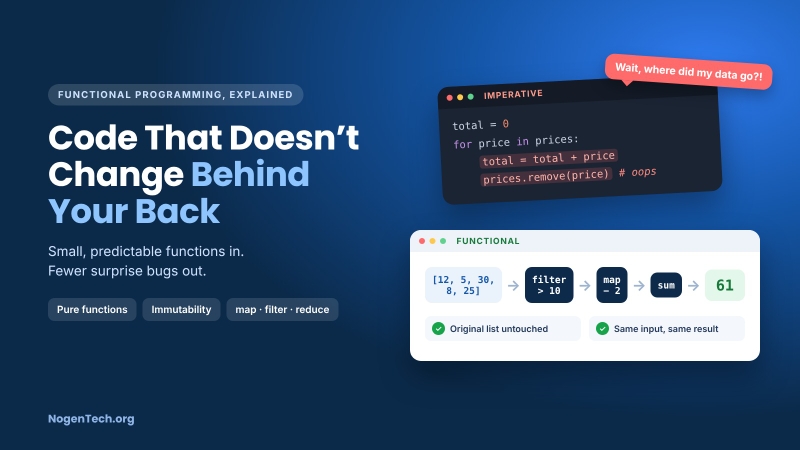
While working on a shopping app, I once changed a shared cart total from $100 to $80 to apply a discount. But when I checked the receipt, it showed $80 instead of the original $100. I had fixed one problem but accidentally created another.
That’s one reason functional programming caught my attention. It encourages developers to use smaller functions that return new values instead of constantly changing shared data. So, let’s break it down. I’ll explain what functional programming actually means, explore its core concepts, compare it with other programming approaches, and walk through some practical examples to show how you can start using it in your own projects. Let’s start with the basics.
What is Functional Programming?
Start creating Verdict in seconds, and convert more of your visitors into leads.
Functional programming(often shortened to FP) is a way of writing code where you build programs out of small functions that take an input, give back an output, and don’t change anything else along the way. It can also be understood as a programming paradigm in which a program’s logic is mainly built by applying and combining functions.
Let’s understand this with a simple example.
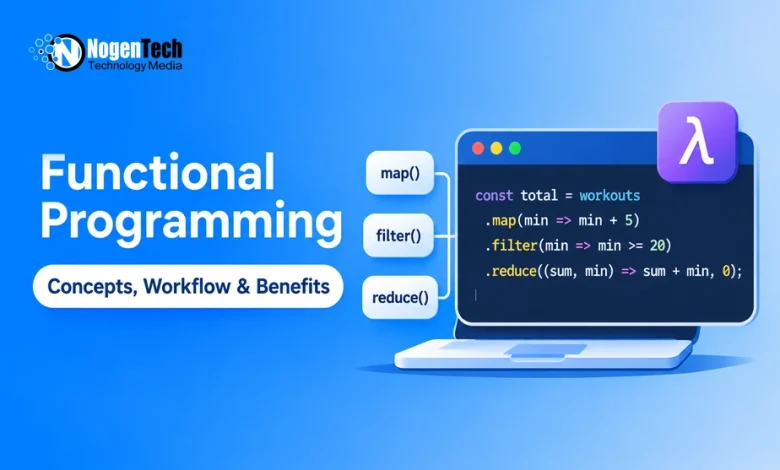
Imagine you’re building a fitness app. You have a list of workout minutes for the week, and you want to add 5 bonus minutes to each session, keep only the sessions that lasted at least 20 minutes, and calculate the total. Each function performs one task, and its result is passed to the next function.
Here’s how you can do that using JavaScript:
 const workouts = [10, 25, 40, 15];

const updated = workouts.map(min => min + 5);

const longSessions = updated.filter(min => min >= 20);

const total = longSessions.reduce((sum, min) => sum + min, 0);

console.log(updated);      // [15, 30, 45, 20]

console.log(longSessions); // [30, 45, 20]

console.log(total);        // 95
Here’s what’s happening:
- map() adds five bonus minutes to every session.
- filter() keeps only sessions of 20 minutes and/or more.
- reduce(): adds the remaining minutes together.
- Notice that the original workouts array remains unchanged. Each operation produces a new result that the next operation can use.
Why Do Developers Use Functional Programming?
Start creating Verdict in seconds, and convert more of your visitors into leads.
So, why do developers use functional programming when traditional programming approaches already work?
The main reason is predictability.
When code constantly changes shared variables or depends on hidden information, understanding what happens next can become difficult. Functional programming encourages developers to write smaller functions, avoid unnecessary changes to existing data, and keep side effects under control.
Here are some important benefits:
- Easier testing: Pure functions produce predictable results, making them easier to test.
At first, I thought testing was only done at the end. Then I realized that code that always produces the same output is much easier to test. And this is also the foundation of good testing practices.
- Better code reuse: Higher-order functions allow developers to reuse behavior without repeating the same logic.
- Better concurrency management: Reducing shared mutable state can make it easier to coordinate tasks running at the same time.
Of course, these benefits don’t mean functional programming automatically makes every application faster or better. Its usefulness depends on the problem you’re trying to solve. Functional programming isn’t the only way to structure code, though there is another approach called object-oriented programming.
Functional Programming vs. Object-Oriented Programming
Start creating Verdict in seconds, and convert more of your visitors into leads.
Functional programming and object-oriented programming (OOP) are two different approaches to organizing software.
Functional programming emphasizes functions and data transformations, while object-oriented programming organizes code around objects that combine data and behavior.
Here’s a simple comparison:
| Feature | Functional Programming | Object-Oriented Programming |
| Main focus | Functions and transformations | Objects and their behavior |
| Data handling | Often favors immutable data | Often uses objects with mutable state |
| Code organization | Functions and composition | Classes and objects |
| Reusability | Function composition and higher-order functions | Inheritance and composition |
| State management | Often minimizes shared mutable state | State may be maintained within objects |
| Common languages | Haskell, F#, Lisp | Java, C#, C++ |
Neither approach is universally better.
Functional programming can be useful when you want predictable transformations and limited side effects. OOP can be useful when modeling systems around objects with their own data and behavior.
Many modern programming languages support both approaches, so developers can combine them in the same application.
The 6 Core Concepts Behind Functional Programming
Start creating Verdict in seconds, and convert more of your visitors into leads.
Functional programming isn’t simply about replacing loops with map() or adding more functions to your code. It involves several fundamental ideas that help developers organize their programs.
Let’s explore six of the most important ones.
1. First-Class Functions and Higher-Order Functions
In many programming languages, functions can be treated like regular values. You can store them in variables, pass them to other functions, or return them from another function.
This is known as treating functions as first-class values.
For example:
const isEven = (number) => number % 2 === 0;

const numbers = [1, 2, 3, 4, 5, 6];

const evenNumbers = numbers.filter(isEven);

console.log(evenNumbers); // [2, 4, 6]
Here, the isEven function is passed directly to filter().
This brings us to higher-order functions. A higher-order function either accepts another function as an argument or returns a function as its result.
Common examples include map(), filter(), and reduce().
Why does this matter?
You can pass behavior around and reuse the same function in different parts of your application instead of repeating similar logic.
2. Pure Functions
A pure function has two main characteristics:
- It returns the same output whenever it receives the same input.
- It doesn’t produce side effects outside itself.
For example:
function calculateArea(width, height) {

  return width * height;

}

console.log(calculateArea(5, 4)); // 20
Give this function a width of 5 and a height of 4, and it will always return 20.
3. Immutability
Immutability means that once a value or data structure has been created, you avoid changing it in place.
If you need a different version, you create a new value based on the original.
For example:
 const prices = [10, 20, 30];

const updatedPrices = [...prices, 40];

console.log(prices);        // [10, 20, 30]

console.log(updatedPrices); // [10, 20, 30, 40]
Notice that the original prices array stays the same. The new array contains the additional value.
This can be particularly helpful when multiple parts of an application share data. One part of the program is less likely to unexpectedly change information another part relies on.
4. Function Composition
Function composition is the process of combining smaller functions to create a larger operation.
Imagine you have one function that converts Celsius to Fahrenheit and another that checks whether the converted temperature is above a certain value.
You can connect these operations instead of putting everything into one large function.
The earlier map(), filter(), and reduce() example demonstrates this idea.
Each function performs one specific task, and its output becomes the input for the next operation.
This makes complex operations easier to divide into smaller, reusable pieces.
5. Recursion
Functional programming often uses recursion for repetition.
A recursive function calls itself to solve a smaller version of the same problem. It needs a stopping condition, commonly called a base case, to prevent endless calls.
Here’s a simple example:
 function countDown(number) {

  if (number <= 0) {

    return;

  }

console.log(number);

  countDown(number - 1);

}

countDown(3); // 3, 2, 1
The function prints the current number and calls itself with a smaller value.
When the number reaches zero, the base case stops the process.
Recursion can be especially useful when working with nested structures, trees, and problems that naturally break into smaller versions of themselves.
However, it isn’t always better or faster than using a loop. The right choice depends on the language and the problem.
6. Pattern Matching and Closures:
Two other useful concepts associated with functional programming are pattern matching and closures.
Pattern matching allows a program to check the shape or type of a value and choose the matching case. It can make handling different kinds of data easier to understand.
Languages such as Scala and Rust support pattern matching directly. Closures are functions that retain access to variables from the surrounding scope where they were created.
For example:
function createMultiplier(multiplier) {

  return function (number) {

    return number * multiplier;

  };

}

const double = createMultiplier(2);

console.log(double(5)); // 10
The returned function remembers the value of multiplier, even after createMultiplier() has finished executing. With these six concepts in mind, you’re ready to try them in your own code.
How to Start Using Functional Programming: A Step-by-Step Guide
Start creating Verdict in seconds, and convert more of your visitors into leads.
You don’t need to rewrite an entire application or learn a completely new programming language to start using functional programming.
You can introduce its techniques into your existing JavaScript or Python projects.
Here’s a simple way to begin.
Step 1: Break Large Tasks Into Smaller Functions
Start by identifying different responsibilities in your code.
Instead of writing one large function that performs several unrelated tasks, divide it into smaller functions.
For example: I started by taking a simple order calculation and splitting it into smaller tasks instead of handling everything in one function. I created separate functions for calculating discounts and taxes.
 function calculateDiscount(price, discount) {

  return price - (price * discount / 100);

}

function calculateTax(price, tax) {

  return price + (price * tax / 100);

}

console.log(calculateTax(calculateDiscount(100, 10), 5));

// 94.5
Each function should have a clear responsibility.
Step 2: Try Using Pure Functions
Whenever possible, write functions that depend only on their inputs. For example:
 function calculateDiscount(price, discount) {

  return price - (price * discount / 100);

}

console.log(calculateDiscount(100, 10)); // 90
This function doesn’t depend on external variables or change anything outside itself. That makes its behavior easier to understand and test.
Step 3: Avoid Changing Existing Data Unnecessarily
Instead of modifying an existing array or object, try creating a new one. I also experimented with updating an array without modifying the original.
 const users = ["Tim", "Sara"];

const updatedUsers = [...users, "Ahmed"];

console.log(users);        // ["Tim", "Sara"]

console.log(updatedUsers); // ["Tim", "Sara", "Tim"]
When I ran this example, the original array stayed the same while the new array included Ahmed.
Step 4: Use map(), filter(), and reduce()
I tried three JavaScript methods that make working with arrays much easier.
 const prices = [100, 200, 300];

const discountedPrices = prices.map(price => price * 0.9);

const affordablePrices = discountedPrices.filter(price => price <= 200);

const total = affordablePrices.reduce((sum, price) => sum + price, 0);

console.log(discountedPrices); // [90, 180, 270]

console.log(affordablePrices); // [90, 180]

console.log(total);            // 270
These three JavaScript methods are useful starting points for functional programming.
- map() transforms each item in an array.
- filter() selects items that meet a condition.
- reduce() combines items into a single result.
Try using them for everyday tasks such as filtering products, calculating prices, or transforming user data.
Step 5: Combine Smaller Functions
Once you’ve created individual functions, try connecting them to build more complex operations. For example, you can transform a list, filter the results, and calculate a total using the same approach shown earlier. This is where function composition becomes useful.
Step 6: Keep Side Effects Under Control
Your application will still need to interact with databases, files, APIs, and users. You don’t need to eliminate those operations. Instead, keep them separate from the core calculations wherever practical. This makes the main logic easier to test and understand. I created a function that simply returned the calculated value.
 let cartTotal = 100;

function applyDiscount(total, discount) {

  return total - (total * discount / 100);

}

const discountedTotal = applyDiscount(cartTotal, 20);

console.log(discountedTotal); // 80

console.log(cartTotal);       // 100
I could calculate the discounted price without changing the original cart total. This made the code more predictable and reduced the chances of accidentally affecting other parts of the application. Now that you know how to apply these ideas, let’s look at which languages make it easiest.
Which Programming Languages Support Functional Programming?
Start creating Verdict in seconds, and convert more of your visitors into leads.
You don’t always need to learn a completely new language to explore functional programming. Several familiar languages support its concepts, although some encourage the approach more strongly than others.
Here are some examples:
- Haskell: A pure functional language that emphasizes pure functions, immutable data, and lazy evaluation.
- Lisp: One of the earliest influential languages associated with functional programming, particularly in list processing.
- ML: A functional language family known for features such as type inference and pattern matching.
- Scala: Combines functional programming with object-oriented programming.
- F#: A language that strongly supports functional programming while also offering other programming approaches.
- JavaScript: Supports functions as values, closures, higher-order functions, and array operations.
- Python: Supports functional techniques such as higher-order functions, lambda expressions, and immutable data structures.
- Java and C#: Both provide features that allow developers to use functional programming techniques alongside other styles.
The level of support varies. Some languages are designed around functional programming, while others let developers combine its techniques with imperative or object-oriented code. So far we’ve looked at the languages. Next, let’s see where developers actually use them.
Where Is Functional Programming Used in Real Life?
Start creating Verdict in seconds, and convert more of your visitors into leads.
Functional programming isn’t limited to classroom examples or small coding exercises. Its concepts are useful in different types of software development.
Here are some areas where developers can apply functional techniques.
- Data Processing: Functions such as map(), filter(), and reduce() are useful for transforming, selecting, and combining large collections of data.
- Web Development: JavaScript developers frequently use functional techniques when working with arrays, processing application data, and organizing reusable logic.
- Concurrent Applications: Immutable data and reduced shared state can help developers manage tasks that run simultaneously.
- Financial Software: Predictable calculations and clearly defined functions can be useful when applications perform calculations that need to be tested carefully. Before you rewrite everything, it’s worth asking whether this approach always makes sense.
These techniques can also be useful throughout the software development process, especially when you’re trying to keep your code easier to test and maintain.
Is Functional Programming Always the Best Choice?
Start creating Verdict in seconds, and convert more of your visitors into leads.
Not necessarily. Functional programming has plenty of advantages, but it isn’t a magic solution for every coding problem.
Some functional techniques introduce additional concepts that beginners or development teams may need time to understand. In certain situations, a simple loop or a direct sequence of instructions may be easier to read and maintain.
Pure functional programming also requires a deliberate approach to handling real-world operations such as database updates, file access, and network requests.
So, when should you use it? Consider functional programming when:
- You want predictable functions that are easier to test.
- You want to reduce unexpected changes to shared information.
- You need reusable operations that can be combined.
- You’re working on logic that benefits from clear input and output relationships.
And when should you avoid forcing it? If a straightforward imperative solution is easier for your team to understand, there’s no reason to replace it just to follow a particular programming style.
The practical takeaway is simple: use functional programming techniques when they make your code clearer, more predictable, and easier to maintain.
Even with these benefits, beginners often hit a few roadblocks along the way.
Common Challenges When Learning Functional Programming
Start creating Verdict in seconds, and convert more of your visitors into leads.
Functional programming has several benefits, but that doesn’t mean learning it is always easy. Here are some challenges beginners may encounter.
1. Understanding Pure Functions: It can take time to get used to writing functions that depend only on their inputs instead of changing external variables.
2. Working With Immutable Data: If you’re accustomed to modifying arrays and objects directly, creating new values instead may initially feel unfamiliar.
3. Understanding Higher-Order Functions: Passing functions as arguments or returning them from other functions can seem confusing when you’re first learning the concept.
4. Learning Recursion: Recursive functions require a clear understanding of base cases and how each function call contributes to the final result.
5. Managing Side Effects: Real applications need to communicate with external systems. Learning how to keep those operations separate from core logic takes practice. The best way to overcome these challenges is to start with small examples rather than trying to convert an entire project to functional programming at once.
When I didn’t understand a concept, I used to read several coding blogs, and each blog taught me something new. Keep learning too!
Final Verdict: Is Functional Programming Worth Learning?
Start creating Verdict in seconds, and convert more of your visitors into leads.
Functional programming is a useful way to think about how you write and organize code. Instead of relying heavily on changing variables and shared state, it encourages developers to combine smaller functions, transform data, and keep behavior predictable.
Concepts such as pure functions, higher-order functions, immutability, recursion, and function composition can make parts of an application easier to understand, test, and maintain.
But here’s the thing: you don’t have to become an expert in functional programming or rewrite your entire application to benefit from it.
Start with one small function. Try using map() or filter() instead of writing a loop for every collection operation. Avoid changing existing data when you don’t need to, and gradually experiment with combining smaller functions.
Over time, these habits can help you write cleaner and more predictable code.
What People Also Ask About Functional Programming
Start creating Verdict in seconds, and convert more of your visitors into leads.
Does functional programming eliminate loops?
No. Functional programming doesn’t mean loops are completely forbidden. Some functional languages support iteration, and many developers combine functional and imperative techniques.
What is the difference between functional and imperative programming?
Imperative programming focuses on a sequence of instructions that tell the computer what to do. Functional programming emphasizes functions, expressions, and transformations of data.
What Is a Monad in Functional Programming?
A monad is a functional programming concept that helps manage computations involving errors, missing values, or other contexts. For example, Maybe handles missing values, while Result handles success or failure.