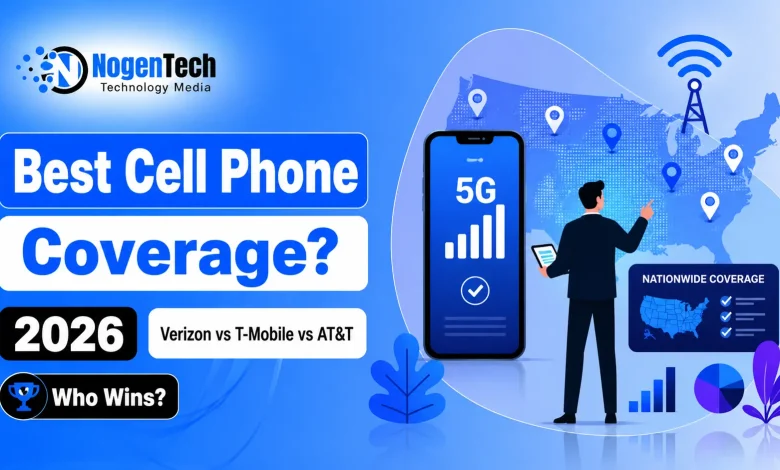
The short answer: No single carrier wins in every situation. But based on the latest data from RootMetrics, the FCC, and Ookla, Verizon leads in overall coverage and rural reliability, T-Mobile leads in 5G speed and availability, and AT&T sits in a strong middle position that works well for most people. Your location is the biggest factor.
Read on to see exactly how they compare, and which one actually makes sense for where you live and how you use your phone.
What Does “Best Coverage” Actually Mean?
Coverage is not just about one thing. It means different things depending on where you are and what you need.
When people ask about coverage, they usually mean one of these: can I make calls without dropping, can I get data speeds fast enough for daily use, and does the signal reach where I actually spend time, my home, my commute, or trips outside the city.
There are three things worth checking before you pick a carrier:
- 4G LTE coverage — still the backbone of most calls and data in the US
- 5G coverage — faster speeds in urban areas, expanding into suburbs
- Real-world reliability — what independent testers actually found on the ground
Which Has the Best Overall Cell Phone Coverage? (The Data-Backed Answer)
Verizon takes the top spot for overall coverage, based on multiple independent tests.
RootMetrics — a network testing firm owned by Ookla — ran tests in over 6,800 locations across all 50 states in the second half of 2025. Verizon scored highest for overall coverage, reliability, data, calling, and texting. According to their State of the Mobile Union report, Verizon also won Best 5G Experience, Fastest 5G, and Most Reliable 5G in that same testing period.
That said, T-Mobile is not far behind — especially in cities. And if raw 5G speed is your main concern, T-Mobile actually beats Verizon.
How Much of the US Does Each Carrier Actually Cover?
Here is a clean look at real coverage numbers from the FCC and independent sources:
Verizon vs T-Mobile vs AT&T Coverage Comparison
| Feature | Verizon | T-Mobile | AT&T | Best Pick |
|---|---|---|---|---|
| Overall Coverage | Strongest overall coverage and rural reliability. | Strong in cities and suburbs, improving in rural areas. | Balanced option across many US regions. | Verizon |
| 4G LTE Reach | Largest reported 4G LTE footprint among major carriers. | Good LTE reach, but behind Verizon and AT&T. | Very strong LTE coverage, close to Verizon. | Verizon |
| 5G Availability | Strong 5G, but smaller national 5G footprint than T-Mobile. | Largest 5G network and strong 5G availability. | Good 5G footprint, usually between Verizon and T-Mobile. | T-Mobile |
| 5G Speed | Very fast in Ultra Wideband areas. | Fastest national 5G speed in many independent tests. | Good 5G speeds, but usually behind T-Mobile. | T-Mobile |
| Rural Areas | Best choice for remote and rural users. | Improving, but still trails in very remote areas. | Strong second choice for many rural regions. | Verizon |
| Cities and Suburbs | Reliable and fast in many metro areas. | Best for 5G speed and availability in cities. | Stable option for mixed urban and suburban use. | T-Mobile |
Verizon Coverage
Verizon covers 70% of the US with 4G LTE — the most of any major carrier. That works out to roughly 327 million people across 2.68 million square miles. Its 5G network reaches over 200 million people, but its national 5G footprint is smaller compared to T-Mobile. In rural areas, Verizon consistently performs better than its competitors, thanks to years of 4G LTE infrastructure investment.
T-Mobile Coverage
T-Mobile’s 4G LTE covers 62% of the US — about 8% less than Verizon. However, T-Mobile has the largest 5G network of any US carrier. Its 5G now reaches over 332 million people across two million square miles, covering 98% of Americans. After completing its acquisition of US Cellular in August 2025, T-Mobile further expanded its rural footprint. It also aims to cover 90% of rural US households using its 600 MHz low-band spectrum, which travels farther than higher-frequency signals.
AT&T Coverage
AT&T covers 68% of the US with 4G LTE, putting it between Verizon and T-Mobile. Its 5G covers about 29% of the country — larger than Verizon’s 5G footprint but smaller than T-Mobile’s. AT&T performs well across the South, Midwest, and Northeast. Coverage gets spottier in Western rural regions. AT&T is also working with AST SpaceMobile on direct-to-cell satellite connectivity, meaning some subscribers already have access to emergency satellite messaging.
Which Carrier Is Fastest? (Speed Test Results)
Speed and coverage are two different things. You can have great coverage but slow speeds, or fast speeds but only in certain cities.
Here is what independent testing shows for 2025–2026:
- T-Mobile recorded the fastest national median 5G download speed — 374.5 Mbps in the second half of 2025 (RootMetrics). Opensignal’s data from 2025 showed T-Mobile’s median 5G download at 238.3 Mbps, far ahead of AT&T and Verizon.
- Verizon’s Ultra Wideband 5G can hit over 800 Mbps in urban areas, but it covers a much smaller geographic area.
- AT&T averages around 184.3 Mbps on 5G and 74.9 Mbps across its combined 4G/5G network — faster than Verizon’s average but slower than T-Mobile.
If you live in a big city and mostly want fast data for streaming, gaming, or working from your phone, T-Mobile is likely the fastest option. In rural areas, speed rankings shift significantly — Verizon and AT&T generally hold up better.
Which Is Best for Rural Areas?
Verizon is the most reliable choice for rural users, based on both coverage maps and real-world testing.
Verizon has spent years building out 4G LTE in areas where other carriers did not bother. Its low-band spectrum reaches farther and works better through trees, hills, and poor terrain. RootMetrics specifically noted Verizon’s rural infrastructure as a reason it wins rural performance awards year after year.
AT&T is a close second for rural coverage. Its 4G LTE covers more land than T-Mobile’s, and its signal tends to be consistent even in areas outside major metros.
T-Mobile’s rural coverage is improving fast. The US Cellular acquisition added meaningful coverage in smaller towns and farming regions. But in very remote areas — the kind with no cell towers nearby — T-Mobile still trails.
If you live outside a major city or travel through rural states, check Verizon or AT&T first.
Which Is Best for Cities and Suburbs?
T-Mobile wins in urban areas, especially for 5G speed and availability.
T-Mobile has built its 5G network aggressively in dense urban environments. Ookla gave T-Mobile the crown for fastest 5G and fastest overall network in 2025. Opensignal’s January 2025 report was practically a clean sweep for T-Mobile — best overall experience, fastest downloads, and top-tier 5G availability.
In cities, all three carriers provide good enough service for most people. The difference shows up in peak hours, building penetration, and data speeds during high-traffic times. T-Mobile handles congestion better in many city cores.
If you live and work in a metro area and want the fastest possible 5G experience, T-Mobile is the one to pick.
What Do FCC Maps Actually Show?
The Federal Communications Commission publishes a National Broadband Map that lets you check coverage by address. The data was last updated with figures through June 30, 2025.
According to that FCC data:
- For 4G LTE: Verizon covers 60% of US land area, AT&T covers 57%, and T-Mobile covers 45%
- For 5G: T-Mobile leads, followed by AT&T, with Verizon third
Note that FCC maps show outdoor coverage for a stationary user. Coverage inside buildings or in moving vehicles can drop significantly — across all carriers.
You can check the FCC National Broadband Map yourself at broadbandmap.fcc.gov to see carrier-by-carrier coverage at your exact address.
What About MVNOs? (Cheap Carriers That Use the Same Towers)
If you want similar coverage at a lower price, Mobile Virtual Network Operators (MVNOs) are worth knowing about.
MVNOs do not own towers. They buy access to a major carrier’s network and resell it at cheaper rates. The tradeoff is that during busy times, the big carrier prioritizes its own subscribers — so MVNO users may see slower speeds when networks are congested.
Popular MVNOs and which network they run on:
- Mint Mobile → T-Mobile’s network (plans start around $15/month)
- Visible → Verizon’s network (plans around $25/month)
- Cricket → AT&T’s network
- Metro by T-Mobile → T-Mobile’s network
- Spectrum Mobile, Xfinity Mobile → Verizon’s network (good bundle option)
- Consumer Cellular → AT&T’s network (ranked highest among value MVNOs by J.D. Power 18 times in a row)
If you mostly use your phone in cities and want to cut your monthly bill without losing much on coverage, Mint Mobile or Visible are solid options. For rural users, stick closer to Verizon or an MVNO that uses Verizon’s towers.
How Do Customer Satisfaction Scores Compare?
Coverage matters, but so does what happens when something goes wrong.
The J.D. Power 2026 US Wireless Network Quality Performance Study — based on over 19,000 customer responses — found T-Mobile ranked first for the 15th straight time among major carriers, scoring 837 out of 1,000 compared to a segment average of 819.
Among value MVNOs, Consumer Cellular has topped the chart for 18 consecutive surveys with a score of 883. Mint Mobile (857) and Visible (821) also ranked well.
Verizon and AT&T have both received lower marks for customer service in hands-on reviews. One tester reviewing Verizon called online support “a giant zero” while noting that phone support was more helpful — though slow.
Coverage data and customer service are two different scores. T-Mobile wins on both fronts when you look at the numbers.
So, Which Has the Best Cell Phone Coverage? (Final Verdict)
Here is how to pick based on your situation:
Choose Verizon if:
- You live outside a major city or travel frequently
- You need consistent calls and data in rural or mountainous areas
- You want the most reliable fallback on 4G LTE anywhere in the country
Choose T-Mobile if:
- You live and work in a city or suburb
- 5G speed is a priority for you
- You want the largest 5G network at a competitive price
- You care about customer service ratings
Choose AT&T if:
- You want solid performance across both rural and urban areas
- You travel through the South or Midwest frequently
- You want a carrier that balances 4G coverage and growing 5G without going all-in on either
Choose an MVNO if:
- You want to save money and do not need premium priority data
- You already know which major network covers your area well
- Your phone use is moderate and mostly in cities
The best step before switching: enter your address into each carrier’s coverage map or the FCC’s broadband map. What works for someone in Chicago may not work for someone in rural Wyoming. Real-world location beats any national ranking every time.
FAQs About the Best Cell Phone Coverage
Which has the best cell phone coverage overall?
Verizon is the best overall pick for broad coverage and rural reliability. T-Mobile is stronger for 5G speed in many cities, while AT&T is a solid balanced option.
Is Verizon better than T-Mobile for coverage?
Verizon is usually better for rural coverage and nationwide reliability. T-Mobile is often better for 5G speed and availability in cities and suburbs.
Which carrier is fastest for 5G?
T-Mobile is usually the fastest carrier for national 5G speed based on recent independent testing. Verizon can be very fast in Ultra Wideband areas, and AT&T offers steady 5G performance.
Which has the best rural cell phone coverage?
Verizon is the most reliable choice for rural users in most cases. AT&T is a close second in many rural regions, while T-Mobile is improving but can still trail in very remote areas.
Are cheap phone carriers good for coverage?
Cheap phone carriers can have good coverage because many use Verizon, T-Mobile, or AT&T towers. The main tradeoff is that speeds may slow during busy network times.
How can I check the best carrier at my address?
Use the FCC National Broadband Map first, then check Verizon, T-Mobile, and AT&T coverage maps. If possible, test the carrier with an eSIM trial before switching your main number.
Sources: RootMetrics State of the Mobile Union H2 2025, FCC National Broadband Map (data through June 2025), Ookla Speedtest Intelligence 2H 2025, Opensignal 2025 Mobile Network Experience Report, J.D. Power 2026 US Wireless Network Quality Study.