
Nighttime Ranch Security: How Thermal Imaging Monoculars Help Monitor Livestock and Detect Coyotes Early
Thermal monoculars help ranchers spot potential coyotes before they reach livestock, locate cattle after dark, and check distant pastures without spotlights.

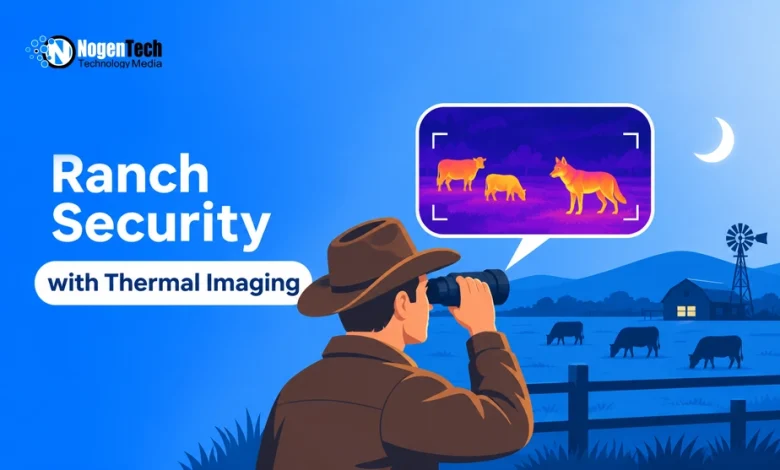
Livestock protection after dark can be difficult, especially on large ranches with distant pastures. Coyotes can approach fences unnoticed, and cattle far from ranch buildings are often hard to locate with flashlights or vehicle headlights.
Security cameras, motion sensors, and outdoor lights help monitor specific areas, but their coverage has limits. Thermal imaging monoculars or thermal spotter devices detect temperature differences and display heat signatures without the need for external light.
These handheld devices help ranchers locate livestock, detect potential predators, and inspect remote fence lines. Here’s how they work and how ranchers can use them for nighttime security.
How Thermal Imaging Monoculars Work for Ranch Security
A thermal imaging monocular is a handheld optical device that detects infrared radiation emitted by objects and converts temperature differences into a visible image.
It can reveal heat signatures in complete darkness without a spotlight or infrared illumination. Key uses on a ranch include:
- Livestock checks: Locate cattle and other animals across open pastures after dark.
- Predator detection: Spot potential coyotes or other animals near livestock.
- Perimeter checks: Observe fence lines, gates, and remote property boundaries.
- Night patrols: Inspect distant areas from suitable observation points without spotlights.
However, trees, hills, and solid barriers can block heat signatures. Weather, distance, and sensor resolution also affect image clarity. A thermal monocular may reveal an animal without enough detail to identify its species.
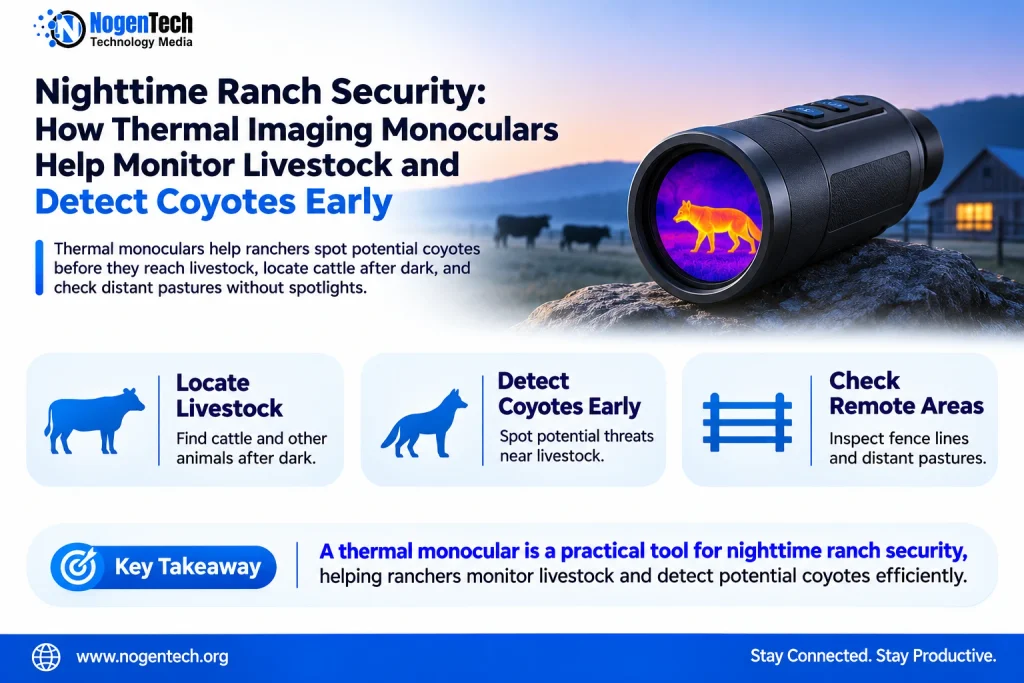
How Thermal Monoculars Help Detect Coyotes Early
Coyotes have excellent night vision and can approach livestock areas without much noise. Calves and other vulnerable animals face particular risks, especially during calving season. According to the USDA Wildlife Services, coyotes account for most predator-related livestock losses in the United States.
Early detection gives ranchers more time to assess a potential threat and take appropriate protective measures. A thermal monocular can reveal a heat signature near a fence or herd, even when the animal is difficult to see in the dark.
For example, a rancher at an elevated observation point may notice a small heat signature near cattle. The device helps locate the animal, but visual confirmation may still be necessary to determine whether it is a coyote.
Thermal Monoculars vs. Other Ranch Security Devices
A thermal monocular works best as part of a broader ranch security system.
| Security Device | Main Purpose | Limitation |
| Thermal monocular | Detect animals and heat signatures at night | Requires manual observation and clear sightlines |
| Trail camera | Record activity at selected locations | Limited to the camera’s coverage area |
| Motion sensor | Alert ranchers to movement | May trigger false alerts from harmless animals |
| Security camera | Monitor gates, buildings, and specific areas | Image quality depends on camera features and light conditions |
These devices serve different purposes. A thermal monocular provides portable observation, whereas fixed cameras and sensors cover designated areas. Similar smart security technologies also use cameras, sensors, and automated alerts to detect unusual activity.
How to Organize Night Patrols With a Thermal Monocular
On large ranches, designated observation points can reduce unnecessary trips across the property.
1. Select Suitable Observation Points
Choose locations with clear views of important ranch areas:
- Elevated ground: Provides a broader view of open pastures.
- Water sources: Helps observe livestock near ponds and troughs.
- Feeder areas: Allows checks on cattle near feed stations.
- Fence lines and gates: Helps identify unusual animal activity near property boundaries.
Hills, trees, and structures can create blind spots, so observation points should account for these obstacles.
2. Scan Pastures and Fence Lines
Use the monocular from a stationary position to check livestock areas and visible property boundaries. Look for unfamiliar heat signatures, unusual herd movement, and animals separated from the group.
A heat signature alone does not confirm a predator. Additional observation may be necessary before taking action.
3. Maintain a Patrol Log
Keep a simple record of:
- Observation time and location
- Unusual animal activity
- Areas that require closer inspection
- Follow-up actions
Repeated activity near a particular fence section may indicate a need for additional security checks.
4. Follow Safe Night Patrol Practices
Always stop the vehicle in a safe location before using a thermal monocular. Do not operate it from the driver’s seat of a moving pickup truck. Thermal optics also cannot replace headlights or flashlights for safe travel across rough terrain.
What to Look for in a Thermal Imaging Monocular for Ranch Use
The right thermal monocular depends on pasture size, observation distance, and patrol frequency. Important features to consider:
- Detection range: Determines how far the device may detect a heat signature. Detection does not guarantee accurate animal identification.
- Sensor resolution: Higher resolution can provide more image detail, especially for distant or smaller animals.
- Field of view: A wide view helps scan large pastures; a narrow view may provide a closer look at distant areas.
- Battery life: Longer battery life supports extended night patrols and remote use.
- Weather resistance: Protection against dust, moisture, and outdoor conditions is important for ranch equipment.
- Portability: A compact, comfortable device is easier to carry between observation points.
Detection range and image clarity deserve particular attention. A monocular may detect a distant animal without enough detail to distinguish a coyote from another species.